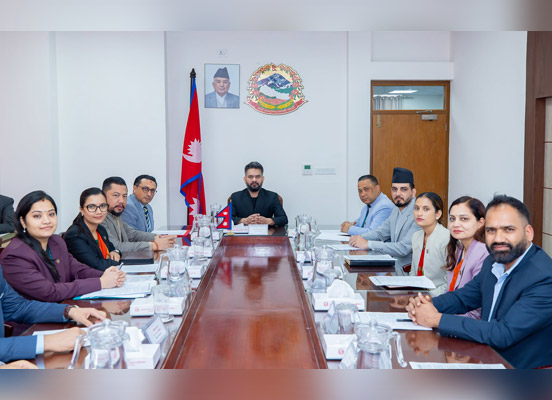
The rise of Nepal’s youngest political establishment symbolized a rebellion against corruption, communist stagnation, and elite politics, but the transition from protest icon to governing authority is proving far more difficult than the rhetoric of change.
By K S TOMAR
From political rebellion to governance crisis
The rise of Nepal’s new political leadership marked one of the most dramatic upheavals in the country’s recent democratic history. The Gen-Z-led anti-establishment wave against corruption, unemployment, and political stagnation weakened both the communist establishment and the Nepali Congress. The electoral success of the new leadership was widely interpreted as a generational revolt against the old political order that had dominated Nepal for nearly three decades.
Yet history repeatedly demonstrates that toppling an old establishment is easier than governing a fragile state. The same forces that propelled the new leadership to power — anger, impatience, and anti-system sentiment — are now creating pressure on the government itself. The transition from protest politics to statecraft is exposing the gap between revolutionary expectations and administrative reality.
The new leadership had promised clean governance, economic revival, accountability, youth empowerment, and systemic transformation. However, criticism is already emerging over delays, governance bottlenecks and lack of visible structural change.
Burden of massive public expectations
The central problem confronting the government is that the Gen-Z movement transformed its leadership into symbols of both national frustration and hope. Such symbolism creates expectations that no administration can realistically satisfy within a short period.
Nepal’s youth did not merely vote for administrative reform; they voted emotionally against decades of dysfunction, corruption, and political cartelisation. High unemployment, migration, and collapsing trust in institutions generated deep frustration across urban Nepal.
But slogans against the old order do not automatically produce institutional capacity. Nepal’s problems are structural, financially constrained, and administratively entrenched. Bureaucratic inertia, patronage politics, and weak governance networks cannot be dismantled merely through political enthusiasm.
Six factors behind the government’s difficulties
Excessive overpromising | The first major problem has been the scale of promises made during the election campaign. The new leadership projected itself almost as a corrective revolution capable of rapidly transforming Nepal’s governance system. Such ambitious rhetoric generated unrealistic expectations that quickly became difficult to fulfil.
Administrative inexperience | The second factor is the lack of governing experience. Many leaders of the new establishment emerged from activism or municipal politics rather than national administrative systems. Running a fragile Himalayan republic involves far more complex challenges of bureaucracy, security and federal coordination.
Lack of ideological clarity | The third weakness is ideological ambiguity. Unlike traditional communist parties or the Nepali Congress, the new political formation functions more as a broad anti-establishment platform than a disciplined ideological movement. It contains reformists, activists and technocrats with differing priorities.
Resistance from the old political structure | The fourth factor is institutional resistance from entrenched political forces. Even after electoral setbacks, traditional parties continue to retain strong influence within bureaucracy and provincial politics. Resistance to rapid change was therefore inevitable.
Economic pressures and unemployment | The fifth challenge is Nepal’s worsening economic environment. The country remains heavily dependent on remittances, tourism and foreign aid. Youth unemployment continues to rise while inflationary pressures persist.
Growing impatience among Gen-Z supporters | The sixth factor is impatience within the same youth constituency that brought the government to power. Social-media-driven movements create rapid emotional mobilisation but also rapid disappointment. The same generation that celebrated the new leadership as revolutionary can quickly become disillusioned if visible outcomes remain limited.
Governance challenges before the new leadership
The biggest challenge before the government is institutional delivery. Protest movements survive on slogans, but governments survive on jobs, inflation management, infrastructure and administrative efficiency.
Political stability remains another concern. Nepal has long suffered from unstable governments, coalition fragmentation and rapid leadership changes. Maintaining internal unity within a broad anti-establishment movement will become increasingly difficult once ideological differences sharpen.
Another challenge is Nepal’s massive brain drain. Large numbers of young Nepalis continue migrating abroad in search of employment and financial security. Unless the government creates economic confidence and investment opportunities, public frustration may deepen further.
Foreign policy: Balancing India and China
Foreign policy represents perhaps the most delicate test for the new administration. Nepal’s strategic geography has always forced Kathmandu to balance carefully between India and China.
The previous communist establishment often attempted to use China as a balancing instrument against India. Chinese investments and Belt and Road projects expanded significantly during that phase. However, China’s slowing economy and concerns regarding debt sustainability have complicated enthusiasm for large-scale projects.
The present leadership appears to be attempting a more calibrated balancing strategy. Kathmandu understands that Nepal cannot afford prolonged tensions with India because of geography, trade dependence, labour mobility and cultural interconnectedness. India remains Nepal’s largest economic partner and principal transit route.
At the same time, the government is unlikely to distance itself completely from China. Beijing continues to be viewed as an important strategic counterweight preventing excessive dependence on India.
India Policy: Pragmatism over confrontation
So far, the government’s India policy appears more pragmatic than ideological. Unlike earlier phases when anti-India nationalism occasionally shaped Kathmandu’s political discourse, the current leadership seems conscious that Nepal’s economic recovery requires stable engagement with New Delhi.
The administration is expected to focus on trade expansion, tourism revival, hydropower exports and connectivity projects. However, sensitivities continue regarding border disputes, treaty issues and political influence.
China policy and strategic calculations
With China, the challenge is different. Beijing prefers predictability and political stability in Kathmandu. The rise of a youthful anti-establishment movement disrupted networks that China had cultivated with Nepal’s communist establishment over many years.
The new leadership is attempting to maintain engagement with Beijing while avoiding strategic overdependence. Nepal is likely to continue accepting selective Chinese investment while carefully avoiding overt geopolitical alignment.
Conclusion: Revolution meets administrative reality
The larger reality confronting Nepal is that political revolutions often underestimate the complexity of governance. Protest movements are emotionally driven; governments operate through institutions, compromise and gradual decision-making.
The Gen-Z uprising undoubtedly represents a historic political transformation. It successfully channelled public anger against corruption, elite politics and communist stagnation into a democratic electoral wave.
But the scale of public expectation may now become the leadership’s greatest vulnerability. The movement promised not merely administrative reform but psychological renewal of the Nepali state itself. Delivering such a transformation requires time, institutional discipline and political patience.
The coming years will determine whether Nepal’s Gen-Z political revolution evolves into a durable democratic transformation or becomes another cycle of public disillusionment in a country long trapped between hope and instability.
-----------------------------------------------

(K S Tomar is a strategic affairs columnist and senior political analyst based in Shimla)