By Maj Gen Sudhakar Jee, VSM (Retd)
There are books that tell a story, reminding what Thomas Jefferson once said, “When injustice becomes law, resistance becomes a duty.”
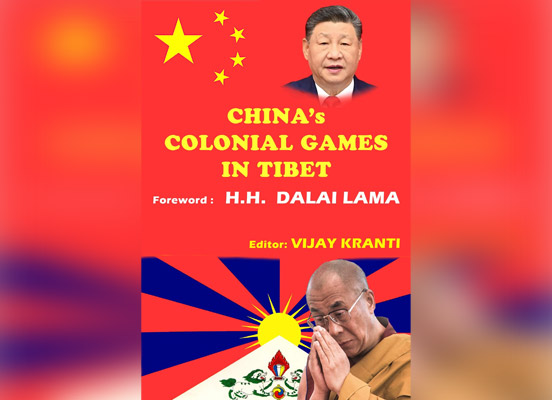
The book, titled ‘China’s Colonial Games in Tibet’, published by VK Media Group, New Delhi for Centre for Himalayan Asia Studies and Engagement (CHASE), and compiled and edited by Vijay Kranti — a renowned journalist, photographer, Tibetologist and a veteran China expert — is a first-ever attempt by any China-focused institution to present a galaxy of scholars and domain experts on the subject on a single platform.
It is perhaps the only one in contemporary times that matches the spirit of the above excerpt. It is an exhaustive study of the prevalent situation inside Tibet, which China has been assiduously hiding from the rest of the world. Hard-bound and spread over around 486 pages, it covers 12 Sections of China’s colonial practices in occupied Tibet, with 60 essays by 39 best-known experts on Tibet and China across the world. The book has been compiled to provide comprehensive information to scholars, researchers, diplomats, policy makers, opinion makers, and students of defense studies, strategy and security.
Given the Chinese government’s absolute blockade on independent reporting, the said book stands out as an exclusive work highlighting the systematic extinction of the indigenous population of Tibet by the Chinese Communist Party (CCP) by cultural genocide and severe environmental destruction beyond public consciousness.
Unleashed by various Organs of the State, particularly the United Front Work Department(UFWD) and especially the Public Security Bureau (PSB), an omnipresent secret organ of the CCP in China Occupied Colonies (COC) like Tibet, East Turkestan (Xinjiang), Southern Mongolia (Inner Mongolia), Manchuria(Northeast China), Macau and Hongkong, the book is a clarion call for the world to stand up unitedly and resist the same, to say the least.
It is only a paradox of reality that Tibet, despite meeting all the relevant modern international legal criteria - own flag, currency, passport, language, scripts, religion, fully functioning state with a defined territory - comprising the regions of U-Tsang, Amdo, and Kham; postal system, international relations with countries, the Article 1 of the Montevideo Convention on the rights and Duties of States for an independent nation, especially during the 1912 - 1951 period, continues to be a COC.
The experts in the opening section have underscored that the COCs can achieve their autonomy, separation, or freedom only if the CCP collapses in China.
Post the coerced signing of the 17-Point Agreement of 1951, China has been systematically dismantling Tibet’s way of life and silencing influential Tibetans, resulting in massive uprisings. These uprisings have further triggered Chinese crackdowns.
The CCP has been ruling Tibet with an iron fist under heavy surveillance and pre-emptive suppression of any form of dissent, and continues to accelerate efforts to erode Tibetan culture, language, and identity through repressive policies. The use by China’s official media of the term “ Xizang” instead of Tibet is an immediate consequence.
It may be recalled that in 1965, China had already reorganized and redefined the geographical boundaries of Tibet, wherein Kham and Amdo (Two Thirds) were broken into various parts and merged into neighbouring Chinese provinces - Yunnan, Sichuan, Gansu, and Qinghai based on their geographical proximity. The remaining part of historical Tibet - U’Tsang (one third) was designated as the Tibet Autonomous Region (TAR).
In the above backdrop, the Dalai Lama has a complex matrix of challenges to navigate, the central issue being the contested question of his succession. As a possible way forward, the Dalai Lama's promotion of democratic reform within the Tibetan polity in exile represents a transformative departure from the theocratic tradition in independent Tibet of the past towards a participatory leadership.
While the book brings out with total clarity that a person appointed by the CCP can never be the real Dalai Lama, China's new law ‘Order-5’, however, indicates that the official position of China on the subject would continue to govern.
The book, therefore, points towards a potential conflict of interest between the stakeholders, although the US Congress has unanimously passed a bipartisan resolution(HR 4331), and signed by the US President into law, that forbids any attempt by China to install its own choice of Dalai Lama.
Further, it is a paradox that there is a systematic cultural genocide of Tibet, and the West is becoming an accomplice to the same due to the fear of economic retaliation from China, as highlighted in the book.
The Chinese government’s systematic persecution of Tibetans began in earnest in the mid-1990s, with the forced relocation of entire populations and the establishment of re-education camps. The mass relocation of natives - displacing the Tibetan nomads with Mandarin Chinese, forcible separation of Tibetan children from their families into state-run boarding schools designed to assimilate children into Han Chinese culture, forced abortion and sterilization of Tibetan women, forced marriages of Tibetan girls with Han Chinese men, and Xi Jinping's call for establishment of ‘Tibetan Buddhism with Chinese Socialist Character’ has not only empowered the authorities targeting all publicly visible Tibetan Symbols but also unleashed a new Taliban face in Tibet.
The People’s Resistance to the above steps by the Chinese Government highlights that despite being under tremendous suffering, interrogation, and surveillance, Tibetans in Tibet have not given up their hope and struggle for freedom. It also underpins the fact that the 169 victims due to self-immolation of Tibetans, both inside and outside the Chinese borders, could go almost unnoticed and uncontested by various world governments, international bodies, and the media, while only one self-immolation of a Buddhist monk in Vietnam in 1963 could lead to the defeat and unceremonious departure of the American army from Vietnam.
The Section also reinforces that the enormity of the tragedy in Tibet appears to be ignored by the world, while the self-immolation of a Street Vendor in Tunisia in 2010 could trigger an unprecedented ‘Arab Spring’ in 19 Arab Countries and the downfall of seven heads of state. The book, highlighting cultural genocide waged by the CCP in Tibet to wipe out the whole Tibetan people by a slow, incremental, systematic, and unrelenting oppression, has underscored the global indifference and silence towards these Tibetan immolations.
The book also brings out the abduction of the Eleventh Panchen Lama, Gendhun Choekyi Nyima, three days after he was officially recognized by the Dalai Lama as the true incarnation of the Tenth Panchen Lama on 14 May 1995 as a future spiritual leader, by Chinese authorities, at the age of six, along with his family.
He and his family continue to be kept away from public eyes by the Chinese Government. China staged a controlled lottery and appointed Gyaltsen Norbu, a political figure, as their Eleventh Panchen Lama. The disappearance of Gendhun Choekyi Nyima has prevented him from fulfilling his greatest responsibility - recognizing the next Dalai Lama.
Further, the Chinese have made clear their intention to use the Panchen Lama institution to manipulate the future succession of the Dalai Lama, as the CCP perceives key leaders of Tibetan Buddhism like the Panchen Lama and the Dalai Lama as threats.
The focused policy of Sinicization aimed at eliminating Tibetan resistance to Chinese rule through cultural uniformity and enforced homogenisation has been brought out with the CCP’s policy that weaponized education as a tool to control the Tibetan mind. The same was aimed at eradicating Tibetan identity - its way of life, religion, and linguistic heritage- and promoting ‘ethnic identity’, especially post 2008 Tibetan uprising against its treatment and persecution of Tibetans.
The book also covers the colonial games of China impacting the Tibetan environment; its implications for Asia and the World; and it's time to confront China on the same. It brings out the changing climate in Tibet that deserves urgent world attention, among others.
The most horrific part of the Chinese brutalities has been the weaponization of the CCP’s ‘Zero COVID’ policy, the state-sponsored human organ harvesting, and DNA profiling in Tibet towards fulfillment of its larger objective of Sinicization.
In his foreword for the book, the Dalai Lama clearly states, in the backdrop of his Middle Way Approach since 1974, that he wants genuine autonomy for Tibet, referring to China’s paramount leader Deng Xiaoping’s assurance to his personal emissary in 1979 that “except for the independence of Tibet, all other questions can be discussed.”
A welcome addition to any personal or institutional collection, the book deserves its rightful place in Libraries of think tanks, policy & opinion makers, pillars of governance in hierarchy at global, regional, and local levels, media houses, schools, colleges and universities, defense establishments among others within India and overseas.
----------------------------------------------------

(Maj Gen Sudhakar Jee is a former Colonel of the Mahar Regiment who served in the Indian Army for over 37 years.)
The views expressed are not necessarily those of The South Asian Times