By Bhuvan Lall
Remembering Padma Vibhushan Dr K B Lall on his 110th birth anniversary, who remains a shining example of excellence, dedication, and continues to inspire future generations.
The days following India’s independence remain the darkest period of the post-independence era. The British had departed, leaving us with a parting gift – partition. At this juncture of Indian history, men were not men, and law was not law. Neighborhoods were being destroyed. Villages were being burnt. Cities were being devastated. Trains filled with corpses were crisscrossing the subcontinent. Millions of homeless refugees were pouring in. Traumatized. Starved. Penniless. The first Deputy Prime Minister of India, Sardar Vallabhbhai Patel, short of an adequate police force, with limited medical facilities, and bare minimum funds, was directly dealing with the communal Frankenstein across India. The deadly riots even threatened to engulf the capital of the nation. If India had to be saved, Delhi had to be saved first.
On a humid morning of late August 1947, Sardar Patel, a man of few words, looked at Krishan Behari Lall (1915-2004), a young Indian Civil Service officer of the 1937 batch, and remarked, “Lall, don’t you belong to Delhi? – go fix this…” Although the official letter appointing Lall as the Chief Executive Officer of Delhi came a few days later, he immediately took charge of saving lives and property across the city during one of the twentieth century’s worst cases of bloodshed. In an official meeting, the head of intelligence in the city police recognized Lall as a prominent youth leader of Delhi during the freedom movement. He exclaimed, “You are Krishen Behari Lall of St Stephens College – It was my duty to track you back then. And now you are my boss!” Using all the resources at his disposal, including family connections within the city’s academic, business, and legal community, Lall set about restoring order in an atmosphere of 72-hour curfews. At his initiative, fully loaded Indian Air Force Douglas DC3 Dakotas flew out to airdrop thousands of food packets that citizens of Delhi had prepared in their kitchens to the stranded refugees at the border crossing into India. At significant risk to his life, Lall slowly brought the entire city back to a state of normalcy.
Lall's remarkable journey began with working closely alongside Sardar Patel during India's formative years, including resolving the problems related to the integration of the princely states into India, thus paving the way for his distinguished career in government administration. He played a pivotal role in shaping India's economic and commercial landscape, driving growth and progress. As a key architect of India's trade policies, he spearheaded several high-profile missions to foster global cooperation and expansion. His innovative approach led to the establishment of the Rupee payment system with numerous countries, ushering in a new era of economic collaboration. Appreciating Sardar Patel’s contribution to India, Lall later recalled, “India’s State structure and administrative system bear testimony to his patriotic vision and wise statesmanship. The monument to the Sardar as leader of men is enshrined in the hearts and deeds of those whose minds he transformed, whose actions he inspired, and whose determination he helped to steel!”
A builder of institutions, Lall was respected by international giants, such as Singapore's Prime Minister Lee Kuan Yew, who said he learned a great deal from K B Lall during his visits to India. Sunanda K Datta-Ray in his book, Looking East to Look West: Lee Kuan Yew's Mission India, wrote, “He (Lee Kuan Yew) said, ‘I was learning from India, you had so much talent. I also came to tell you that you had so much to teach me. Your officers taught me so much. I would take them out to golf, and talking to them was a great help for me,’ he said. He spoke glowingly of K B Lall and other senior civil servants.”
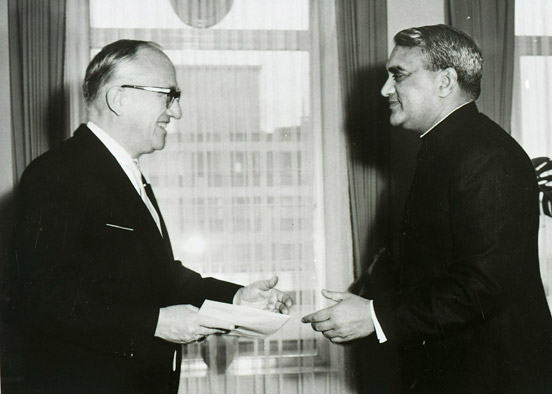
Prime Minister Jawaharlal Nehru appointed Lall as India's first Ambassador to the European Common Market, now known as the European Union, in Brussels from January 15, 1962, to July 9, 1966. He concurrently served as India's Ambassador to Belgium and Luxembourg, and as Permanent Representative to the GATT. His leadership skills shone through his election as Chairman of the Action Committee of the GATT in 1963, Chairman of the Council of Contracting Parties to the GATT in 1964, and Chairman of the GATT Committee on Trade and Development in 1965. Ambassador Lall played a pivotal role in representing India at various international economic and trade conferences, including the Trade and Development Board of UNCTAD and other United Nations Conferences, and notably served as Chairman of the Group of 77 Developing Countries during the 1964 UNCTAD session.
Raul Prebisch, Former Secretary General of UNCTAD, later recorded, “In the early days of UNCTAD, when I met K B Lall, I was impressed by his personality. I followed with great attention his speeches in which he deployed his knowledge of development problems. He would not fall into easy rhetoric, but rather explained his views in a sober and forceful fashion. He was always oriented towards pragmatic solutions and gradual advances when it was not possible to do otherwise… K B Lall has always shown an outstanding ability to face and interpret new facts and enrich his thinking… I cannot refrain from the following reflection. Dr Lall, with an enlightened group of leaders of the 77-not many, but very effective-made a plea for the rebuilding of the world economic order.”
Professor Rajendra Jain of Jawaharlal University, New Delhi, in his paper India and Britain’s First Application to Join the European Community, 1961–1963 for Indian Council for World Affairs noted, “India was privileged to have the suave and sagacious Krishen Behari Lall as its first ambassador to EEC from 1962 to 1966… Lall’s greatest contribution was undeniably his masterstroke in proposing that once Britain and EEC successfully concluded their negotiations, the enlarged Community should enter into a comprehensive trade agreement with India. This proposal was accepted and became a part of the entry package negotiated by Edward Heath as Leader of the British negotiating team.”
Upon his return to India, Lall, at 51, took on the pivotal role of Commerce Secretary, leveraging his expertise to towards meaningful change. During his tenure as Commerce Secretary (1967-1970), he was elected Chairman of the GATT and of the Group of 77 at UNCTAD, earning widespread recognition for his instrumental role in securing approval from developed countries for a system of general trade preferences that empowered developing countries. Additionally, he served as Chief Consultant to ECAFE (1968-71) and as a Member of the Board of Governors of the Asian Institute of Cooperation and Development (1969-72).
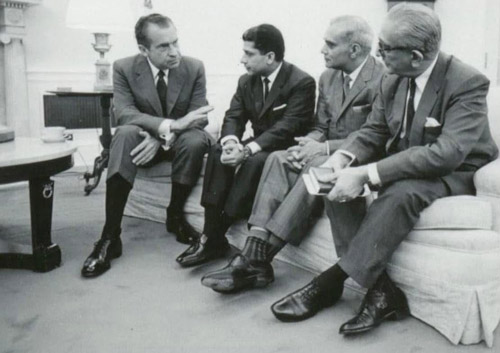
K B Lall in conversation with President Richard Nixon at the White House's Oval Room, in July 1969. (Photo courtesy of the author)
In July 1969, days after Neil Armstrong's groundbreaking moon landing, President Richard Nixon's official visit to India marked an important moment in US-India trade relations. A tense meeting on Raisina Hill was transformed by Lall's quick wit, as he remarked, "India is committed to enhancing the commercial aspect of our relationship. As you venture into interplanetary commerce, we hope you won't overlook the vast potential of trade with three-quarters of the globe." His words were met with laughter, and the meeting concluded on a high note for India. A young IAS officer, Yashwant Sinha, who later became India's Finance Minister and Foreign Minister, worked under Lall's guidance and wrote in his autobiography, “KB was known as ‘God’ among the younger officers of the Ministry of Commerce”.
In 1970, Lall took the reins as India's Defense Secretary, marking the beginning of a momentous era. His meeting with Dr. Henry Kissinger, the US Secretary of State, in July 1971, on the eve of the India-Pakistan war, showcased his exceptional diplomatic acumen. Recently declassified papers highlight Lall's remarkable abilities and stature, cementing his legacy. With the steadfast support of Defense Minister Jagjivan Ram, Lall's visionary leadership at the Ministry of Defense played a crucial role in securing a decisive victory in the 1971 War. Decades later, Field Marshal Sam Manekshaw, in an interview with Frontline magazine, credited the civilian leadership, particularly K B Lall, for their instrumental role in shaping the outcome of the 1971 Bangladesh War. Notably, India's Defense Strategist K Subramanyam reflected on Lall's unique approach, saying, "His way of showing appreciation was to entrust me with writing the Annual Report. Shri K B Lall's inimitable style of achieving results continues to inspire."
In November 1972, in a rare appointment, Lall was elevated to the post of Principal Defense Secretary, equivalent to the rank of Cabinet Secretary.
Subsequently, Lall served as India’s Ambassador to the EU, Belgium, and Luxembourg again, between May 23, 1973, and August 10, 1977, making him the only diplomat to be posted twice as Ambassador to the EU. T. N. Kaul, former Indian Foreign Secretary and Ambassador to the USA, in his book, A Diplomat’s Diary, has noted that a person like K B Lall would have stood out in any country. And H Y Sharda Prasad, former Media advisor to the Prime Minister, added, “I began working for the government in 1957, and in the next three decades and more, I had the privilege of working with (and receiving the trust of) several brilliant ICS luminaries. Among them, I should like to recall… K B Lall, whose grasp of economic matters was legendary and whose humor was Puckish…
Upon his return to his motherland in 1977, Lall established the Indian Council of Research on International Economic Relations (ICRIER), an organization that would go on to play a pivotal role in shaping public and economic policy. Under his visionary leadership, ICRIER made significant contributions to India's monetary policies, driving positive change and fostering a more prosperous future. His impact on the organization was profound and far-reaching.
In 2001, Lall's remarkable dedication to the nation was recognized by Prime Minister Atal Bihari Vajpayee, who honored him with the Padma Vibhushan, the country's second-highest distinction.
Speaking about his early years in the ICS, Lall said, “For the first two weeks of my service (Sept 1938), I was attached to the Deputy Commissioner in Nagpur. This had been done to enable the young Assistant Commissioner to have the privilege of paying his respects, not only to the senior Secretaries but also to the Congress Ministers. I remember calling on Pandit Ravi Shankar Shukla, D.P. Misra, and D K Mehta. From the day I met them, I acquired tremendous respect for them…. Later, at the time of the Tripura Congress, I spent a week in Jabalpur, which brought me in touch with Netaji Subhash Chandra Bose and Vishnu Kamath (an ICS officer who had resigned to join the freedom movement).” Lall looked back at his illustrious career in the service of his motherland rather modestly and stated, “The Indian Civil Servants specially those who were young when the nation had a tryst with destiny, must regard themselves as very fortunate. They were given exceptional opportunities gave them exceptional opportunities to make a substantial contribution to the consolidation of the Indian Republic and to the furtherance of social and economic change. I had the privilege to serve three Prime Ministers, two distinguished Finance Ministers, an eminent Defense Minister and some very able Ministers in charge of Commerce and Industry. Although not a member of the Foreign Service, I served twice as Ambassador to the European Community and Permanent Representative to UNCTAD and GATT. As I reflect on the effort that went into establishing rupee trade with the Socialist countries, negotiating the general scheme of preferences in favour of developing countries, and initiating innovative trade development measures, I feel quite happy at the results achieved.”
India lost a visionary and a key architect of India’s international trade with the passing of Dr K B Lall on January 8, 2004, at the age of 89. An exceptional civil servant and a kind soul, he inspired countless lives. He was a role model for many civil servants and diplomats, always generous with his time and eager to learn more about the world. Prime Minister Manmohan Singh, (one of the early Directors of ICRIER) in an inaugural address during ICRIER’s Silver Jubilee in New Delhi on November 6, 2006, said, “I would like to begin by paying my tribute to the memory of Shri K.B. Lall, ICRIER's founder and builder. Till his very end, he took a keen interest in ICRIER's work… Shri K. B. Lall was a fine representative of a generation of visionary civil servants that India was fortunate to have in the early years after our Independence. They worked with the political leadership to create and sustain great institutions.... There was already a realization that we had to pay greater attention to our economic relations with the outside world….”
Former Foreign and Finance Minister of India, Yashwant Sinha, ends his autobiography (Relentless) recalling a vital life lesson and insight about Dr K B Lall, “Someone had once complained to K B Lall, who was my Secretary in the Ministry of Commerce, that a person Lall had helped was criticizing him. Lall’s reply was a gem, and one I remember to this day. “He acted according to his character; I acted according to mine; why should I change my character to match his?” he replied. This has been the guiding principle of my life as well.”
Dr K B Lall, ICS, Padma Vibhushan, remains a shining example of excellence and dedication, and continues to inspire future generations.

(The author is the biographer of Subhas Chandra Bose and Har Dayal and the author of India on the World Stage. He can be reached at [email protected])