Realizing the Viksit Bharat vision will require that economic growth be deliberately translated into equitable opportunities, sustainable livelihoods, and measurable improvements in well-being for all segments of society.
By Madhav Menon & Aneesh K A
Nearly eight decades after Independence, India stands at a pivotal moment in its history. In 2025, as the nation approaches its centenary in 2047, the vision of “Viksit Bharat” has become a defining aspiration. The 2025-26 Union Budget placed this vision at its core, emphasizing inclusive growth for women, youth, farmers, and the underprivileged, alongside the ambitious goal of building a $30 trillion economy within the next two decades.
Achieving such a transformation calls for coordinated progress across agriculture, industry, services, infrastructure, health, education, and human capital, each interlinked with the others in shaping a true Viksit Bharat 2047.
Sectoral transformations
The story begins in the fields, where agriculture remains the bedrock of rural livelihoods even as its share in GDP has declined. From the high-yield breakthroughs of the Green Revolution to the precision tools and digital platforms of today, the sector has undergone steady modernization.
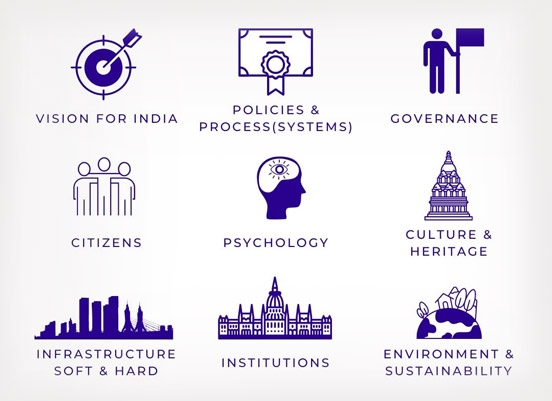
The building blocks of the Viksit Bharat mission. (Graphic courtesy: Viksit Bharat Abhiyan/Facebook)
Record harvests, expansion into allied activities, and government initiatives like PM-KISAN, which has channelled ₹3.69 lakh crore directly into farmers’ accounts since 2019, reflect a steady evolution. In FY24, agriculture and allied activities accounted for about 16% of GDP, with growth of 3.5% in the second quarter of FY25- modest, yet vital for millions of households. This rural base feeds into wider economic stability, providing demand for industry and services.
Manufacturing, once a small and import-dependent segment, now occupies a more prominent role. The Make in India initiative has attracted significant investment, making India the world’s second-largest mobile phone producer and driving significant FDI inflows into manufacturing. Manufacturing’s share of Gross Value Added (GVA) reached 13.82% in 2024-25, supported by steady growth in the Index of Industrial Production (IIP) and increased capital expenditure. Industrial expansion is not just about output; it is about creating linkages with agriculture through food processing, with services through logistics and design, and with infrastructure through materials and construction. These connections are crucial for building a competitive and resilient economy.
The services sector, now the largest contributor to GDP at over 55%, has undergone a profound transformation driven by urbanisation, reforms, and technological innovation. Beyond IT and business services, it encompasses finance, education, healthcare, logistics, and tourism- activities that both feed into and benefit from growth in agriculture and industry. Services generate employment, foster global integration, and drive innovation, yet they also face the challenge of creating enough high-quality jobs for a young and rapidly urbanizing population in India.
Physical and human infrastructure
Infrastructure development binds these sectors together, providing the physical backbone for trade, mobility, and connectivity. Recent years have seen unprecedented investments, with the 2025-26 Budget allocating ₹11.21 lakh crore to infrastructure. High-speed rail expansions, new Vande Bharat trains, and the expansion of the National Highway network to 146,195 km enhance the flow of goods and people. In energy, the transition to renewables has pushed capacity to over 209 GW, representing nearly half of total installed capacity.
Water access, another foundational element of development, has expanded dramatically under the Jal Jeevan Mission, bringing piped water to over 79% of rural households. Infrastructure is closely tied to health outcomes. Better transport enables access to care, and reliable power supports modern medical facilities. India’s Human Development Index (HDI) now stands at 0.685, with life expectancy at 72 years, reflecting progress in healthcare delivery. Programs like Ayushman Bharat have reduced financial barriers, while digital health platforms have extended services to remote areas. Yet, the growing burden of non-communicable diseases, gaps in rural healthcare, and the need for elderly care require sustained investment and innovation.
Education stands at the intersection of social and economic transformation, shaping the workforce that will drive India towards Vision 2047. The school system now reaches nearly 25 crore students, with both government and private institutions playing vital roles. The National Education Policy (NEP) 2020 aims to achieve universal enrolment, improve quality, and integrate digital learning, while addressing dropout rates that remain significant at the secondary level. Skill development, digital literacy, and alignment with market needs are critical to ensuring that the demographic dividends that India is facing today translate into productive capacity.
Economic growth has also brought profound social change. Women’s labor force participation has risen sharply, now at 41.7% for those aged 15 and above, with rural participation nearly doubling in just a few years. Political representation has expanded through the constitutional reservation of one-third of legislative seats for women. Representation of Scheduled Castes, Scheduled Tribes, and OBCs in government jobs has improved since independence, and the decision to conduct a caste census reflects an effort to address inequalities with greater data and transparency. Poverty rates among the disadvantaged groups have fallen, according to NITI Aayog’s Multidimensional Poverty Index, though challenges remain.
Challenges ahead
While India’s recent achievements are commendable, the trajectory towards Viksit Bharat 2047 remains constrained by structural and emerging challenges across sectors. In agriculture, climate variability poses severe risks to productivity, necessitating adaptive strategies such as climate-resilient crop varieties, efficient water management, and diversification of cropping patterns.
Equally critical is the reform of agri-markets to ensure remunerative prices, including Minimum Support Prices (MSP), and strengthen farmer bargaining power. The industrial sector confronts the dual imperative of expanding manufacturing capacity to meet global competitiveness while safeguarding the rights and welfare of gig and informal workers through robust social protection frameworks and ensuring decent working conditions. The services sector must bridge the mismatch between labor market demands and workforce skills, a task complicated by the disruptive potential of automation and digitalization.
Infrastructure development must transcend mere expansion, emphasizing inclusivity, environmental sustainability, and resilience against climate-induced shocks. Public health systems are under mounting pressure to address the complex needs of an ageing population, which India is going to face by 2050, alongside persisting gaps in universal health coverage.
Education policy, in turn, must extend beyond widening enrolment to enhancing pedagogical quality, fostering critical thinking, and aligning curricula with evolving economic and societal requirements. Addressing these interlinked challenges demands integrated policy frameworks, sustained investment, and institutional innovation.
Addressing these multi-dimensional challenges is essential if India’s aspirations for 2047 are to be realized. The advances in physical infrastructure, industrial expansion, agricultural modernization, and human capital development form a strong foundation, but they remain uneven in reach and impact. Persistent poverty, underemployment, and structural inequalities underscore the unfinished nature of the developmental project.
Realizing the vision of Viksit Bharat will require that economic growth be deliberately translated into equitable opportunities, sustainable livelihoods, and measurable improvements in well-being for all segments of society. This calls for a coherent policy architecture that weaves together economic dynamism, social inclusion, environmental stewardship, and transparent, accountable governance, ensuring that the gains of progress are not confined to statistical aggregates but are reflected in the lived experiences of every citizen. Only through such an integrated and people-centered approach can the journey from freedom to fulfilment truly be completed.
--------------------------------------------
(Madhav Menon is a graduate student of Economics, and Dr Aneesh K A teaches Economics at CHRIST (Deemed to be University), Delhi NCR Campus)
The views expressed are not necessarily those of The South Asian Times.