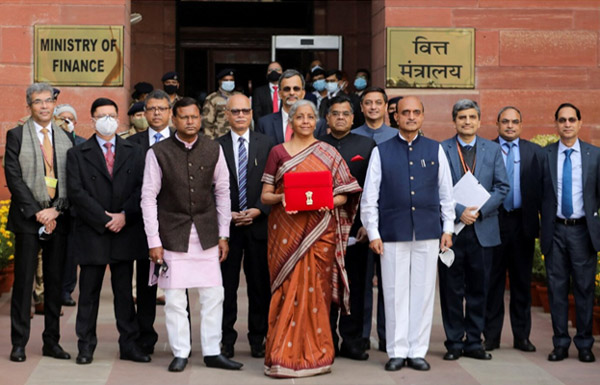
This will be Nirmala Sitharaman's second full-fledged Budget in Modi 3.0, and her overall eighth budget presentation in Parliament. She has presented six annual and two interim budgets under the NDA government's consecutive terms in power at the Centre.
New Delhi: Mild cuts in personal income tax rates to boost consumption and concessional Corporate Tax scheme for manufacturing hubs and FDIs to push the 'Make in India' strategy are likely in Budget 2025-26 with the government aiming to push economic growth.
The Budget on February 1 will come on the back of the government again overachieving its gross fiscal deficit target in FY25 at 4.7 per cent of the GDP vs 4.9 per cent in FY25 (RE) amid solid personal Income Tax revenue stream.
In line with the fiscal glide path, FY26 fiscal deficit to GDP ratio will be targeted at around 4.5 per cent. This trend of the government overachieving its fiscal target has been seen over the last few years, according to a report by Emkay Global Financial Services.
According to the report, the government’s net borrowing in FY26 will be lower than that in FY25 at Rs 11.15 lakh crore, with small savings likely to fund around 24 per cent of the fiscal deficit. It also expects the RBI dividend in the same ballpark as in FY25 at around Rs 2.1 lakh crore.
The policy ahead will stay focussed on improving growth potential in the medium term, including boosting the investment dynamics while maintaining fiscal discipline, the report states.
Meanwhile, India Inc. is optimistic about the growth prospects of the economy and wants the Union government’s thrust on capital expenditure (Capex) to continue in the Union Budget 2025-26, according to a survey released by apex business chamber FICCI.
According to the survey results, about 64 per cent participants expressed optimism regarding India’s growth prospects ahead of the Union Budget. Nearly 60 per cent of participants projected a GDP growth rate between 6.5 and 6.9 per cent for 2025-26.
Though the numbers mark a moderation from the high growth of over 8.0 per cent witnessed in 2023-24 – it is in sync with persistent headwinds on account of external factors. Majority of respondents highlighted the need for sustaining public Capex, with 68 per cent calling for a thrust on Capex to sustain the growth momentum.
At least a 15 per cent increase in Capex allocation for FY 2025-26 is being looked forward to by members of the Indian industry. Additionally, over half of the respondents emphasised the importance of reforms to further enhance the Ease of Doing Business.
About 47 per cent of the participants expect the government to meet the fiscal deficit target of 4.9 per cent for FY 2024-25 and another 24 per cent reported that the government could improve and report a lower fiscal deficit number for the current year. Further, concern was expressed regarding the muted demand situation. A significant number of industry members have called for a review of the direct tax structure.
Income tax payers want FM Sitharaman to cut ratesNew Delhi: A pre-budget survey reveals that individual taxpayers want relief on the personal tax front to increase their disposable income in Budget 2025-26 to be presented in Parliament by Finance Minister Nirmala Sitharaman. A majority of respondents, 57 per cent, want lower tax rates, while 25 per cent advocate for higher exemption limits, according to the survey carried out by consulting and services firm Grant Thornton Bharat. Based on the latest data available, a significant number of taxpayers have switched to the simplified new personal (default) tax regime. In fact, currently, 72 percent of taxpayers have opted for this, and only 28 per cent remain in the old tax regime. However, to further enhance the appeal of the new tax regime, about 46 per cent of respondents advocate for lowering tax rates, while 26 per cent believe exemption limits can be increased, the survey states. Despite the government's indication that the old tax regime may eventually be phased out, it appears that 63 per cent of the taxpayers still seek an increase in incentives under the old tax regime, the survey points out. |