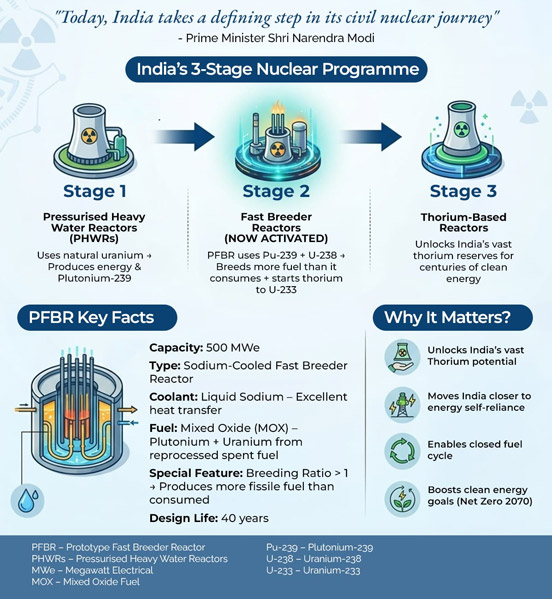
Chennai: India has marked a major milestone in its nuclear energy program with the indigenously designed and built Prototype Fast Breeder Reactor (PFBR) at Kalpakkam in Tamil Nadu successfully attaining its first criticality, marking the initiation of a sustained nuclear chain reaction.
The attainment of criticality demonstrates that India has mastered one of the world's most complex reactor technologies. With this achievement, India has officially entered the second stage of its three-stage nuclear power program. Once fully operational, India will become only the second country in the world, after Russia, to operate a commercial fast breeder reactor.
The development also marks a significant step in India's clean energy journey, reinforcing the country's commitment to reliable, low-carbon power. Additionally, it brings India closer to its goal of achieving net-zero emissions by 2070, as announced by Prime Minister Narendra Modi.
This PFBR is a 500 MWe (MegaWatt electrical) reactor that will be used to breed Uranium-233 from thorium. Thorium is considered a practically vast energy source and this stage holds the key to India's long-term energy security.
The sodium-cooled fast reactor uses mixed oxide (MOX) fuel — plutonium and uranium from reprocessed spent fuel — enabling a closed fuel cycle and producing more fissile material than it consumes.
With a breeding ratio greater than 1 and a design life of 40 years, PFBR is a key step towards long-term energy security, reduced import dependence, and clean energy goals. For a nation with scarce uranium, fast breeder reactors act as a bridge, allowing India to stretch uranium supplies while building the fuel base required for the thorium-driven third stage of the program.
Nuclear power currently contributes 3 per cent of India's electricity generation, with an installed capacity of 8.78 GW. Government projections suggest this will rise to over 22 GW by the early 2030s, with a long-term target of 100 GW by 2047.