Shugan C. Jain represents Jains at the National Commission for Minorities Conference
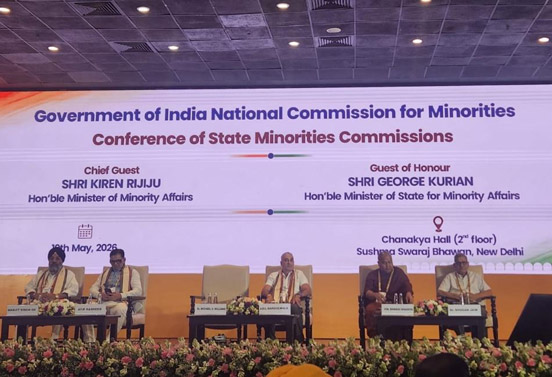
At the Conference of State Minorities Commissions organized by the National Commission for Minorities on 19th May 2026 at Chanakya Hall, Sushma Swaraj Bhawan, New Delhi, Mr. Shugan C. Jain represented the Jain community as a distinguished speaker. He was accompanied by Dr. Palakh Jain during the prestigious gathering, which brought together representatives from all six notified minority communities of India. The occasion was graced by Sh Kiren Rijiju as the Chief Guest.
In his address on the “Role of Jains in the Development of India,” Mr. Shugan C. Jain eloquently highlighted the profound and continuous contribution of Jain philosophy and the Jain community to India’s civilizational journey. He emphasized that the roots of India’s development story can be traced back to the teachings of Lord Adinath, the first Tirthankara, who is regarded in Jain tradition as the father of organized social and urban civilization. Dr. Jain explained how Lord Adinath introduced essential aspects of civilized living, such as agriculture, crafts, trade, and social organization, thereby laying the foundation for a structured and prosperous society.
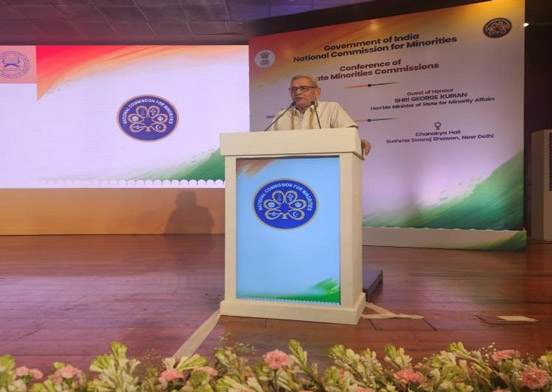
Dr. Jain further elaborated that Jain values such as Ahimsa (non-violence), Anekantavada (pluralism and multiplicity of viewpoints), and Aparigraha (non-possessiveness) have significantly shaped India’s ethical, economic, and cultural ethos across centuries. He noted that these timeless principles have inspired generations of entrepreneurs, philanthropists, scholars, industrialists, and social reformers from the Jain community who have contributed immensely to nation-building.
Highlighting the economic contributions of Jains, he spoke about the community’s remarkable role in trade, commerce, banking, industry, and modern entrepreneurship. He underlined that Jain business traditions are deeply rooted in ethics, trust, integrity, and social responsibility, which have strengthened India’s economic fabric over time. He also referred to the Jain tradition of daan (charitable giving), which continues to support education, healthcare, animal welfare, disaster relief, and social upliftment across the country.
He also drew attention to the contribution of Jains in preserving India’s cultural and intellectual heritage through ancient manuscripts, temples, literature, and educational institutions. Also, he proposed to the Ministry why these are important areas of concern for the Jain community. He emphasized that Jain philosophy promotes harmony, peaceful coexistence, environmental consciousness, and sustainable living — values that are increasingly relevant in the modern world.
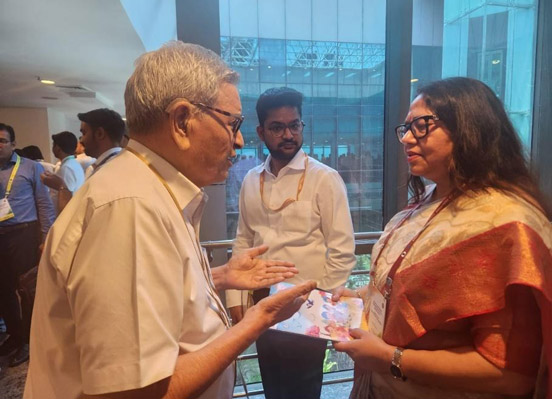
The address was appreciated for presenting Jainism not merely as a religion, but as a holistic way of life that has continuously contributed to India’s moral and developmental framework from ancient times to the present day. The conference served as an important platform for inter-community dialogue and reaffirmed the constructive role played by minority communities in strengthening India’s unity, diversity, and inclusive progress.
Lastly, during the interactions with State Ministers and members of the National Commission for Minority Affairs, the work of Jain studies was presented and discussed with them.
(Photos and text courtesy: Dr Palakh Jain)