By Rishab Rathi
The Trump administration’s sweeping tariffs have unsettled India’s economic and strategic calculations at a critical juncture. A punitive 50 per cent duty, split between a 25 per cent “reciprocal” tariff and another 25 per cent tied to continued imports of discounted Russian crude, marks the harshest US trade action in recent memory.
Trump and senior officials have gone further, branding India as a “Russian oil laundromat” and accusing it of “profiteering” from discounted barrels to the tune of nearly $16 billion. The rhetoric is unusually hostile for two nations that publicly claim to be strategic partners.
The economic fallout of these measures is already visible. Indian exports of steel, aluminum, auto components, and pharmaceuticals are facing steep declines, with engineering exports to the US contracting by double digits. Industry associations estimate the tariffs could wipe out $8–10 billion in annual revenue, hitting labor-intensive sectors and small manufacturers the hardest.
They have framed and defended the tariffs as “aggressive leverage” intended to serve both economic and geopolitical aims by disrupting Russia's war chest. Beyond oil, the move signals a broader US frustration with India’s strategic autonomy. Its reluctance to endorse Trump’s ceasefire rhetoric after Operation Sindoor, the balancing between rival blocs, and transactional energy diplomacy have all complicated ties.
But is India’s tightrope-walking alone to blame? Trump’s renewed embrace of Pakistan is unsettling not just for its policy implications, but for what it reveals about the fickleness of US statecraft. When General Asim Munir, the Pakistani Army Chief, was received at the White House this July, it was not simply protocol but symbolism. The timing was striking: this praise came in the immediate aftermath of the Pahalgam terrorist attack, in which 26 civilians lost their lives, an attack that India has linked to support from Pakistan. The gesture signaled that the US continues to view Pakistan as its most reliable instrument of leverage, a partner it turns to when seeking to shape its neighbor’s strategic choices.
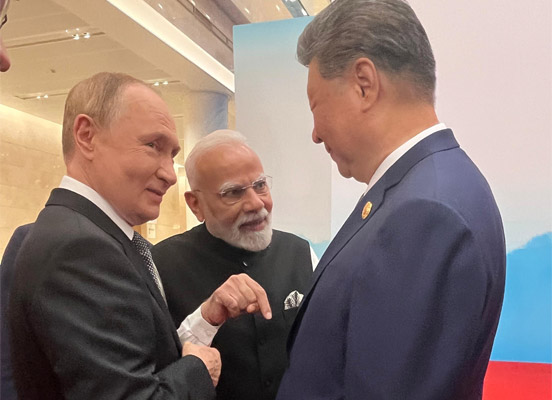
The immediate political consequence of the US move has been to accelerate India’s outreach to Russia and China. During the recently held Shanghai Cooperation Organisation (SCO) Summit, Prime Minister Modi and President Xi jointly affirmed that their nations see themselves as “development partners rather than rivals.” They discussed bolstering trade ties, restoring direct flights, easing visa and pilgrimage restrictions, and maintaining peace along their Himalayan border. Xi emphasized the increasingly “complex and turbulent” global situation, urging members to shoulder greater security and development responsibilities. He rejected a “Cold War mentality,” called for an equal and orderly multipolar world, and opposed hegemonism and bloc confrontations.
While India–Russia energy and defense engagements continue unabated, External Affairs Minister S Jaishankar urged greater Russian investment beyond energy. While at the SCO Summit, Modi and Putin reaffirmed their partnership, stressing its resilience even in difficult times.
Even as India continues to uphold its partnership with Russia while simultaneously working to improve its ties with China, it risks tilting its neighborhood into the latter’s orbit. Nepal is deepening ties through China-promoted SCO initiatives like the SCO Local Economic and Trade Cooperation Demonstration Area (SCODA), and it has expressed strong objections to the India–China Lipulekh trade agreement directly to Xi Jinping at the summit.
Meanwhile, Myanmar, with over $21 billion in Chinese investments, notably via the Kyaukphyu deep-sea port, continues to anchor itself in China’s Belt and Road infrastructure logic. In the Maldives, China remains a key economic partner, with $1.3 billion in outstanding debt and a free-trade agreement in place since January 2025, even as India introduces new financial pledges nearing $1 billion to bolster its influence. Absent sharper, anticipatory measures in its immediate neighborhood, its rapprochement may unintentionally facilitate rather than counterbalance China's strategic footprint.
It is against this backdrop that the Quad emerges as India’s principal counterweight to Xi’s expanding influence. The summit is scheduled for later this year in India. Originally designed to promote maritime security and democratic collaboration, the Quad now confronts a more volatile Indo-Pacific. The Philippines has filed 35 protests this year against Chinese harassment in its waters, Taiwan lives under the shadow of PLA drills, North Korea flaunts hypersonic missiles, and clashes between Cambodia and Thailand show even ASEAN’s quieter corners are not shielded from instability.
While recent ministerial meetings emphasized cyber resilience, critical mineral supply chains, and maritime security, the larger question is whether the Quad can withstand internal frictions at a time when external pressures are multiplying. For India, the optics of hosting this summit while under punitive tariffs from the US are especially complex. With the relations under strain, making the Quad’s task of setting a coherent agenda far more complex.
India must engage a partner that is simultaneously indispensable and unpredictable, balancing the strategic benefits of its support against the uncertainties it brings. The Quad has struggled to present a unified front against China, particularly as its members now prefer a pragmatic approach over a confrontational stance. The uneven priorities among Quad partners complicate collective efforts to manage China’s assertiveness. Since its 2017 revival, the Quad has issued over a dozen joint statements but delivered only two notable security initiatives: the Malabar naval exercise and the Indo-Pacific Partnership for Maritime Domain Awareness (IPMDA).
Neither has curbed Chinese activity in the South China Sea, where over 50 land reclamation and militarization projects have proceeded unchecked since 2018.
Capacity-building remains fragmented with Japan and the US transfer vessels to Vietnam, while India and Australia run separate training programs outside a common framework. Even during the recent Chinese escalation at Scarborough Shoal, where naval and coast guard 'combat readiness' patrols were carried out on August 29, the Quad issued no joint response. Without a secretariat or funding mechanism, its initiatives lack coherence and follow-through.
Reports now suggesting Trump will skip the Quad Summit later this year are set to deepen regional uncertainty and undercut its diplomatic weight. The Quad’s summit arrives as both a stage and a stress test. Australia, following Prime Minister Albanese’s July 2025 visit to Beijing aimed at revitalizing trade ties and launching new dialogues on steel, energy, and digital trade, is seeking closer economic engagement with China. At the same time, it must balance this with its security commitments through AUKUS and the Quad. Japan, raising defense spending to levels unseen since the Pacific War, sharpens its spear while nursing a brittle economy.
The Quad, then, is being asked to do more than convene; it must convince. Its challenge is not simply to align four countries, but to prove that in a world defined by coercion, volatility, and the caprice of great powers, there remains space for steadiness. For India, the challenge is more complex: managing a tentative thaw with China while keeping the coalition alive and countering influence in its neighborhood. At the same time, doubts linger over whether a grouping whose strongest member is also its weakest link can deliver the stability the Indo-Pacific urgently craves.
---------------------------------
(Rishab Rathi is a Research Assistant at the Centre for Policy Research and Governance (CPRG), and is pursuing a PhD in International Relations at Jawaharlal Nehru University, Delhi)
The views expressed are not necessarily those of The South Asian Times