By Vipul Tamhane
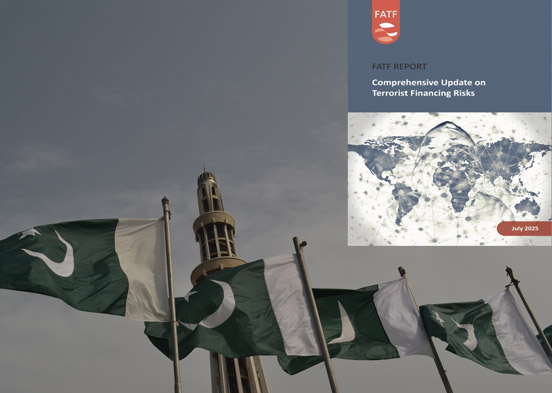
With the release of the landmark report of the Financial Action Task Force (FATF) for the first time explicitly defining state-sponsored terrorism, the case against Pakistan has received a historic blow, and the already entrenched position of India vis-à-vis the terror financing activities of Islamabad has been given further moral backing. The elaborate assessment not only validates India's concerns but also reveals the use of complex methods employed by terror networks working at the state level.
Defining state-sponsored terrorism
This placement of the latest report of FATF indeed marks a cornerstone in the annals of counter-terrorism documentation as it defines state-sponsored terrorism crisply as: "a state financing terrorist activities actively as part of its policy". The definition implies serious consequences for Pakistan, which has had the sordid reputation of having supported terror groups operating across and within its borders for several decades. The timing of the adoption of this definition has great significance, as the Department of Revenue under the Ministry of Finance, Government of India, has already sent three detailed letters to FATF elaborating on why Pakistan must be placed on the gray list.
Such a proactive stance taken by India actually demonstrates a change in strategy on the part of India in its diplomatic interface with international financial watchdogs. It had earlier considered state-sponsored terrorism emanating from Pakistan as a terrorist financing risk in its 2022 risk assessment, thereby showing far-sightedness, which has now been officially endorsed by the FATF.
Terror groups and their operations
This report of the FATF supports the Indian perceptions as it specifically names the Pakistan-based terrorist organizations, such as Lashkar-e-Taiba, Jaish-e-Mohammed, and Tehrik-e-Taliban Pakistan (TTP), as persistent global threats. These organizations are mentioned for their cross-border operations and following a more sophisticated style of informal fundraising and logistics, and recruitment support.
As per the findings of the report, the continued existence of terror groups, supported by state actors and operating with impunity, is concerning. It is stated in the document that terror groups have access to funding sources internationally, and so the international community should always be watchful of terror groups. Perhaps the most disturbing is the fact that networks linked to terror continue to function and are rebranded, tweaking their operations to maintain a level of invisibility.
Modern terror financing methods
The FATF report sheds new light on the evolution of the systems of terror financing, reinforcing that traditional methods of value transfer (such as hawala) continue to operate at the informal level to facilitate transnational financial transfers. Major funding (‘directly’ and ‘indirectly’) for terror actors and groups is raised and transacted through charities in Pakistan. The informal cash economy located along the borders of Pakistan also supports funding transfer processes.
Digital platforms also form the basis of terrorism financing and recruitment. Online gaming platforms were cited specifically as concerning, as terrorists are communicating freely on these gaming forums and targeting more susceptible youth to recruit into terror groups and networks. The report describes these platforms as extremely concerning because of the cross-border transfer of value that is not traceable, assets transferred in-game convert to real money, and the limited enforcement of KYC, which presents possible manipulatable vulnerabilities.
Case studies: Pulwama and Gorakhpur attacks
The FATF report included explicit examples of e-commerce platforms being exploited for terror financing, with mention of the 2019 Pulwama attack. The investigation discovered that the aluminum powder used in the Pulwama attack was purchased through e-commerce platforms, like Amazon, with the intent of maximizing the impact of the explosions. This was an example of an ordinary commercial platform being weaponized for terror purposes.
Equally, as the case of the 2022 Gorakhnath temple attack demonstrates, attackers' use of financial instruments is very sophisticated, undoubtedly preparing for prosecution. The attacker in this case sent ₹6,69,849 through PayPal while utilizing VPN services to hide the IP address. As detailed in the FATF report, the attacker was in receipt of $10,323.35 from foreign jurisdictions and made payments to the VPN providers through 44 international transactions worth ₹6,69,841.
Domestic terror infrastructure
While analyzing international terror financing, current investigations by the National Investigation Agency (NIA) of India have revealed an alarming move by Lashkar-e-Taiba (LeT) in establishing internal jihadist infrastructure in high-security prisons in India, with Bengaluru as the operational hub.
According to the NIA's findings, T Nasir, convicted of terrorism and a life convict in Bengaluru Central Prison, acted as the ideological and operational command hub for the identified networks of internal jihadists. The NIA uncovered that Nasir used contraband mobile phones to coordinate flows of money, give orders, and direct actions outside prison, thereby transforming the prison into a terror-planning site.
The conspiracy involved systematic corruption in the prison system. Nasir's contraband mobile devices were facilitated by Dr Nagaraj (the prison psychiatrist), and Assistant Sub-Inspector Chan Pasha received bribes in exchange for intelligence relating to Nasir's movements when he went to court. This network also included Anis Fatima, who served as an important link transmitting Nasir's instructions to her son (Junaid Ahmed), who was absconding.
Cross-border terror operations
The activation of terror networks in prisons has also manifested in ongoing cross-border operability. Punjab's Anti-Gangster Task Force has recently unearthed an active terror plot by Harvinder Singh Rinda, an operative with Babbar Khalsa International in Pakistan.
Upon receiving information from witnesses on Rinda, and realizing he was under operational control of ISI and other aligned organizations, the Punjab Police reversed warned their operational direction towards Gurdaspur's forest area, an absolute weapons of mass destruction cache. Meaning, a recovery of two AK-47 rifles, 16 live cartridges, two magazines, and two P-86 hand grenades exceeded the operation's initial intention/instruction to only confirm his threat to operationalize terrorism among various criminal syndicates (disorder/violence) with sophisticated intelligence crossing the border undetected.
Gurdaspur is of critical importance. The area's geographical features, such as the river channels, brush valley, and gouged forest areas governed by canals, confirm it as ideal for any environmental characteristics incorporated, to drone observations, arms dumping, and ingress or egress crossing the border. The geographic area has been utilized, traditionally, by ISI and Khalistani operatives, such that the Punjab police managed to intercept over 40 drones in the Gurdaspur region alone during 2023 alone.
Implications and future challenges
FATF's report, with its clear definition of state-sponsored terrorism and a wealth of evidence for Pakistan's financing terrorism, enables an argument for increased international time and/or scrutiny. The way in which terrorists adapt their operational and execution tactics, using sophisticated lessons learned from domestic and international law or standard operating procedures, as well as growing technology (i.e., gaming platforms, prison systems, etc), begs for counter-measures to be coordinated/initiated from democratic institutions.
The national reports and international documentation of systemic terror through FATF are enough evidence in themselves to show that Pakistan cannot escape its responsibilities as a state that facilitates and promotes terrorism and infiltration. The investigation involving India, the awareness of the world community and Pakistan's existing problems make it more difficult for Pakistan to respond positively to international calls to revisit and mitigate systemic terror issues.
As a ground-breaking report, FATF's investigations impose a call to action for authentic vigilance and legitimacy from a coordinated international response to state-sponsored terrorism, and Pakistan's insidious activities are an excellent example of why it is needed in the policing and legislative environment of today.
(The writer is a counter-terrorism expert and governance consultant.)
The views expressed are not necessarily those of The South Asian Times