By Meher Grewal
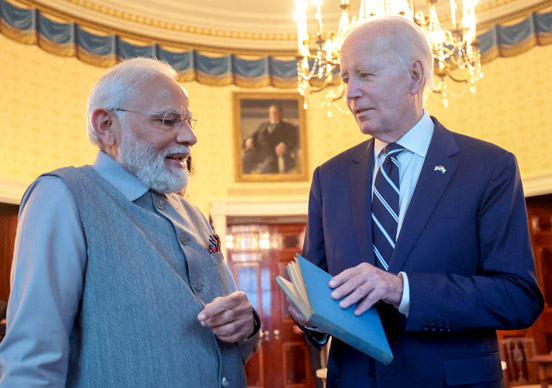
United States President Joseph Biden and Indian Prime Minister Narendra Modi affirmed that the US-India Comprehensive Global and Strategic Partnership, the defining partnership of the 21st century, is decisively delivering on an ambitious agenda that serves the global good (MEA, 2024).
India and the United States share the vision of Indo-Pacific stability, rising defense relations, and common democratic values. Nonetheless, even the closest partnerships are likely to face conflicts, especially in cases that go beyond geopolitics and when national economic interests are at variance. In particular, when the US slapped tariffs on several countries' imports, including India, in 2018 25% on steel and 10% on aluminum, disagreements started to escalate (Financial Times, 2018).
India viewed the US's action as unfair and protectionist, weakening the rules-based trading system and trust on the part of allies. New Delhi announced tariff barriers of its own on US products to reinforce economic sovereignty. The US administration justified the measure by claiming that it was essential to protect American enterprises and workers. On the other hand, it was like a bolt from the blue coming from one of the most trustworthy allies in New Delhi's perception.
It got worse when the US took away India's Generalized System of Preferences (GSP) benefits in June 2019. The plan was to keep exporters competitive by allowing a vast number of Indian products to enter the US market free of import duties. The matter went from bad to worse when the US disallowed India's Generalized System of Preferences (GSP) subsidies in June 2019.
The program was designed to help exporters stay competitive by permitting a large number of Indian products to enter the US market duty-free. The leather, technical goods, and textile industries were among the most heavily impacted by the loss of this access. Besides that, India's decision to withdraw from the Trade Promotion Agreement between the two countries resulted from high tariffs imposed on US products, restrictions in various sectors, such as e-commerce, and subsidies in the Indian agriculture sector, which the US claimed to be unfair. Although there are some issues, the two countries have still managed to keep their channels of communication open through such platforms as the Trade Policy Forum to ensure that the conflict does not spread to other areas of cooperation, which include technology, defense, and climate projects.
Recently, the US has imposed steep tariffs (up to 50%) on many Indian exports, citing India’s continued purchase of Russian oil. India strongly objects to these tariffs, calling them unfair and harmful, while standing its ground on sectors such as agriculture and dairy. There is also external pressure: the US is pushing for other allies (like the EU/G7) to also impose high tariffs on India (and China) over energy ties with Russia.
Agriculture as a strategic red line
Indian agriculture is not merely an economic sector; it is the whole political agenda, the base of rural life, and the main stabilizer of society. More than 85% of the farmers in India work on small or marginal pieces of land (The Hindu BusinessLine, 2024). They are of the opinion that the abolition of agricultural tariffs may destabilize rural incomes that are already on the edge of safety, by imports that are cheap, heavily subsidized, and coming from industrialized countries.
The Minimum Support Price (MSP) system and public grain stockpiles are the instruments that ensure that farmers get fair prices and that food security is maintained by the country. As per India, these steps are necessary in the path to self-sufficiency in food production and are not subject to choice.
India is also talking about how the US criticizes subsidies in an unfair way, giving the example of the fact that the federal government each year hands out billions of dollars to American farmers. In the opinion of New Delhi, a truly open dialogue on the reduction of farm-related measures should be bilateral and not down to one side only. By concentrating on a handful of US agricultural products and retaining its position on tariffs in agriculture, India made it clear that its farming sector is off the table in trade talks. Such steps were not spontaneous actions; they were not antagonistic either, and they helped protect the incomes of the most vulnerable while at the same time sending the message that India would maintain its independence in the matter of global trade policies.
Crops and livestock are not the only aspects of agriculture. The goal is to survive. It sustains entire villages, provides jobs, feeds us, and preserves rural customs. Agriculture is the backbone of the economies and cultures of many nations, particularly those with sizable farming populations. It's difficult to restore if it's lost or destroyed.
Imagine a nation that completely depends on outsiders to grow, transport, and market its food, relinquishing control of its own food system. It's not only dangerous. That is risky. When a crisis, conflict, or natural disaster strikes, food security becomes crucial. A nation becomes politically, socially, and economically vulnerable if it is unable to provide for its own citizens.
Balancing firmness with partnership
India’s conduct during the tariff dispute shows a deliberate mix of strength and diplomacy. India opted for targeted countermeasures while keeping lines of communication open. This approach allowed New Delhi to protect its core interests without letting the trade disagreement damage cooperation in defence, technology, and strategic security. This balancing act reflects an understanding that trade frictions can serve as leverage if handled carefully.
By showing it can push back where necessary, India strengthens its negotiating position in other areas. But the long-term challenge lies in moving beyond a defensive posture to a more forward-looking trade strategy, diversifying export markets, boosting manufacturing competitiveness, and pursuing agreements that expand opportunities without undermining agricultural sovereignty.
For Washington, recognizing agriculture’s unique role in India is essential. This is not simply a matter of market access; it touches the lives of hundreds of millions, influences elections, and underpins national stability. In today’s interconnected world, where economics and security are deeply linked, ignoring this reality could weaken a partnership that both countries need to address larger global challenges.
Conclusion
Despite being based on strategic collaboration and shared democratic values, the US-India relationship may nonetheless be tense, particularly when national economic interests diverge. For India, agriculture is a question of livelihood, social stability, and political sovereignty in addition to being a trade concern. New Delhi's strong position on safeguarding its farmers is a reflection of both policy and a deeper dedication to maintaining the city's rural core.
Although trade disagreements might occur, the larger alliance doesn't have to be derailed by them. It is essential to approach one another with empathy and an understanding of the distinct internal circumstances as both nations negotiate the challenges of international trade. To establish trust, the US must know India's agricultural sector. Long-term development for India will depend on a balance between independence and openness.
------------------------------
(Meher Grewal is a student of Economics & Political Science at Christ (deemed to be) University, Delhi-NCR)
The views expressed are not necessarily those of The South Asian Times