By Vipul Tamhane
What's the latest news from India regarding the suspension of the Indo-Pak Indus Water Treaty of 1960? Well, on April 24, the Cabinet Committee on Security (CCS) announced that it would put the IWT "in abeyance" until Pakistan made genuine efforts to stop cross-border terrorism.
This would be a significant step or not toward asymmetric warfare between the two nations, as India for the first time declared that it was willing to employ international law as a tool for national security, even to change the traditional legal norms for strategic purposes.
From water sharing to diplomatic leverage
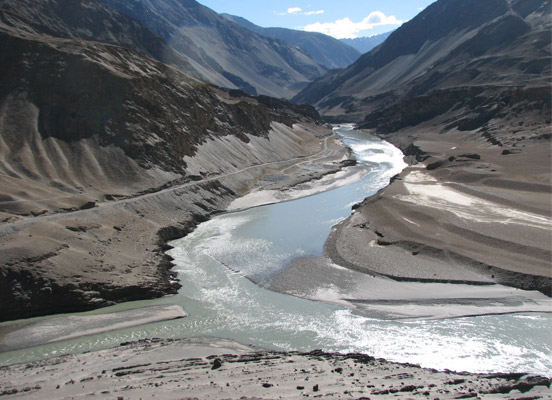
The Indus Waters Treaty has been heralded as a model of transboundary cooperation for decades, since it was facilitated by the World Bank and signed on September 19, 1960. It concerns the sharing of water among the six rivers of the Indus basin: with India holding the eastern tributaries (Ravi, Beas, and Sutlej), and Pakistan being awarded the western rivers (Indus, Jhelum, and Chenab). Article II provides that the Indian uses of the western rivers will be confined to non-consumptive ones like run-of-the-river hydropower, with approval of design and joint inspections. The Permanent Indus Commission, comprising representatives of both capitals, is tasked with supervising the treaty's implementation and settlement of disputes arising in its interpretation and application.
For little over 60 continuous years, the Treaty has endured war and diplomatic crisis without having been abrogated even once in the context of the 1965 and 1971 conflicts. But as India's foreign secretary noted, 'The IWT was crafted for stability, not for security adjustment.'. The Indian government viewed the Pahalgam attack, in which militants linked to Pakistani intelligence killed tourists in a sectarian massacre on April 23, as an opportunity, and indeed a necessity, to rebalance its stance in law against Islamabad.
Instead of formally abrogating the Indus Waters Treaty with attendant reputational costs, India has opted to suspend its obligations. Hence, the de facto posture of suspension of treaty obligations comes into play; that is, New Delhi would cease to entertain ordinary communications under the treaty or attend bilateral meetings of the Indus Commission. Pending dispute settlement matters, including Kishenganga and Ratle, will not be settled as India abstains from recognizing the Court of Arbitration or Neutral Expert mechanisms. It is crucial to note that, as of now, India has kept its jurisdictional basis intact, as it maintains that IWT, though in a technical sense, is still operative, and it has not legally terminated it. This provides India with the chance to revive treaty operations, should Pakistan abide by certain security conditions, and sends a signal to the international community that India's actions are reversible and sanction-based, while strategically disallowing Pakistan from gaining the upper hand in the convoluted water-sharing theater.
On background, a senior government spokesperson put it best: "This is not stepping back from international law. It is pursuing India's interests using it." Ministry of Jal Shakti (Water Resources) called it New Delhi's desire to maintain hydropower development over the eastern rivers within the treaty, notwithstanding that most cross-border water negotiations are at a standstill.
How the IWT constrained India
The entire spectrum of Indian punitive restrictions, which came along after the revocation of special status for Jammu and Kashmir in 2019 included, amongst other things, total sealing of the Attari-Wagah border, downgrading diplomatic ties with expulsion from membership of Indian military diplomats -- as persona non grata -- not to mention the move among military personnel. However, these steps still brought the thorn that remains stuck in India's access to the strategic use of water. Retaliation through withholding water would spell treaty violations and make that country subject to international derogation, whereas a very lengthy process of dispute resolution could not provide an immediate fix to the pressing panels of threats to security. Also, considering that India had no exit clause in cases of war or bad faith by Pakistan.
Thus, now India holds the IWT in abeyance to transform water into a lever of coercive diplomacy, thus reducing a strategy. Meanwhile, the geopolitical landscape of India is still fraught, especially concerning Pakistan. Historically, the Indus Waters Treaty (IWT) has prevented India from utilizing water as a tool of statecraft. Water denial would constitute a treaty violation and attract international censure, while the lengthy dispute resolution mechanisms would yield no immediate answers to security threats. India, in effect, is putting the IWT on hold while employing water as an instrument of coercive diplomacy, modulating a previously limited terrain by treaty law.
Building a legal foothold
This strategic change of direction in India's strategy toward the IWT has been in the works for years. For the last three years, India has carefully built up its case in law against Pakistan. New Delhi has presented parallel forum objections, contesting the World Bank's acceptance of concurrent cases before the Court of Arbitration and a Neutral Expert, contending this contravenes the sequential dispute-settlement framework of the treaty.
Further, India officially protested against the misuse by Pakistan of the consular communications of the Indus Commission to hinder Indian irrigation and hydropower schemes. India gave a notice in late 2023 to amend some procedural provisions of Article XII(3), which was unprecedented in magnitude. At the same time, India has promoted run-of-the-river hydropower projects on the Ravi and Chenab, meeting technical specifications and overriding Pakistani objections. These steps set the stage for keeping the IWT in suspense, warning that India will go up if security situations don't improve.
Disrupting dispute settlement
India's choice to increase the suspension of treaty mechanisms casts a doubt over the two major forums: the Kishenganga and Ratle Arbitral Tribunals. India has backed out of these arbitrations since 2022, citing procedural errors, and their suspended progress will now deteriorate as both countries do not agree to resume. The Neutral Expert Proceedings would also still be pending as small design problems of Pakistan, such as the spillway size, are for New Delhi negotiable unless terrorism restrictions. Neither of the tribunals can operate properly without India's support, and any fresh conflicts would again have to go back to political forums, creating another complication for the already strained water-sharing relationship of the two nations.
Pakistan’s limited response options
Countermeasures available to Islamabad are practically non-existent. A case could only be adduced before the International Court of Justice with India's consent, which New Delhi has explicitly refused. The UN Security Council presents another forum where a resolution is at risk of being vetoed, while at the same time further isolating Pakistan diplomatically.
The dispute relating to IWT is practically off the technical track and now high-stakes diplomacy. Some observers maintain that Pakistan's options may be limited to token protests and forays of lobbying for third-party mediation, none of which would necessarily compel India to recoil.
---------------------------------------------------
.jpg)
(The author is a counter-terrorism expert and governance consultant.)
The views expressed are not necessarily those of The South Asian Times