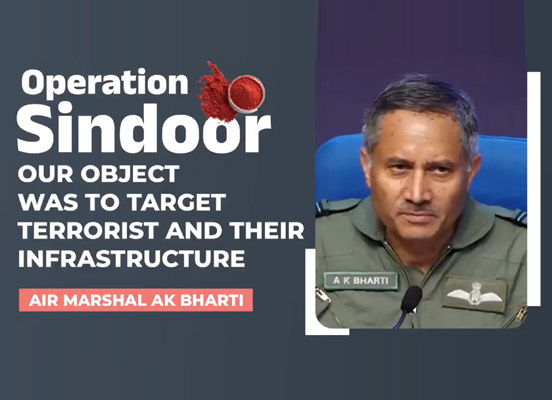
Operation Sindoor represents a significant shift in India’s counter terrorism doctrine. It demonstrates that India is no longer going to be content with demarches and delves.
By Vipul Tamhane
On May 7 night, India conveyed a clear, unambiguous message along the Line of Control that terror would no longer be tolerated. In an operation code-named Operation Sindoor, the Indian Armed Forces launched a huge, targeted retaliatory attack on Pakistan-based terror hubs in the wake of the despicable Pahalgam tourist attack. This action was not merely a military operation; it was an expression of sovereign intent, geopolitical will, and strategic imagination.
Applying a mix of surgical strikes and great audacity, India bombed and obliterated nine terror training camps deep within Pakistan and PoK, while, according to reports, killing hundreds of terrorists, including personnel of Jaish-e-Mohammed (JeM), Lashkar-e-Taiba (LeT), and Hizbul Mujahideen.
What distinguishes Operation Sindoor from earlier retaliatory strikes like the 2016 surgical strikes and the 2019 Balakot airstrikes is not just its scale but its layered deception, psychological warfare, and symbolic messaging. Named to invoke the sindoor, a sacred symbol of marital sanctity snatched from women in the Pahalgam carnage last month at the Baisaran Meadow, this operation was a tribute to the victims and a vow of justice delivered.
Operation Sindoor was remarkable not only due to the successful execution of operational precision and planning in the face of escalation but also because of the manner in which surprise was secured. For two full weeks, following the Pahalgam attack, India appeared to be temporizing while public fury began to subside. Commentators speculated that the Modi government may have preferred to exercise economic measures or diplomatic pressure, tightening the screws through FATF blacklisting; FATF intervention; the IMF; or even the Indus Waters Treaty.
Instead, India used the cover of normalcy to mask preparations for a deep-strike operation. High-level meetings were convened, on camera and off, with the Service Chiefs, NSA Ajit Doval, and Defense Minister Rajnath Singh. Public announcements, including a major census decision and civil defense drills, contributed to the perception of delay. Even large-scale military exercises in Rajasthan seemed routine to observers. The goal was clear: Deceive the adversary into believing retaliation would not come in the form of kinetic action. The Overton window of predictability was thus shattered.
By the time fighter jets took off on May 6 and missiles struck their targets in the early hours of May 7, Pakistan was caught in the most vulnerable of states, alert, but confused by the frequency of drills. Despite their best surveillance, the Indian Air Force’s precise timing allowed a mere 30-second window of surprise, just enough to lock, strike, and return.
Operation Sindoor sought to destroy targets important to the militancy establishment, thereby delivering operational and symbolic defeats to terrorist groups. The annihilation of Markaz Subhan Allah in Bahawalpur and Markaz Taiba in Muridke, the latter of which had prepared the plan for the 26/11 Mumbai attacks were long overdue. Also hit was Masood Azhar's sanctuary with reports indicating that he had collateral damage in his family. Hospitals were overwhelmed with casualties, especially combatants, but demonstrated the ferocity of the operation. More significant losses occurred as further strikes were carried out on Markaz Ahle Hadees in Barnala, Nalla Camp in Muzaffarabad and Sayyidna Bilal Camp that weakened the infrastructure of LeT and Hizbul
Mujahideen and materially curtailed their ability to operate.
The strikes did not include civilian areas and religious areas where non-combatants would have been present, supporting the accuracy of the objectives and India's stated proportionality principles. India's response was not only military, as it was a psychological message to Pakistan and Its proxies. The name of the operation meant much, the timing after a severe civilian massacre, and the clandestine approach also suited a much larger story of revenge. Additionally, the Indian government's strong messaging was further supported by a careful media briefing after the strikes, visibility of the actual damage, and Prime Minister Modi's silence on the issue.
In a remarkable break from established custom, there was no chest-thumping. No exciting press conferences. No premature announcements were made. Instead, the government allowed the footage and the facts to speak for themselves, allowing the world and India's audience to interpret what they saw, and to make their own conclusions. Foreign Minister Vikram Misri, while briefing, said that the Pahalgam massacre was intended to stir communal tensions across India. The fact that it did not succeed was attributed not just to India's security apparatus but Indian society as whole.
While operationally successful, this operation carries substantial strategic risks and restraint. With conflicts occurring at a global scale from Ukraine to the Middle East, the world continues to be on edge about any further military escalation, particularly between two rivals with nuclear capabilities. India had to balance showing resolve while preventing the subcontinent from a state of full-scale war.
Reportedly the Pakistani Air Force (PAF) scrambled aircraft and actively tracked Indian fighters, but it appears that they did not intercept them. This restraint may either be a result of a calculated decision (not to intercept) or could be a result of a temporary paralysis from the speed of events. Either way, it aided in de-escalation, at least for the time being.
Important takeaways from Operation Sindoor
India's recent military operation titled "Sindoor" marked a dramatic change in strategy with operational surprise after weeks of a heightened state of military preparedness. Through deception and nested exercises India's forces had carried out earlier, for two weeks, India neutralized Pakistan's security. The messaging of the operation thus resonated strongly with Pakistan's domestic audience, presenting an image of national solidarity and inclusion by empowering women officers in the briefings. This was thus framed as a controlled retaliation and not revenge. Nevertheless, the stakes were high.
While reminding people of the Kargil conflict, India's downside or vulnerability can be pilot losses and/or allegations of adventurism. Considering that India allowed the benefits to outbalance the dangers, it represents a new resolve on India's part to respond forcefully and ahead of time in order to de-risk. Overall, this is a new point of expansion of India's military activities in an intricate and multi-layered geo-political sphere. Eventually, Pakistan is unlikely to suffer the repercussions of India's military risks, but still, India's message was clear, domestic and regional. By conducting this operation, it highlights that India will go all the way in pursuing national add-ons to traverse safe regional rebalancings.
What comes next?
If sources are to be believed, Operation Sindoor was only Phase One. The government has reserved its right to continue targeting terror sanctuaries based on Pakistan’s reaction. Thus far, Pakistan’s military has responded with the usual bluster, some artillery activity near civilian areas in Jammu & Kashmir, and attempts to rally international attention. However, there is also a recognition within their establishment that India’s tolerance threshold has changed irreversibly.
This operation also puts the ball firmly in Pakistan's court. Will it respond militarily, and risk escalation? Will it slink away behind a diplomatic cover, hoping to rebuild its terror architecture again over time? Either way, now it's up to Islamabad.
Operation Sindoor represents a significant shift in India’s counter terrorism doctrine. It demonstrates that India is no longer going to be content with demarches and delves. India has jumped to a new doctrine of precision, plan, patience, and power. Whether this leads to a long-term strategic shift or is simply a one-off exhibition of strength depends on what Pakistan does next. But one thing is certain, the message has been made by India. Loud. Clear. And unapologetically.
---------------------------------------------------
(The author is a counter-terrorism expert and governance consultant.)
The views expressed are not necessarily those of The South Asian Times