By K S Tomar
The world is no longer willing to indulge a state that uses jihadist proxies as strategic assets.
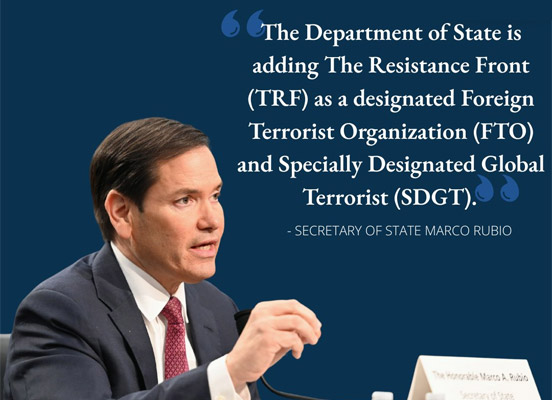
The United States’ decision to designate The Resistance Front (TRF), a proxy of the Lashkar-e-Taiba (LeT), as a global terrorist organization is a significant development. Coming just days after the deadly attack on Indian Army personnel in Pahalgam, Kashmir, the US action is being seen as a big diplomatic win for India, which has long maintained that TRF is a repackaged face of LeT designed to give the impression of a home-grown insurgency in Jammu and Kashmir.
The US State Department’s move to designate TRF and its top commander, Basit Ahmad Dar, under Executive Order 13224 puts into motion legal and financial consequences, freezing assets and cutting access to any support. It also delivers a resounding blow to Pakistan’s continuing use of terror as an instrument of foreign policy in Kashmir. India has presented compelling dossiers to the US and other Western countries about TRF’s links to LeT, ISI, and Pakistan’s deep state. Washington’s acknowledgment adds to India’s growing international clout in calling out cross-border terror networks.
Pahalgam attack turns global spotlight on Pakistan
The July 8 ambush in the Pahalgam area of south Kashmir's Anantnag district, which left four army personnel and a policeman dead, acted as the final trigger. India cited this brutal attack in its fresh briefings to allies, including the US, highlighting that the TRF had publicly claimed responsibility. New Delhi stressed that these attacks were not just local acts of violence but part of a larger ISI-scripted strategy to destabilize Kashmir under the guise of resistance.
The timing of the US action was not coincidental. It came immediately after India intensified its diplomatic lobbying, and the Pahalgam incident helped establish the urgency and seriousness of Pakistan’s proxy operations. The Indian government provided technical inputs, including evidence of social media handlers operating from Pakistani territory. It also demonstrated how TRF’s claim of indigenous resistance was hollow, revealing its roots in Rawalpindi’s terror ecosystem.
Implications for Pakistan: Isolation and FATF heat
The designation will have consequences beyond mere symbolism. TRF’s funding channels, recruitment networks, and social media propaganda tools are now under the scanner. Pakistan-based operatives will find it increasingly difficult to move funds, communicate with sleeper cells, or coordinate attacks without being tracked by international intelligence.
Moreover, the US designation may lead to renewed interest from FATF and other global bodies. Although Pakistan has been taken off the FATF grey list, its actions remain under close watch. The TRF episode could easily push Pakistan back into trouble if further terror links are established. This would jeopardize its already fragile economy and make it harder to secure IMF and World Bank support.
India gains strategic leverage
Strategically, this development provides India an upper hand. The global recognition of TRF as a LeT proxy demolishes Pakistan’s narrative of “indigenous resistance” in Kashmir. It also strengthens India's case for targeting such operatives within J&K and along the LoC without fear of international backlash.
Domestically, this designation is a morale booster for security agencies battling hybrid militants—local recruits radicalized and armed by Pakistan through online handlers. It could also be used as a reference point by Indian agencies to initiate stronger legal actions under the Unlawful Activities (Prevention) Act (UAPA) and push for similar bans within the European Union and UN frameworks.
Diplomatic push by India bears fruit
Over the past two years, India’s foreign policy machinery has worked tirelessly to expose terror proxies like the TRF. Multiple dossiers were shared with the Financial Action Task Force (FATF), United Nations, and key allies such as the U.S., France, and Germany. Indian diplomats repeatedly flagged how groups like TRF, People’s Anti-Fascist Front (PAFF), and United Liberation Front of Jammu and Kashmir (ULFJK) were merely aliases created by Pakistan to evade sanctions and scrutiny.
Foreign Minister S Jaishankar’s consistent messaging—especially his scathing critiques of Pakistan at multilateral forums—has shaped global opinion. The US action is the outcome of this sustained campaign. It also signals that the West is now more willing to hold Pakistan accountable, even if indirectly. This is a significant shift from earlier years when strategic concerns over Afghanistan often compelled the West to turn a blind eye to Pakistan’s double game.
Pakistan’s denial strategy falls flat
Predictably, Pakistan has denied any association with TRF or involvement in the recent attacks. However, this time its denials have found little takers. International observers are more inclined to believe India’s evidence-based assertions than Pakistan’s habitual denials. Pakistan’s track record—its hosting of Osama bin Laden, sheltering of Hafiz Saeed and Masood Azhar, and continued support to Afghan Taliban factions—has eroded its credibility.
Even within Pakistan, security analysts have begun to question the long-term utility of these proxy groups. With its economy in crisis and growing international scrutiny, Islamabad finds itself increasingly isolated. The US terror designation will add to Pakistan’s diplomatic woes and could even revive concerns within FATF about compliance and blacklisting risks.
China’s calibrated reaction keeps door open
China’s silence on the US decision is also notable. While Beijing has blocked similar designations in the past—most infamously shielding Masood Azhar from UN terror listings for years—it has refrained from overtly defending TRF. This could indicate that even China sees the futility in defending such groups, particularly when global patience with Pakistan-sponsored terrorism is wearing thin. It also reflects the changing dynamics in India-China relations where trade and geopolitical compulsions may be outweighing traditional alignments.
Momentum must be sustained against other proxies
While the TRF designation is a big milestone, India must not relent. Similar pressure must be maintained to ensure action against other ISI-run fronts like PAFF, ULFJK, and Ghaznavi Force. Each of these groups operates using similar playbooks—anonymous digital propaganda, false narratives of Indian “occupation,” and social media-based radicalization.
India must press its case before the UN Security Council, especially its counter-terrorism committee, to expand the list of designated groups and individuals. Simultaneously, bilateral engagements with countries like UAE, Saudi Arabia, and Russia must continue to ensure that Pakistan does not find alternate support.
A defining step in global counter-terror collaboration
The US move against TRF reflects a rare moment of international convergence in South Asia. In a region often marred by strategic ambiguity and diplomatic hedging, this clarity stands out. It reinforces the message that proxy warfare through terror will no longer be tolerated.
India must seize this momentum to build a global consensus against terror havens. Pakistan, meanwhile, has a clear choice: dismantle these proxies or face mounting isolation. The world is no longer willing to indulge a state that uses jihadist proxies as strategic assets. The Pahalgam attack may have claimed lives, but it also ignited a chain of global responses that will haunt Pakistan’s terror factories for a long time.
.jpg)
(The writer is a strategic affairs columnist and senior political analyst based in Shimla)
-------------------------------------------------------
The views expressed are not necessarily those of The South Asian Times