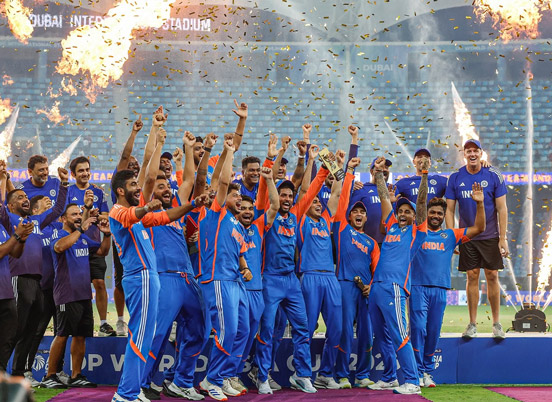
The Asia Cup 2025 final match was not merely a game of cricket. It was a deliberate and calculated display of national resolve that transcended sport.
By Vipul Tamhane
Four months ago, a military operation codenamed ‘Sindoor’ saw Indian forces decimate eleven Pakistani airbases and their global standing. Four months later, on a different kind of battlefield under the floodlights, our Indian cricket team systematically dismantled the arrogance of eleven Pakistanis on the cricket field. The parallel is stark and the message is unequivocal: whether in the theatre of war or on the cricket pitch, the result for Pakistan remains the same: ‘Total humiliation’.
The Asia Cup 2025 final match was not merely a game of cricket. It was a statement, a deliberate and calculated display of national resolve that transcended sport. The Indian team’s conduct was a masterclass in using a global platform to expose a nefarious neighbor, justifying every act of perceived “disrespect” as a necessary response to a state that wages perpetual grey-zone warfare.
The world must understand the context. This match was not played in a vacuum. Just days before the first ball was bowled, Pakistan’s Prime Minister, Shehbaz Sharif, stood at the hallowed podium of the United Nations General Assembly and performed what has become a familiar, macabre dance. He admitted, with breathtaking audacity, that Pakistan harbors terrorists. He framed it as a ‘sacrifice’, claiming that had his nation not “controlled” these elements, they would be “roaming the streets of London and New York.”
This was not a gaffe; it was a boast. India’s swift right to reply at the UN labelled Pakistan’s reputation correctly: “Terroristan” coined by Indian Diplomat to the UN, Rentala Srinivas, who is a Second Secretary at India’s UN mission. India made it clear to point out the state whose fingerprints are visible on acts of terror across the globe.
This is the ecosystem the Indian team was forced to share a field with. And they understood the assignment perfectly. This moral clarity was mirrored in the individual battles on the field. The confrontation between Jasprit Bumrah and Haris Rauf was a microcosm of the larger conflict. In a previous match, Rauf, a cricketer of modest achievement but immense arrogance, had mocked Indian fans with a gesture implying the downing of Indian fighter jets, a false and toxic narrative peddled by the Pakistani military.
The ICC, in a display of typical fecklessness, fined him a paltry 30% of his match fee. But justice was served in the final. Bumrah, the quiet assassin, clean bowled Rauf with a devastating yorker. His response? A subtle, knowing smile and a celebration that mirrored Rauf’s own earlier provocation. It was a massive slap on Rauf's face, a silent message that said, “It’s not happening.” At that moment, Bumrah was every Indian who had to endure Pakistan’s proxy war. He was calm, precise, and devastatingly effective. He knew a fine might follow, but he also knew that some statements are worth the cost.
The most potent symbol of this understanding was not a blistering century or a searing yorker, but a silent, powerful snub. The Indian team’s outright refusal to accept the trophy from the hands of Mohsin Naqvi, the Chairman of the Pakistan Cricket Board, was a diplomatic bombshell disguised as sporting protocol. Why? Because Mohsin Naqvi is not just a cricket administrator. He is the Interior Minister of Pakistan, the man directly responsible for the nation’s internal security and, by extension, its policy of harboring and exporting terrorists.
Naqvi’s lineage is steeped in this very subversion. His political and familial history is a web of connections to violent lashkars and separatist conspiracies aimed at destabilizing India. He is the embodiment of the Pakistani deep state’s fusion of terrorism, politics, and now, sport. To share a podium with him, to accept a trophy from his hands, would have been to legitimize a regime that India is fighting on every other front. So, they didn’t. They let him scurry away with the trophy, while they celebrated a victory that was about far more than runs and wickets. It was a declaration: we will not share a stage with your terror master.
Another angle to that is the PTV narrative mocking the T-20 World Cup jerseys with ‘Pakistan’ written on it, as win or lose, team India will wear their name. The blue heroes under Gautam Gambhir’s diplomatic vigilance aren’t going to take that symbolism at least here; ‘Pakistan has nothing honorable to give us’, the message was subtle yet clear. This symbolic defiance mattered as much as the victory itself. What remains unanswered is how Mohsin Naqvi, Pakistan’s Interior Minister and PCB chief, found himself on the final’s podium above legitimate board heads of other playing nations, including hosts UAE. The ICC must explain why a political figure, deeply tied to anti-India posturing, was brought to confer this cricketing honor.
The Indian players amplified this message off the field. Suryakumar Yadav announced the donation of his entire match fee to the Indian Armed Forces, a direct and powerful rebuke to the nation that funds terror with its every resource. The post-match comments were not about mere tactics; they were a roasting, a collective refusal to pretend that this was just another game.
The truth that Pakistan and its apologists refuse to acknowledge is that Pakistan is a state whose very identity is parasitic, existing only in opposition to India. Its politics, its defense budget, and its foreign policy - all are consumed by a pathological hatred for its neighbor. It is not a constructive state but a reactionary project, surviving on IMF loans and the export of jihad. Where India builds Chandrayaans and leads in digital infrastructure, Pakistan builds terror complexes and narratives of denial.
This is why the Indian team’s “disrespect” was not just justified; it was necessary. It was a long-overdue corrective to a nation that mistakes hot air for achievement and terrorism for foreign policy. The BCCI may have provided Pakistan with crores that will inevitably be funnelled into its terror machinery, but the players ensured the price Pakistan paid was a humiliation so profound that it will echo far beyond the boundary ropes.
The Indian team was not just cricketers that day; they were warriors. They understood that the pitch was merely another front in a long-standing conflict. And on that front, they delivered a result more decisive than any military operation: they showed Pakistan its true place in the world order, not as a rival, but as a nuisance.
----------------------------------------------------
.jpg)
(Vipul Tamhane is a counter-terrorism expert and governance consultant)
The views expressed are not necessarily those of The South Asian Times