Pakistan desperately clings to the region not out of love, but because of greed, say top Baloch voices.
By Vipul Tamhane
The global order is undergoing challenges, not just from states but also from cries for justice, identity, and freedom from divided countries, with voices rising from within. One voice has risen sharply, determinedly, and solidly: Mir Yar Baloch, a known Baloch writer, has proclaimed Balochistan's independence from Pakistan to demand international action in solidarity.
As India-Pakistan tensions re-ignited, Mir Yar Baloch issued what may be a historic announcement later on. Not only does he assert freedom for the troubled province of Balochistan, but he also demands that India grant permission to open a Baloch embassy in New Delhi. The demand is not necessarily symbolic, it is strategic. It is a 'proclamation of sovereignty by a people who have suffered decades of military repression, extraction of resources and cultural annihilation'.
For the Indian public and policymakers, this should not merely be a moment of televised (NewsX) curiosity, it must be a moment of reckoning. Balochistan is not just a geopolitical card to counter Pakistan’s duplicity on Kashmir. It is a region whose people have suffered brutal suppression at the hands of a military regime that uses religion as a facade while fueling a mafia-style control over territories, without fair representation.
Razak Baloch, Secretary General of the Baloch American Congress, spoke with passion and conviction, reminding the world that Balochistan was independent in 1947. He was immediately betrayed by Muhammad Ali Jinnah, who dispatched Pakistani forces to occupy Balochistan in 1948, whatever semblance of a 'standstill agreement' that might have existed, which was meant to maintain Balochistan's independent status. Razak's message to the world, and in particular India, was simple: provide us with not only diplomatic support but also the real tools of defense, just as the world has provided Ukraine with products in its desire for freedom.
The legitimacy of this statement is magnified by the preparation process. The self-sent Republic of Balochistan now counts with a flag, a national anthem, an emblem, a capital (Quetta), and a parliament. Leaders are in the process of preparing a transitional government, where women have been promised a role. This is not a rebellion; this is a nation-in-waiting.
Ahmar Mustikhan is a senior journalist and champion of freedom. He pulls no punches in characterizing Pakistan as a "slave state" created by colonialism, itself a rogue state supported by foreign powers for their own geo-strategic reasons. He fully puts it out there, bluntly revealing the historical crimes and moral deterioration at the helm of Pakistan, labeling the army as mercenaries and calling the Pakistani state ideology a "jihadi mindset". His words are provocative, but they reflect a deeper truth: Pakistan has long leveraged extremism as both shield and sword, exporting terror while strangling its own pluralistic elements.
Balochistan, Sindh, Gilgit-Baltistan, and even parts of the so-called “Azad” Kashmir (PoK) have long been treated as colonial holdings rather than integral constituents of a democratic state. The world must recognize that Balochistan is a political, not a military crisis; itself afflicted with political oppression, economic deprivation, and human rights violations!
Bilal Baloch, another journalist and native voice, pointed out that Pakistan is desperately clinging to Balochistan not out of love, but because of greed. The mineral wealth, the strategic coastline, and the potential for Chinese exploitation under CPEC (China-Pakistan Economic Corridor) make Balochistan an economic lifeline for a country otherwise teetering on collapse.
Nonetheless, the people of Balochistan are clear about one thing: They will not allow their land to continue to be looted and their culture destroyed and their children branded 'terrorists' because they demanded dignity. The Baloch have never participated in any foreign or domestic violations in the name of religion. They have never requested to have extremism misappropriated in their name. What they were always looking for was self-determination, democratic governance, and to be able to live as free people.
In the wake of Operation Sindoor, Pakistan's reaction is likely to be both reactionary and repressive. The military establishment will be psychologically damaged from the fallout of the operation and may respond by rounding up dissidents, declaring curfews, and censoring information throughout the affected province. Officially, Islamabad will blame someone else (notably India and/or foreign intelligence agencies being charged with fomenting insurgency), while behind closed doors, they will make last-ditch efforts to prevent further fissures, implementing a combination of military force and political concessions. However, such efforts may only fuel more resentment from an already alienated population, especially if long-standing issues such as neglect, violence/abuse, and second-class citizenship remain unaddressed.
The international community's response will be contingent upon how the events unfold, and if Pakistan commits human rights abuses on a mass scale, we may see strong global condemnation from Western democracies and human rights organizations. The United States might encourage political dialogue, but whether it would directly exert influence is dependent on the shifting attentions of the US in the region. China, which has significant economic interests in Pakistan through the CPEC, will become uneasy with acts of instability that disrupt its economic and strategic interests. The risk that internal unrest will become a liability for China could cause this "all-weather friendship" to be strained if there's instability in Pakistan.
India's diplomatic capability and standing in the global order will be challenged here. She may seek to use diplomatic channels to further highlight Pakistan's crumbling internal unity and utilize the opportunity to further isolate Islamabad on the globe. If it does break, it would be an existential blow to Pakistan, as it would demolish the mythology of unity/deeply rooted lines its military/political elite have long tried to mask.
The international community can no longer turn a blind eye. The United Nations must urgently send a fact-finding mission and consider peacekeeping operations. India, a rising power with a civilizational commitment to pluralism and democracy, must seize this moment as a moral imperative to support a legitimate liberation movement. Balochistan is at a crossroads. So is the world.
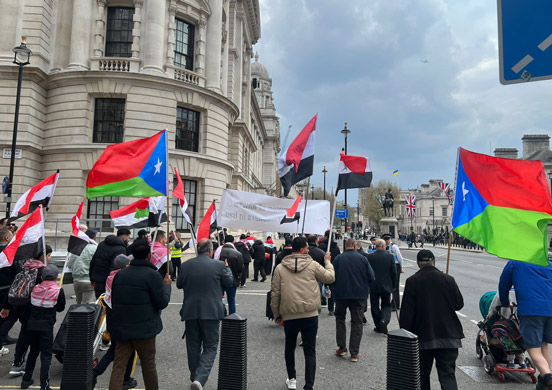
As the Baloch flag flutters and their anthem plays for the first time before global audiences, the question we must ask ourselves is not whether they will be free, but how long the world will delay justice in the name of diplomacy. History will not be kind to those who stayed neutral in the face of colonial reoccupation disguised as nationalism. Let India lead by example. Let the world listen. Balochistan has spoken. It is time we hear.
---------------------------------------------------
.jpg)
(The author is a counter-terrorism expert and governance consultant.)
The views expressed are not necessarily those of The South Asian Times