Mali going down would be like a seismic event whose waves would be felt globally. Is the world even watching?
By Vipul Tamhane
While the world continues to focus on conflicts in the Middle East and Ukraine, a scary scenario is unfolding in West Africa that should really worry everyone. Mali, a country of more than three times the area of Spain, is on the verge of being the first country ruled by the humanitarian wing of Al-Qaeda. The consequences extend far beyond the arid Sahel region, and the arrival of Europe is, in fact, closer than we would think.
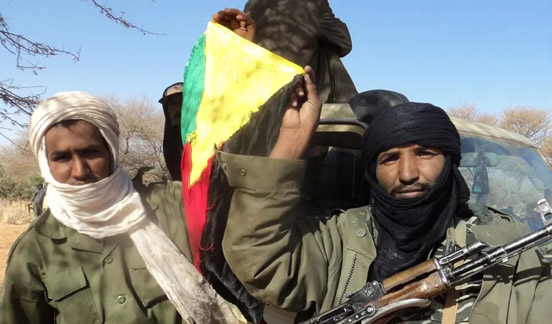
The terrorist group JNIM (Group for the Support of Islam and Muslims) has surrounded Bamako, Mali's capital, and is actually carrying out a blockade of fuel and food from the city in a deliberate siege. These aren't poorly equipped fighters living in hidden caves. It's one of the most powerful armed groups of the Sahel, trained by Al-Qaeda in Pakistan, dismantling a capital city turn by turn from the outside. Without fuel, Mali's military is powerless in the air and on the ground to the extent needed to lift the blockade. The occupants are tightening the noose every day in this vicious cycle.
In case of success by JNIM, we won't only be witnessing a gigantic humanitarian catastrophe in a "forgotten corner" of Africa. We will see Al-Qaeda pulling off what even Osama bin Laden never managed: creating a functioning state with territory, borders, resources, and political legitimacy at its disposal. This would be the third example of an Islamist regime taking over power in as many years, after the Taliban's Afghanistan and Al-Sahara's HTS (Hay'at Tahrir al-Sham) conquering Syria. The incidents that we thought were only isolated cases are now becoming a deeply troubling pattern.
How did we get here?
The seeds of today's crisis were planted in 2011. The killing of bin Laden by the US military led to a general perception that Islamic terrorism was on its last legs. Rather, the situation provided Al-Qaeda with an opportunity to upgrade its strategy by no longer relying on jaw-dropping attacks but controlling the territories one at a time, ruling over the villages in the Sahel, imposing Sharia law, and taking taxes. While attention was on the Syrian crisis and the rise of ISIS, Al-Qaeda was silently extending its presence across Africa's ungoverned areas. The Sahel, with Mali, became the epicenter of this phenomenon.
The circumstances escalated post the Western retreat. The coups that took place between 2020 and 2024 served as a backdrop for Mali and its neighbors to pin their woes on France and the USA. The anti-colonial discourse, coupled with authentic frustration, drove the Western armies to exit. The French forces wound down Operation Barkhane; the Americans decommissioned several bases, including the one in Niger that had cost $110 million and was staffed by more than 1,000 soldiers who were now gone, except for the one in Djibouti, which was still very far away.
The void was quickly filled by Russia with Wagner mercenaries, who were nowhere near the Kremlin-controlled “Africa Corps” that was exchanging security assurances for gold, lithium, and loyalty. However, the Russians were the ones who caused the unrest instead of calming the situation down; they even staged the 2022 Moura massacre that claimed 500+ civilian lives, thus pushing the local population towards the jihadists.
At the same time, the jihadist factions were getting more creative thanks to the victories. The Taliban's 2021 comeback in Kabul and HTS's 2024 seizure of Damascus showed that the strategy of attrition worked. JNIM openly imitates this slow-and-steady Tiger strategy of the Taliban, and it's paying off.
Why the world, especially Europe, should care
Mali going down would be like a seismic event whose waves would be felt not only in Africa but also in Europe and the rest of the world. The immediate and very real possible consequences of this are for Europe to worry. The escape routes from the Sahel to the Mediterranean are the migration corridors. Europe’s already overburdened asylum systems would be put under terrible pressure with the influx of millions of people escaping jihadists’ rule. This would ignite the political upheaval that migration crises always do in the European continent.
History shows that controlling territory turns terrorist groups into serious threats. In the time when ISIS was governing parts of Syria and Iraq, it was masterminding and carrying out horrific attacks in Paris, Brussels, Nice, London, and Barcelona. The "caliphate" attracted more than 40,000 foreign fighters worldwide. The establishment of an Al-Qaeda state in Mali, only a few kilometers across the Mediterranean, could have a similar effect in terms of recruitment and operational capacity, with Europe as the key target.
Besides the strategic implications, the matter becomes even more dangerous.
Mali is home to gold, lithium, and uranium deposits that would, in turn, enable terrorist activities on an industrial scale if they were to finance themselves from these deposits. A safe area for terrorist activities is synonymous with aggravating scenarios such as training camps, airfields, and places that serve as a base for planning operations. Also, this means a strong recruitment message, i.e. "We drove away the West and constructed an Islamic state."
The figures are not disguised. Terrorism deaths in the Sahel account for half of the global numbers, with their tenfold increase just since 2019. The number of countries that have experienced attacks has increased from 58 to 66 in the year 2024, the greatest change during the last six years. This is not a local crisis that can be stopped from spreading; on the contrary, it is a very dangerous situation that, among other consequences, poses a direct threat to Europe and international security in general.
Is it too late? What must be done?
The global community should not close its eyes to this crisis. It is high time the United Nations held emergency Security Council sessions to sanction the opening of humanitarian corridors in Bamako and also effect targeted sanctions against the leaders and financiers of JNIM. What we require is a mission to restore peace in Mali led by Africans and supported by the West through intelligence, logistics, and training, but without taking over, thus maintaining respect for sovereignty and ensuring that real security is given.
Being as important as this is the issue of the accountability of those external actors whose abuses provide fuel for recruitment. International investigation and imposed sanctions should be the consequences of Wagner's mercenary operations. If Pakistan has played a role in the resurgent activities, that involvement should be clearly investigated, and the country should be sanctioned accordingly, barred from international intelligence sharing alliance and should be put on the FATF grey list as well. The economic incentives behind the conflict, such as illicit mining, illegal smuggling trade, and exploitation of natural resources, must be effectively stopped through a well-coordinated international enforcement plan.
However, these measures on the military and economic fronts are not going to be enough. The root causes of the problem - governance failures, corruption, and lack of opportunities, making extremists attractive - should also be addressed alongside security measures. Local institutions, the rule of law, and economic development through security operations are the only ways of preventing a repeat of the same battle.
The past is loudly warning us not to make the same mistake with this crisis. Raqqa and Mosul were very far away and safe at that time, too, but the sound of their bombs reached Western capitals later. The fall of Afghanistan had a global impact. Mali is not a problem of others. It is ours, and time is running out.
-----------------------------------------------------
(Vipul Tamhane is a counter-terrorism expert and governance consultant)
The views expressed are not necessarily those of The South Asian Times