By Pompy Konwar, Palak Mahajan & Poulami Sanyal
Technology isn’t the barrier-policy, logistics, training, and integration are. It’s time for a national framework for drone-enabled primary care.
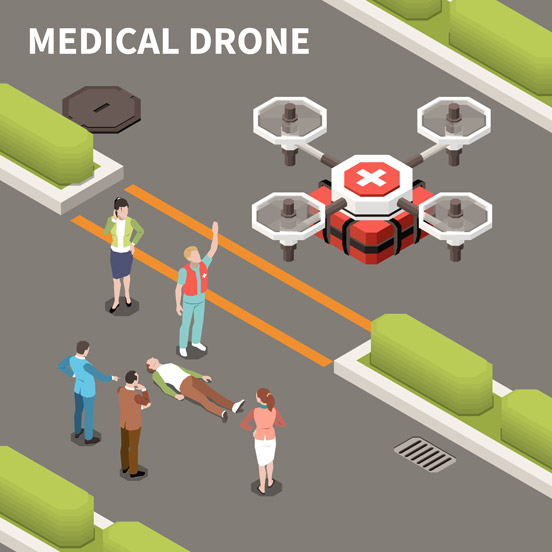
For years, drones were dismissed as little more than curious flying machines. Today, they routinely carry vaccines, blood samples, and life-saving medicines to places where roads, bridges, and boats simply give up. When a three-hour mountain journey can be reduced to a 15–20 minute flight, the question is no longer whether drones work in healthcare. The real question is why they are still treated as experiments rather than as part of the health system itself.
India’s primary healthcare network was designed for a more predictable climate; one that assumed stable roads, functioning bridges, and reliable connectivity. Climate change has disrupted those assumptions. Floods wash away roads, landslides cut off hill districts, and islands remain isolated for days. Each disruption triggers a quieter public health crisis, such as vaccines fail to arrive, blood samples go untested, and essential medicines stop moving.
Climate change and emergence of drones
Floods, cyclones, cloudbursts, heatwaves, and landslides have claimed thousands of lives in the country due to climatic disruptions. According to an analysis by Down To Earth, extreme weather events affected India for 322 days in 2024. In such conditions, continuity of care depends not on innovation showcases but on resilient logistics. This is where drones have already proven their worth.
Across states such as Manipur, Nagaland, Himachal Pradesh, Meghalaya, and the Andaman Islands, drones have transported vaccines, diagnostics, blood samples, and emergency medicines when no vehicle could move. In Meghalaya, under a health system strengthening initiative, a drone now connects a district hospital to a remote primary health centre that otherwise requires a two-hour journey by road and boat.
According to a Government of Meghalaya press release, under the Meghalaya Health Systems Strengthening Project, the state became the first in India to launch a government-led drone delivery network for transporting medicines, vaccines, and diagnostic samples to remote health facilities. What was once a 35-kilometre ordeal is now completed in about 12 minutes. In Manipur, drones have similarly replaced 3-4-hour mountain drives with 20-minute aerial corridors. These are not futuristic visions but are operational realities. Drones are doing what climate change is undoing.
Behind the “flying box of medicines”
Behind this apparent simplicity lies a carefully engineered logistics system. Medical drone delivery is not just a “flying box of medicines” but requires appropriate technology to adapt to terrain and purpose. Short routes of under 10 kilometres often rely on multirotor drones for quick transfers.
Longer and more difficult terrains use vertical take-off and landing drones, while fixed-wing hybrid models cover distances of up to 100 kilometres for extremely remote districts. Cold-chain integrity depends on lightweight carriers and continuous temperature monitoring, not bulky ice boxes. In high-altitude districts, faster battery drain means planning for double-battery systems and temporary charging points along routes. These technical challenges are real-but they are solvable. The bigger obstacles are systemic.
When climate, weather, and connectivity push back
Weather in the Northeast and other difficult terrains is unpredictable. Sudden wind gusts, fog, drizzle, and early sunsets routinely disrupt flights. Dense forests and mountain valleys can interfere with GPS signals, while many remote health facilities lack flat, obstruction-free landing spaces. In Nagaland, one drone had to land on the rooftop of an unused house after discussions with the community. Each of these problems has a workaround, but only if drone operations are planned as part of the health system, not as add-on pilots.
Human and administrative gaps are even larger
Human and administrative gaps are even harder to bridge. Studies have highlighted that in several districts of Manipur and Nagaland, many health workers initially did not understand the role of drones in service delivery. Some worried about the increased workload; others were intimidated by the technology. Acceptance grew only after hands-on training, materials in the local languages, and sustained community engagement within communities and frontline staff (Angwanwadi workers, ASHAs, etc).
India’s supply chain architecture presents another bottleneck. Medicines are allocated district-wise, and inter-district movement by drone is rarely built into indenting systems. Regulatory processes under the Drone Rules, including beyond-visual-line-of-sight permissions and insurance requirements, often involve multiple agencies and long delays. These gaps risk keeping drones confined to “successful pilots” rather than integrating them into everyday public health operations.
India needs a national drone-enabled health system
India needs a comprehensive national framework for drone-enabled primary care, and it needs it urgently. Such a framework should -
Building a health system that flies
Drones will not replace doctors, ambulances, or frontline health workers. They cannot deal with understaffing or decades of underinvestment in infrastructure. But they can restore one essential function of primary healthcare in a climate-disrupted era: ensuring that time-critical supplies reach the last mile, even when the ground beneath our systems fails.
India does not need more proof that drones work. It needs a system that lets them work safely, at scale, and every day. In a turbulent climate century, a health system that flies is no longer an innovation. It is an obligation.
(Pompy Konwar is a Senior Research Associate, Palak Mahajan is a Research Associate, and Dr Poulami Sanyal is a Fellow at New Delhi-based Pahle India Foundation.)
The views expressed are not necessarily those of The South Asian Times