[The opinions expressed in this article are those of the author. They do not purport to reflect the opinions or views of The South Asian Times.]
By Basab Dasgupta
I was awed at the sight of all the improvements in the city when I recently visited Kolkata after thirty years. Most of these developments were almost unimaginable when I lived there, including the metro, flyovers, fast bypass roads, western-style shopping malls, and dozens after dozens of high-rise buildings with modern residential flats.
At the same time, I was also disappointed by many aspects of the city that did not seem to bother the locals. The most disturbing item to me was the trash on the street sides. Not overflowing garbage bins at a few places; trash was everywhere: in big piles, small piles, and scattered on the pavements; papers, leftover food, thrown away rags, old torn clothing, miscellaneous small objects, plastic sheets, debris from unfinished construction projects, and so on. Some piles had a strong stench. There were no organized trash bins nor garbage trucks anywhere in sight.
I asked many people about the trash collection system. No one seemed to have a clear idea about how the trash was collected; many said that “Dhapa” was the ultimate dumping ground. The usual routine for the maid is to periodically take the trash to some neighborhood dump area and forget about it; some truck from the Kolkata Municipal Corporation is supposed to come to pick up the garbage, but no one knows when and how frequently those trucks come.
“Recycling” is an unknown concept. One still sells old newspapers to hawkers who, in turn, sell them to a paper mill through various middlemen. I noted that, in every house I visited, there was no trash can in the bathrooms! I had no place to throw items like a used piece of dental floss or a wrapper from a disposable razor. It seemed that people were unaware that trash collection, recycling, and disposal must be an integral part of the planning of a civilized society. The prevalent thinking is that you just litter it on the street and then it ceases to be your problem!
I commented to my friends that if I were the mayor of Kolkata, my first priority would be to do a critical review of the trash collection system and make major revisions; if nothing else, I would put large garbage dump containers at every city block. Many of them reminded me that one could think of creative ideas, but implementing them would be impossible because no one obeyed the rules.
There are beggars, homeless people, not to mention those illegal refugees from Bangladesh. Others mentioned that nothing gets done because corruption is everywhere. Garbage is one thing, but then there was also dust. Dust was on the streets, on the pavements, in the air. If you leave the windows in your home open, dust comes in and coats everything with a thick layer. Unless you dust and mop your house every day, it becomes obvious because everything turns dark. I have lived in dusty cities in Mexico, but those were in desert climates with a shortage of water. This was surely not the case in Kolkata, famous for its monsoon seasons.
The answer lies in the lack of a proper drainage system underneath the city. The rain could have periodically washed all the dust into an underground drainage and finally into a river, but without such drainage, dust remains on the streets. The Kolkata drainage system is not sloped towards the Ganges but carries wastewater to the east with an ultimate destination of the river Matla.
Encroachments of these river banks for the purpose of pisciculture further restrict water flow. In any event, dust temporarily turns into mud when rain comes and then dries again into dust because muddy water does not flow out fast enough.
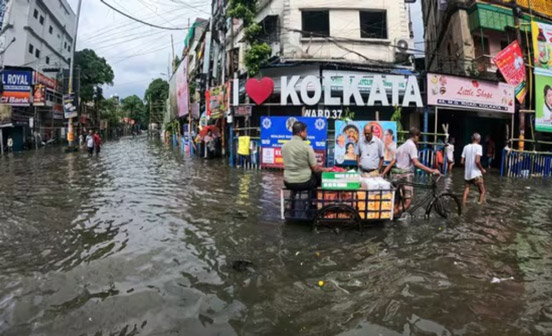
The recent unprecedented flooding in Kolkata just before Durga Puja reminded me of those observations during Kolkata visit. Knowing the obsession of Bengalis with politics, I know that nothing will get done. There will be plenty of finger-pointing. BJP will certainly use this catastrophic incident in their campaign to remove Mamata Banerjee from power in next year’s election. She is already playing defense, blaming others. Climate change activists will blame it on global warming. There will be complaints about the government not spending enough money on modernizing infrastructure and associated corruption.
I am not a sanitary engineer, but it is not difficult to understand how water flows. I have a simple suggestion that might go a long way in preventing similar flooding in the future. Kolkata residents need a mandatory formal training and awareness program on how to keep their neighborhood clean. This starts from maintaining a clean home (clean rooms, clean kitchen, and clean bathrooms) to understanding how trash collection in the neighborhood works.
All the trash blocks entrances to the drains, and they also clog the water flow further down the drain because of the build-up of various debris, including mud formed from the mixing of dust and rain. It would be a good idea to periodically clean all the drainage pipes/tunnels to the extent one can.
This solution is really a matter of resetting our mindset and priorities. If we can build thousands of incredibly dazzling, magnificent puja pandals with intricate artwork and novel design involving months of dedicated hard work, we can certainly spend some time maintaining a clean home and neighborhood. All one needs is strong leadership and some self-discipline in the right direction.
The following steps are essential. Each home must have a trash can whose size depends on the family size, and each neighborhood a large trash bin or vat where the trash cans can be emptied into. We can organize periodic cleaning of neighborhoods involving all residents participating in various cleaning chores. If the corporation is unable to provide adequate service, private companies should be encouraged to go into the trash collection business. Separation of waste is a must, and recycling of paper products, glass, and cans must be practised religiously. The trash pickup schedule must be known to all residents so that trash disposal chores can be planned as a weekly routine. Trash collectors must be notified if the trash bins start to overflow.
I was pleasantly surprised to learn that such a program already exists. It is called the “Garbage-free India Program”. The cities of Indore and Surat have consistently been at the top of the ranking of cleanest cities. Unfortunately and not surprisingly, Kolkata is considered to be so dirty that it is not even ranked. Clearly, the state of West Bengal, or at least the city of Kolkata, needs to make a firm commitment to this program.
Remember, no one is going to completely rebuild the city and its drainage system unless it is destroyed by war or natural disaster! The city of Kolkata evolved from three small villages - Kalikata, Sutanuti, and Govindapur - through unplanned urbanization and later stagnated for decades without improvements in the infrastructure. It is still basically a collection of villages with the residents having a primitive mindset where survival instinct is the only driving force. We must change that mindset and not just the cityscape with buildings and malls.
-------------------------------------------------------------

(California-based Basab Dasgupta has a doctorate in Physics from the University of Wisconsin and has worked with Sony as Vice President of an operating division)