[The opinions expressed in this article are those of the author. They do not purport to reflect the views of The South Asian Times.]
By Akshita Gupta
In today's interdependent world, foreign policy has outgrown traditional notions of territory, military might, or economic alliances. It is increasingly a reflection of the moral values a nation professes to uphold. Of these, human rights are at the forefront of international concern, topics of debate in parliaments, international forums, universities, newsrooms, and even on social media. Yet, the relationship between foreign policy and human rights remains deeply complicated.
The struggle of the states, balancing what is morally right versus strategically beneficial, intensifies the following query: Can human rights realistically form the basis for a foreign policy, or are they invoked only in a selective fashion for the fulfillment of national interests? The balance is crucial, as it underlines an understanding of global politics today.
The changing landscape of foreign policy
For most of modern history, foreign policy has taken its cue from the realism school of thought, focused on power, national interest, and security above all else. During the Cold War, for instance, both the United States and the Soviet Union supported multiple authoritarian regimes, simply because they aligned ideologically or strategically, even if those regimes abused human rights.
The end of the Cold War, the rise of the United Nations and international courts, and increasing global awareness changed expectations dramatically. What a nation does within its borders is no longer seen as “purely domestic.” Human rights violations can lead to refugee crises, civil wars, terrorism, and global instability—all of which cross borders.
Today, human rights feature in diplomatic negotiations, trade deals, sanctions, and international alliances. However, this development has not remedied the ongoing problem of how states try to balance ethical responsibility with political practicality.
Why human rights matter in diplomacy
There are several reasons human rights have become unavoidable in modern foreign policy discussions:
1. Building global credibility
A country standing for democratic values, gender equality, or freedom of speech acquires moral legitimacy in the international arena. The latter increases its soft power-the capability of being influential, not due to force or money, but thanks to values
2. Global crisis prevention
Human rights abuses are often the precursors of crises that spill over borders: wars, migration waves, extremism, and political instability. When nations support human rights abroad, they help prevent conditions that could later threaten their own security.
3. Fostering development
Generally, countries with strong institutions, adherence to the rule of law, and respect for rights tend to develop faster and more equitably. Fair governance reduces corruption, builds investor confidence, and strengthens international cooperation.
4. Response to public pressure
Also, governments are more scrutinized in the digital era. Cases of violations, even outside national borders, call for words from leaders.
The persistent tension: Interests vs ideals
With the ever-growing importance of human rights, foreign policy is often filled with contradictions. Words may speak to values, but actions often reflect strategic necessities.
Economic necessities
Countries with oil, natural gas, or strong markets often receive diplomatic protection despite poor human rights records. Economic partnerships often outweigh moral concerns.
Security alliances
Countries remain allied with nations that have military or strategic benefits for them, even if those countries suppress freedom. For example, many powerful countries have long allied themselves with regimes that counter terrorism or provide regional stability.
Selective advocacy
The accusations that human rights are more often used rhetorically against rivals but handled in a completely different way when similar abuses by allies are at issue weaken global trust.
Sovereignty argument
Many nations firmly resist such pressure, claiming that human rights concerns violate their sovereignty. It thus generates tension between universal values and national independence
Cultural interpretations
Human rights norms, from their articulation often by Western democracies, may conflict with certain cultural or ideological beliefs of other parts of the world; hence, these different understandings create different prioritizations of which rights deserve priority.
How the great powers handle human rights
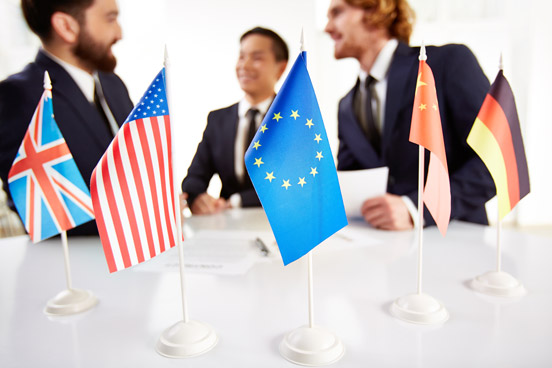
United States | It has traditionally been seen as a protector of freedom worldwide and has often denounced abuses in competing countries. But the US has repeatedly sided with authoritarian allies when it strategically needed to, which has muddled its commitment to these values.
European Union | The EU is one of the loudest voices internationally for human rights, often adding rights conditions to trade agreements and rewarding countries that commit themselves to reforms. Yet, it often has internal divisions and populist pressures that can dilute its common voice.
China | It offers an alternative model: one that prioritizes economic development, stability, and sovereignty. It rejects Western definitions of rights, especially political freedoms, and advances economic partnerships without calling for reforms. This is a competing vision in global governance.
India | The largest democracy in the world, India rhetorically supports human rights, while having to balance its position in a complex regional environment. Ties with neighbors, energy needs, and security priorities often temper the strength with which it speaks out on rights issues.
The tools nations use to promote human rights
There are several diplomatic, economic, and legal tools that countries depend on to encourage better human rights conditions abroad:
1. Diplomatic dialogue | Raising concern through official meetings or international forums is one of the normal methods. It favors persuasion over punishment.
2. Economic measures | Sanctions, travel bans, the freezing of assets, and conditional trade deals have also been used to pressure countries into improving rights. Yet sanctions sometimes hurt ordinary citizens more than political elites.
3. Development aid | These nations often provide financial or technical assistance to improve the state of judicial systems, governance, women's rights, or education.
Humanitarian intervention
Where atrocities such as genocide occur, intervention by the international community may be justified under the doctrine of R2P to include military action. Such interventions, even while intended to save lives, inevitably raise many controversies over motives and consequences.
International law and bodies | The UN, the International Criminal Court, and regional human rights courts set frameworks for monitoring abuses and holding perpetrators accountable.
Beyond governments: The influence of civil society | Human rights diplomacy today is not driven by states alone; it strongly involves NGOs, media, social activists, and global youth movements. Organizations such as Amnesty International, Human Rights Watch, and a multitude of local groups expose violations and rally international pressure. Social media magnifies these voices, making it harder for states to hide abuses. This multi-actor system ensures that human rights remain a central part of global political conversations.
New challenges for human rights in foreign policy
As the world evolves, new human rights issues demand fresh diplomatic approaches.
Digital human rights | Mass surveillance technologies, internet shutdowns, and online censorship have started to become major concerns that need to be prioritized along with the serious issues of traditional rights, such as freedom of speech.
Climate and environmental rights | Climate change has become a human rights issue, as rising seas, extreme weather, and food insecurity are affecting vulnerable populations disproportionately. Environmental justice is inextricably bound to foreign policy.
Migration and refugees | Wars, economic crises, and climate pressures are pushing displacement to historic levels. Countries must make tough choices in balancing national security with humanitarian responsibility. A Multipolar World. With the dispersion of power into multiple global centers, China, India, the EU, among others, the global consensus on standards of human rights becomes increasingly muddled. Diplomacy in the decades ahead will be conducted on this fractured landscape.
Conclusion
Toward a more ethical foreign policy? | The relation between foreign policy and human rights is essentially characterized by both advances and contradictions. Even while nations are increasingly recognizing the importance of human rights, strategic interests often limit consistent action. Yet, the global trajectory remains hopeful: civil society pressure, international cooperation, and rising public awareness push countries toward greater accountability. Ultimately, nations must learn that human rights are not an obstacle to foreign policy; they are integral to it. A world with protections for rights is more likely to be stable, prosperous, and peaceful. Balancing power and principle will never be easy, but it's fundamental to building.
(Akshita Gupta is a student of Media and Public Affairs at Christ (Deemed to be University), Delhi-NCR)