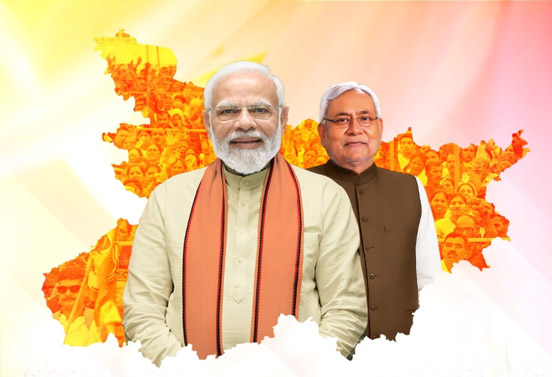
Bihar has reaffirmed a foundational truth of Indian politics: voters reward credibility, not chaos.
By K S Tomar
Bihar’s sweeping mandate in favor of the NDA is not just an electoral victory but a reaffirmation of two deeply entrenched political truths: Narendra Modi’s unmatched national credibility and Nitish Kumar’s enduring administrative reliability. The 2025 verdict marks a rare moment in Indian politics when a twenty-year-old anti-incumbency cycle collapsed under the weight of trust, welfare delivery, and the perception that stability matters more than caste arithmetic. Bihar has repeatedly been a laboratory of shifting political currents, but this time the undercurrent was simple—people voted for continued governance rather than experimental leadership.
Modi–Nitish chemistry and women-centric governance
The NDA’s victory is the product of a layered political chemistry where Modi’s national popularity merged with Nitish’s local image of order, predictability, and women-centric governance. The campaign’s pivot towards women—particularly through proposed monthly cash transfers—added a decisive emotional dimension, reviving Nitish’s “Sushasan Babu” aura that had dimmed over the last decade. Even critics concede that the women’s vote has become the new backbone of Bihar politics, and Nitish once again proved his mastery over this constituency.
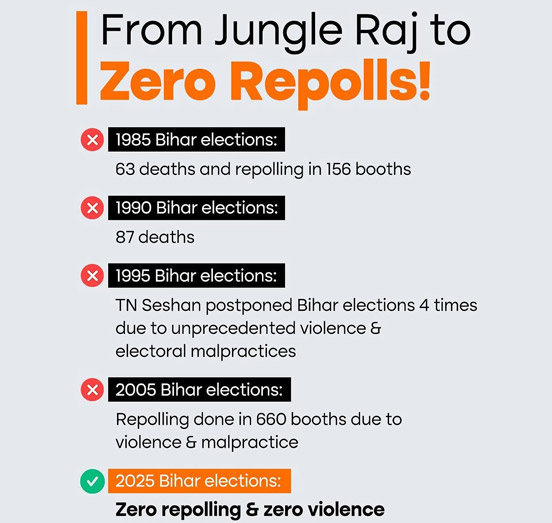
(Infographics courtesy: Bharatiya Janata Party)
Ten clear reasons behind NDA’s victory
This election demands an honest understanding of why the NDA won, and the reasons unfold in clear order. First, Modi’s personal credibility overshadowed every caste or class barrier. In a state accustomed to political volatility, his promise of stability, national pride, and welfare continuity appealed across demographics.
Second, the BJP’s organization—arguably the strongest in the state’s electoral history—converted narrative into numbers with precision. From panna-pramukh mobilization to RSS booth coverage, the party delivered a turnout advantage in nearly every competitive seat.
Third, Nitish Kumar’s governance image regained traction among women, EBCs, Mahadalits, and first-time voters who preferred continuity over uncertainty.
Fourth, welfare architecture—free rations, rural housing, electricity saturation, Ujjwala, and now targeted cash support—built a loyal base that found little incentive to shift.
Fifth, the disjointed RJD–Congress campaign suffered from a lack of coherence, leadership fragmentation, and trust deficit, particularly on law-and-order issues.
Sixth, the fear of returning to “Jungle Raj” continued to linger, subtly steering undecided voters toward NDA without the coalition even needing to raise the pitch aggressively.
Seventh, caste politics did not disappear but was overshadowed by the sentiment that predictable governance is superior to identity-driven uncertainty.
Eighth, booth-level rationalization and voter-list corrections—while disputed by opponents—worked in NDA’s favor across marginal constituencies.
Ninth, Congress’s structural decline became even more pronounced, reducing it to a peripheral force.
Tenth, young voters, sceptical of Tejashwi’s job guarantees, opted for the stability of Modi’s national leadership.
The Modi–Nitish symmetry of trust
What makes this mandate striking is the convergence of Modi’s towering national appeal and Nitish’s local administrative legacy. The BJP played the long game—positioning Modi as the guarantor of welfare continuity while presenting Nitish as the custodian of Bihar’s law-and-order and development architecture. It was a narrative engineered for trust: Modi projects aspiration and national security; Nitish projects stability and household-level welfare. Together, they produced a political symmetry unmatched by any opposition alliance.
BJP’s unmatched organizational machinery
The BJP’s organizational edge deserves deeper recognition. No party in Bihar matched its ability to penetrate booth clusters, deploy micro-cadres, track voter migration patterns, or revive local infrastructure at will. This was not merely a campaign—it was an electoral operation. The RSS contribution was especially visible in rural EBC belts, where quiet mobilization neutralized anti-incumbency that could have damaged Nitish’s segments. This synergy explains why Modi’s rallies electrified the state while BJP’s cadres ensured that electricity translated into votes.
Nitish Kumar’s political resurrection
Nitish Kumar’s political resurrection in this election is equally consequential. Despite twenty years in power, his credibility among women and marginalized communities remains intact. The proposed cash transfers—₹2,000 per month to adult women—proved catalytic in swinging undecided households. Bihar’s women, who had already benefited from cycles, liquor restrictions, reservations, and upliftment schemes, saw this as protective cushioning in unstable economic times. Nitish’s governance brand—despite recent political flip-flops—still carries an emotional weight in rural Bihar that the RJD could not compete with.
Why the Opposition failed to inspire confidence
The opposition’s campaign faltered for predictable reasons. Tejashwi Yadav’s employment promise, once an effective magnet, lost credibility due to the absence of fiscal realism. His messaging could not overcome deep-seated concerns about the past era of lawlessness, which resurfaced every time the NDA warned, even subtly, about the consequences of regression. The youth, once drawn to RJD’s employment-centric message, fractured into multiple blocs as doubts increased about feasibility. The Congress, meanwhile, continued its decline with weak mobilization, lack of credibility, and no capacity to influence caste realignments. Rahul Gandhi’s “vote-chori” narrative failed to resonate because it offered grievance without governance.
Caste politics no longer the decisive factor
Caste politics, though still influential, no longer dictates outcomes in Bihar. The Muslim-Yadav consolidation could not withstand the NDA’s penetration among Pasmanda Muslims, Mahadalits, non-Yadav OBCs, and—most critically—women voters who transcend caste calculations. The myth of MY invincibility stands punctured for the second consecutive election. This is now a structural shift, not an aberration.
Governance challenges before the new government
However, the incoming government faces significant challenges. Bihar’s fiscal health is fragile, and the burden of expanded cash transfers could strain an already stretched budget. With a debt-to-GSDP ratio touching nearly 39 per cent and revenue dependency on central transfers consistently above 60 per cent, sustaining welfare expansion will require careful balancing. The central government’s support will be crucial, but even that has limits when multiple states are replicating similar schemes. There is a real danger that economic populism, if not matched with capital investment, could hinder job creation—ironically reinforcing the employment concerns raised by the opposition.
Long-term risks of welfare overreach
Cash transfers to women, while effective politically, will test administrative delivery. A scheme expected to cover over one crore adult women could cost upward of ₹25,000 crore annually. This raises questions about where Bihar will cut expenditure—education. Infrastructure? Local development? The Modi–Nitish government must now convert political goodwill into institutional reforms that improve long-term financial sustainability. If welfare promises become fiscally unsustainable, the very economic stability that voters trusted the NDA to protect may come under pressure.
National implications of Bihar’s mandate
The verdict nevertheless has wide national implications. Bengal, Tamil Nadu, Haryana, and Jharkhand will closely study this template—where organizational strength, welfare delivery, and the Modi factor overshadowed caste arithmetic and local anxieties. Bihar has reaffirmed a foundational truth of Indian politics: voters reward credibility, not chaos.
-----------------------------------------------

(K S Tomar is a senior political analyst and strategic affairs columnist based in Shimla)