As Pakistan positions itself as a mediator between Iran and America, New Delhi's restraint is not weakness; it is strategic clarity.
By Vipul Tamhane
Although fighting continues in the Gulf region, diplomatic efforts have started to replace the sounds of missile warfare. The current situation includes active ceasefire negotiations, competing mediators for their mediation capabilities, and Islamabad offering its spaces for important diplomatic discussions between Washington and Tehran.
The Indian public, mostly the opposition, has raised its cursory demand asking why our country lacks representation in the negotiations. The short answer is: because the table was not built for us. The emerging talks will show their main aspects to observers throughout each passing hour.
Reports indicate that senior American officials will meet their Iranian counterparts in Islamabad, though the exact identities of the specific officials remain unknown. Prime Minister Shehbaz Sharif has already signaled Pakistan's eagerness to host, practically rolling out the red carpet before any agreement has even been inked.
Pakistan's heart rules over its logic for this role without testing its merit. The country maintains a 909-kilometre land border with Iran, and this border serves as a route for extensive smuggling operations that the Islamic Revolutionary Guards control, though the two locked horns in a fire exchange in early 2024.
Pakistan’s only selling point is its Islamic connection, as it is the second biggest Muslim nation, which has the highest Shia population worldwide. Pakistan’s assertion that the United States may find Islamabad acceptable as its Major non-NATO ally status allows it to sustain military ties with Washington, where the US sees them as a watchdog ally in South Asia, despite its grey zone strategies and a history of disputes.
Pakistan claims that its Army Chief Gen Asim Munir has developed a close personal relationship with President Donald Trump, making them eligible for this mediation. Good for Pakistan. But none of this explains why India should feel left out.
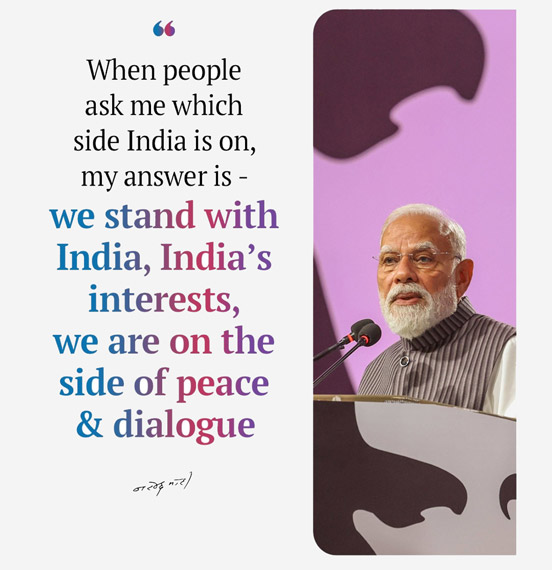
The Indian government maintains a neutral position. New Delhi has established strategic partnerships in the Middle East that include seven countries: Saudi Arabia, the UAE, Bahrain, Qatar, Kuwait, Egypt, and Israel. India-Iran ties blend civilizational depth with strategic pragmatism: energy, connectivity, and regional access converge, yet with due caution due to US sanctions, Israel alignment, and divergent geopolitical priorities.
India's relationship with Israel has developed into a deep partnership, which the country built through its relationships with four prime ministers who created stronger defense links, technological exchanges, and shared strategic goals. The requirement for India to participate in mediation talks, which exclude Israel from discussions about Iran means India must violate its fundamental principles, which diplomats cannot resolve through their diplomatic expressions.
The discussion requires evaluation of India's expected contributions and the required concessions that India must make. Pakistan, overestimating its diplomatic rigor and global image, positions itself as a client state that permits flexible operations because it will accept problematic contradictions in return for economic benefit, diplomatic recognition, and the ongoing prospect of isolating India from its regional partners.
India logically refrains from participating in that particular game. Its ambitions are larger, its constituencies more complex, and its self-image too proud to function as a rentier power at someone else's negotiating table.
The contradictions swirling around Pakistan's mediation bid, meanwhile, are almost entertaining. This flares a slew of false narratives on the lines of the Indian government, demonstrating active support for this conflict while its leaders attempt to maintain a neutral position, which constitutes their first act of hypocrisy, which is far from the truth.
For any nation-state, there’s no place for FOMO on the geo-political game board. There is no shame in recognizing that not every crisis requires your signature on the peace accord. Sometimes the most powerful thing a rising nation can do is choose its moments wisely.
Pakistan's misplaced clarity about what it wants, however delusional some may be, is ironically one of its strengths in this crisis. It knows it wants its status elevated in the Islamic world. It wants Saudi oil debt rolled over. It wants American military ties restored. Islamabad seeks to use the present time as a means to decrease New Delhi's status within the South Asian geopolitical circuit. India presents itself as a complex international power that operates as a democratic system and maintains diplomatic relations with every nation throughout the world.
The complex system functions as a strength for most situations. The entire situation creates complexities for mediation because it requires an appropriate process through which to solve matters.
Parties involved in the negotiation process must be cognisant of their limitations and understand the vital role that their presence will play in determining whether they will succeed or fail to achieve crucial objectives to bring about global equilibrium that is disturbed due to this conflict.
The Middle East requires an Indian presence because India possesses economic power, a significant diaspora population, and established energy ties and military relationships; in short, it has actual skin in the game. India needs to protect its geopolitical interests through established diplomatic, economic, and security channels instead of using temporary mediation to resolve its fragmented conflict across various regional areas involving divergent regional actors, rather than engaging in ad-hoc mediation in a fragmented conflict that needs a tailored solution with multi-party involvement.
Pakistan should have its time, but right now on the bench. The nation needs to analyze its self-rigor to endure the conflicting demands that may arise from its effort to meet the needs of all parties involved. India will maintain its distance from the situation because it knows which battles should be fought and which should be watched from a distance, until its entry is sought as an imperative.
(Vipul Tamhane is a counter-terrorism expert and governance consultant)
The views expressed are not necessarily those of The South Asian Times