How New Delhi and Washington are navigating the complex reality of Taliban-ruled Afghanistan.
By Vipul Tamhane
After four years from when the Taliban once again took control of Kabul in August 2021, the geopolitical landscape of South Asia has been changed irreversibly. These changes can be characterized by the absence of a partnership between the two powers in Afghanistan and, instead, their two major democracies dealing with the consequences of the reality of a Taliban-led government in the country. The move by India to convert its technical mission in Kabul into a full embassy is the most significant regional development of this changing scenario, pointing to issues like regional stability, counter-terrorism cooperation, and great power competition in Central Asia.
India's calculated gambit
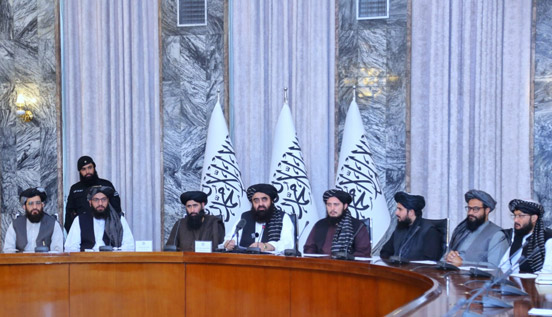
In a strategic pivot, Delhi's change of heart from vehemently opposing the Taliban to engaging them cautiously through the diplomatic channel is probably one of the most unexpected shifts of Indian foreign policy during the last few years. The visit to India by Taliban Acting Foreign Minister Amir Khan Muttaqi in October 2025, which is the topmost contact between the two sides, and the embassy upgrade are clear signs of India decisively moving on from its initial "wait and watch" mode.
Such a transition comes from a strict strategic point of view rather than from an ideological standpoint. The fight against terror is still the main issue of India. New Delhi is extremely vigilant against such scenarios as that of Lashkar-e-Taiba or Jaish-e-Mohammed creating safe havens in Afghanistan from where they can launch attacks in India. It is through a direct presence in Kabul that India can communicate with whom it wants, in this case, the Taliban, secure their assurances, and keep a check on emerging threats.
The existence of regional rivalries makes these security imperatives more acute. A Taliban government not only friendly with, but also dependent on, Islamabad for survival would pose a major threat to Indian influence in the region. On the other hand, if China would be the main external patron of the Taliban, she would be extending her reach dangerously close to the border that she shares with India.
The declining Taliban-Pakistan border security cooperation has proved to be a surprising chance for India's comeback in the area; on the other hand, India has been steadily developing its relations with Afghanistan through economic means.
With a total investment of more than $3 billion, consisting of the construction of dams, roads, and even the parliament building, India has been the only major donor to Afghan infrastructure. Thus, it is quite obvious that New Delhi is not ready to give up its power. Projects such as Iran's Chabahar port and air cargo corridors are providing Pakistan-independent routes to Central Asia, and thus economic connectivity is becoming strategically indispensable.
India's method is a good example of "making friends without giving the green light". The country offers the new administration cooperation opportunities without actually recognizing the 'Islamic Emirate' as it reopens its embassy and receives a Taliban-appointed envoy in New Delhi. At the same time, India has stepped up its humanitarian aid, ambulances, medical supplies, food, and earthquake relief, positioning itself as a friend to the common people of Afghanistan and at the same time, differentiating its work from the Taliban's failures of governance.
America's strategic distance
While India plays a direct hand, the United States takes a strategic step back, though it is not without concern for the plight of the people. One of the defining features of Washington's policy is the list of things it refuses to do, i.e. recognition of the Taliban government, direct aid to the government, or unfreezing of more than seven billion dollars of the Afghan central bank reserves that are held in US financial institutions.
This is the financial leverage that is Washington's most powerful weapon, i.e, the one that keeps the regime on the brink of economic collapse. Nonetheless, the same lever has intensified the humanitarian crisis in Afghanistan, thereby creating a moral dilemma that the US resolves by supplying aid to international organizations and NGOs rather than the Taliban government.
US involvement is restricted for the most part to counter-terrorism operations, that is, to making sure that ISIS-K and Al-Qaeda do not recover the power of staging attacks outside their territories. The realistic negotiations in Doha or via intermediaries concern humanitarian access, safe passage for Americans and Afghan nationals at risk, and the sharing of intelligence related to terrorism. The exchanges take place amidst mutual suspicion.
Washington still voices its disapproval of the Taliban's human rights violations, especially the rights of women and democratic governance. On the other hand, these demands have been sacrificed for security reasons. The US has made the transition from building democracy to managing the crisis, thereby conceding limited influence over the internal affairs of Afghanistan.
Convergence and contradiction
By employing different tactics, the US and India still have similar strategic objectives. Neither of them is keen on having Afghanistan turn into a terrorists’ safe haven. Both are rushing to block the state’s fall and the subsequent disaster of the humanitarian kind. Both, to be sure, have been very critical of the Taliban, but at the same time have made big contributions to the betterment of the Afghan people. Joint bilateral intelligence operations, which are improved by platforms like the Quadrilateral Security Dialogue, are facilitating the fight against terror that both countries are engaged in.
However, there are still significant differences. For instance, the full re-establishment of India's embassy indicates a more straightforward engagement than that of Washington, which is taking a cautious step back. While India's normalization is used by the US to consolidate its position in Afghanistan and to give it an edge over China, there is also some concern that it might have the opposite effect i.e. help legitimize the regime and reduce the collective pressure.
The tools that are at their disposal are basically different. The US utilizes financial sanctions and asset freezes, while India opts for development projects and presence through diplomacy. These rather different tactics need to be very well coordinated in order to be effective.
The path forward
The trilateral relationship faces a future of "managed instability" that will last for a long time. India will probably reduce its formal recognition of the Taliban while increasing its practical cooperation with Kabul. The Taliban will still make attempts to get political recognition and release of sanctions while continuing to hold on to their strict ruling ideology. The US will pursue its pressure-based policies and will treat significant changes, like lifting the asset freeze, conditioned on the Taliban's behavior, which is likely to be not changed in the near future. The three players do not form a triangle of partnership, but rather a complicated geometry of competing and partly overlapping interests.
The Indian embassy in Kabul may be a source of intelligence and a possible mediator of US concerns at the same time. Still, the fundamental situation is two democracies, each keeping in check the challenge posed by an actor that they do not fully trust and cannot ignore at the same time. It is not a question of whether this arrangement is perfect, it is obviously not, but rather of whether it is sustainable. For millions of ordinary Afghans who are trapped between the power play of giants and the inflexibility of ideology, the answer will decide whether their country goes through the process of stabilization or gets further isolated and drowned in despair.
-----------------------------------------------------
.jpg)
(Vipul Tamhane is a counter-terrorism expert and governance consultant)
The views expressed are not necessarily those of The South Asian Times