By Lalit Gargg
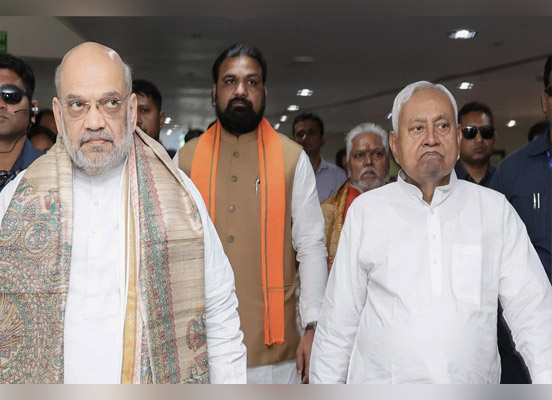
A significant and historic turning point in the politics of Bihar emerged when the long-serving Chief Minister Nitish Kumar decided to step down from his post and move to the Rajya Sabha, for which he has already filed his nomination. The presence of India’s Home Minister Amit Shah in Patna during the nomination further added importance to this political development. Having remained at the center of Bihar’s politics for nearly two decades, Nitish Kumar’s decision is not merely a personal political move; it also signals a major transformation in the structure and direction of power in the state.
This development comes at a time when Bihar’s politics is already passing through a complex phase of alliances, political equations, and shifting balances of power. With this decision, it has become evident that Bihar’s politics is entering a new phase. While this transition indicates new possibilities, it also raises several questions. Is this a reflection of respect for the public mandate, or a deviation from it? Is it a step toward a new direction for Bihar, or simply another chapter in political strategy? For a long time, Nitish Kumar has been widely known as the “architect of good governance.” During his tenure, he provided Bihar with relatively stable political leadership and made significant efforts to streamline governance at multiple levels. His work in areas such as road infrastructure, education, women’s empowerment, strengthening of panchayati raj institutions, and administrative reforms has often been highlighted. Under his leadership, Bihar attempted to move away from its earlier image of lawlessness and crime toward one associated with development and stability.
Therefore, his decision to step down as Chief Minister and move to the Rajya Sabha is not merely a change of position; it can also be viewed as a redefinition of his political role. Some analysts believe this step has been taken to expand his role in national politics, while others see it as a strategy to provide space for a new generation of leadership in Bihar. Another perspective suggests that since many of the state’s developmental possibilities have not fully materialized, the Bharatiya Janata Party may be seeking to bring its own Chief Minister to accelerate Bihar’s developmental trajectory. Following this decision, opposition parties have reacted sharply. They argue that the electorate voted in favor of a government under Nitish Kumar’s leadership in the Assembly elections, and stepping down midway through the five-year mandate does not do justice to the public’s trust. Opposition leaders claim that the decision is driven by political calculations and fails to adequately reflect public sentiment. Some have even described it as a “betrayal of the mandate” and an example of “compromise politics.” According to them, if the leadership had to change, the more democratic course would have been to return to the people for a fresh mandate. Thus, the debate has expanded beyond a simple change of power to include questions of democratic ethics.
On the other hand, this entire development is also being interpreted as part of the BJP’s long-term political strategy. Political observers suggest that the party is moving toward strengthening its independent political identity in Bihar. If a BJP Chief Minister takes office in the state, it could mark a new chapter in Bihar’s political history. The party has consistently claimed that it aims to implement development, good governance, and crime-free administration in a more effective manner. Party leaders argue that accelerating development, increasing investment, creating employment opportunities, and bringing greater transparency into administration require a new leadership structure. In a democratic system, change in power is both a natural and necessary process. When such transitions occur through democratic means and political consensus, they often strengthen the system itself. Over the past two decades, Bihar has experienced a relatively stable political environment, much of the credit for which has been attributed to Nitish Kumar’s leadership. Now that he is moving away from active administrative responsibilities toward parliamentary politics, it will be important to see how the new leadership maintains that stability.
A positive aspect of any leadership transition is that it often introduces fresh ideas, new energy, and revised priorities in governance. Alongside this development, discussions about the emergence of a new generation of political leadership in Bihar have also intensified. Many political observers believe that this change will not remain limited to a single individual or party but may influence the broader character of the state’s politics in the coming years. If the new leadership structure works effectively on key issues such as development, employment, education, and social harmony, this transition could prove beneficial for the state. Should the new government succeed in meeting these expectations, the decision could yield positive outcomes for Bihar.
The proposed shift in power in Bihar is also being viewed by the BJP as a major political and administrative opportunity. The party believes that the state has long lagged behind on issues such as development, good governance, corruption-free administration, and security, and that these challenges can be addressed through decisive leadership and strong administrative will. In this context, many observers refer to the example of Yogi Adityanath in Uttar Pradesh, where the government’s tough action against crime and mafia networks, along with administrative discipline and expanded development initiatives, has attempted to bring notable changes to both the state’s image and public life. Similarly, there are expectations that if the BJP receives the opportunity to provide clear leadership in Bihar, it may work toward establishing new benchmarks in crime control, corruption-free governance, administrative transparency, and development.
Even today, a widely held perception persists that Bihar has not progressed at the desired pace in sectors such as education, healthcare, employment, and infrastructure, and that crime and insecurity have often affected everyday life. If the new government prioritizes development, law and order, and social security with firm policies, this change in power could become a catalyst for a new direction and transformation in the state. For this reason, some political analysts view the situation as a potential opportunity for Bihar—an opportunity through which a new stream of good governance, development, and secure public life may emerge, leading the state toward a new chapter of progress. The movement of Nitish Kumar toward the Rajya Sabha is therefore not merely a political event but the beginning of a significant transformation in Bihar’s political landscape. While the opposition continues to question the issue of the public mandate, the ruling side presents it as an opportunity for new leadership and a fresh direction.
History has often shown that political transitions can open the doors to new possibilities of development. If this shift in power strengthens governance, crime control, corruption-free administration, economic progress, and social harmony in Bihar, it may prove to be an important turning point for the state. Only time will determine what chapter this decision ultimately writes in Bihar’s political history. What is certain, however, is that this change will inevitably lead the state’s politics toward new debates, new challenges, and new possibilities.
--------------------------------------------------
(The author is New Delhi based writer, journalist and columnist. The views expressed are not necessarily of The South Asian Times. )