By Basab Dasgupta
If one lives in Southern California, one cannot avoid the influences of Iranian culture. A rather large number of Iranians fled their country when the Shah regime was toppled in 1979, and many of them found the greater Los Angeles area to be a perfect sanctuary.
One benefit of this influence was my exposure to Iranian food, which I love. The food is tasty, healthy, and filling. I often shop at an Iranian grocery store in the city of Irvine.
Several years ago, I was checking out a couple of food items at that store. There was an older Iranian couple in front of me at the checkout lane with a cart full of groceries. I pleaded with them to let me go ahead of them, and they agreed. I thanked them and joked, “I am from India, and we are neighbors. You are helping a neighbor”. The wife asked in a complaining voice, “Then why are Indian women not supporting the women’s movement in Iran?” I was surprised, “Oh really? I did not know”.
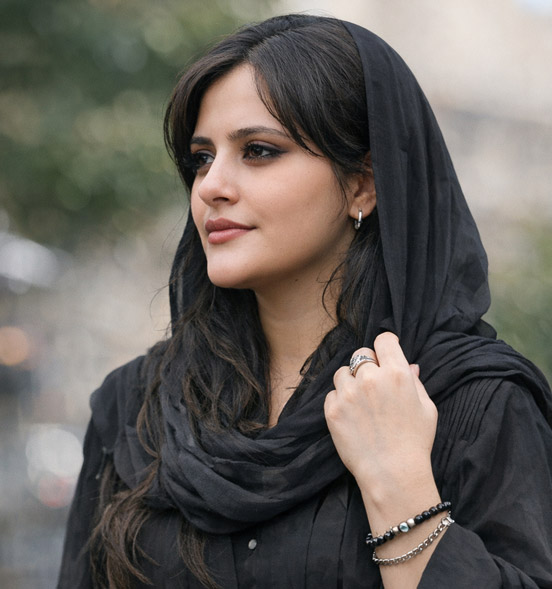
All I knew was that a young woman, Mahsa Amini, died in September of 2022 while in police custody; she was arrested by the “morality police” for not wearing her hijab tightly enough, as dictated by the strict Islamic rule. This triggered country-wide protests and demonstrations. I did not know other details about this movement and the reactions in India. I hit Google when I came home.
According to the internet, there was support from Indian women, but with one interesting twist. While women in Muslim countries in the Middle East were protesting against forced wearing of hijab, Muslim women in India protested hijab bans, such as the ban in the state of Karnataka.
A month or so later, I visited the home of Mr Mirgaffari, an Iranian ex-colleague. During the visit, I mentioned that painting has become my pastime during retirement and shared with him photos of some of my paintings from my cell phone.
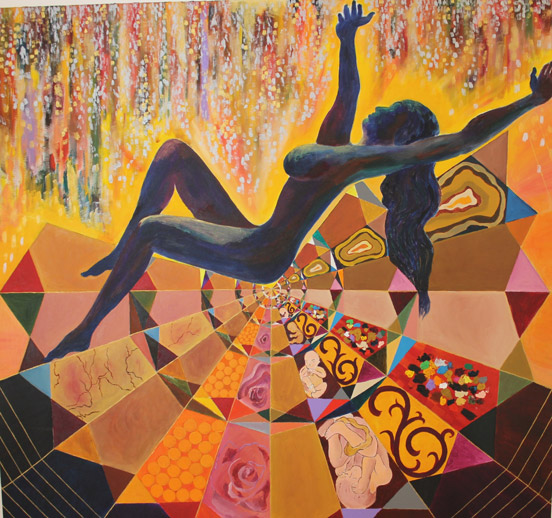
(Artwork courtesy of the author)
One of the paintings, titled “Woman” (shown here) shows a woman with her hair rolling down without any headgear, extending her hands towards the sky, as if she is seeking freedom and blessings from God. She is lying on a geometric structure that lies tangled in a spider’s web, trapping her. I intended to convey the message that a woman is the originator and center of everything in life, including babies, wealth, food, aging, complexity, beauty, color, etc. The idea of the painting just came to me, and I certainly did not have any political agenda. Mr Mirgaffari immediately commented that it looked like an image with a political message similar to the message of the Iranian Women’s Rights movement: “Women, Life, Freedom”.
Now I was intrigued and searched the internet to read all the information available about this movement. The first shock for me was how Amini died. According to eyewitnesses in custody, she was severely beaten by the police. The authorities reported that she had a heart attack, entered into a coma, and subsequently passed away in a hospital. The eyewitnesses in custody said that her injuries were the result of a severe beating, and she died from a brain injury.
Secondly, hundreds of protesters were killed by the regime over several years. The death count was, at least, 530 (as of February 21, 2023) according to the US-based Human Rights Activists’ News Agency (HRANA), including 71 children. The celebrities and athletes had stepped forward in their support of the movement. Death sentences and arrest warrants were issued against them, including a soccer player in the FIFA World Cup and an Oscar-winning actress.
I remember asking Mr Mirgaffari, “Who is the leader of this movement?” and was surprised by his answer. He said, “There is no leader, and that is a good thing. If there were a leader, he or she would have been immediately executed”.
I understood some other aspects of the movement. Women in Iran are not protesting against Islam. They want the Koran and other religious scriptures to be interpreted in a more gender-neutral way. Moreover, it is not really about religion but an unequal treatment of women whereby women are treated as second-class citizens. This is not a new issue for Iranian women. Their frustration has been brewing for decades, and the present movement was just an outlet for all that pent-up anger and outrage.
Thirdly, it is not just a women's movement in Iran; women in the entire Middle East were watching the developments because the treatment of women in those countries is not any better. For example, the Taliban regime in neighboring Afghanistan had announced that women would not be allowed higher education at the university level and ordered the universities to stop giving application forms for admission into universities.
I felt ashamed that there was no wider or more in-depth coverage of this movement in the US news media, considering that it might be the most significant women’s movement in this century. This is in sharp contrast to what happened during the “MeToo” movement in the US a few years ago. I was surprised to read about widespread supporting activities across the globe, especially from European countries like France. I felt that Narendra Modi had an opportunity to show his commitment to the secularism of India by being more vocal and active in support.
I am neither a political activist nor a feminist, but I decided to make my contribution to the cause of this movement. I donated my painting to the organizers of this movement. If they wanted, it could be replicated with the caption “Women, Life, Freedom” on posters, T-shirts, mugs, hats, and virtually anything.
I did not follow how this movement proceeded over the last few years. I was aware that it was still ongoing and protesters were being tortured and killed by the brutal Khomeini regime. I was thrilled to see the recent uprising against the ruling party by millions of Iranians who took to the streets despite the deaths of tens of thousands of innocent people. My greatest joy was to watch the young Iranian women taking off their hijabs and either throwing away or burning them on the streets openly defying the ruling of the Islamic rulers.
Finally, the judgment day arrived last week. Ayatollah Khomeini was killed on Feb 28th by the Israeli Defense Force with US support, along with many of his associates. There have been cheerful celebrations by the Iranian diaspora all over the world. The military conflict is not over, but the destiny is clear. There will soon be an end to the current brutal regime, and Iran will be a free, peaceful country once again.
It is generally believed that the present widespread revolt against the Khomeini regime was a gradual culmination of grievances of all Iranians and not just women, but all originating from the death of an innocent young girl, Mahsa. I want to shout out “Masha Allah" (meaning “what Allah has willed”) to signify that Mahsa’s sacrifice of her life was a sacred act according to Allah’s wish to free all her people.
---------------------------------
(California-based Basab Dasgupta has a doctorate in Physics from the University of Wisconsin and has worked with Sony as Vice President of an operating division.)
The views expressed are personal and not necessarily those of The South Asian Times