By K S Tomar
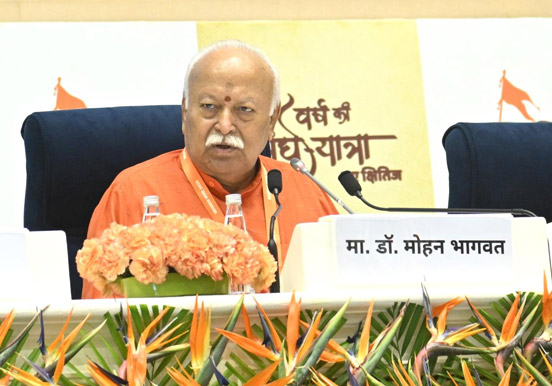
As Mohan Bhagwat recently turned 75, his personal milestone coincides with the centenary of the Rashtriya Swayamsevak Sangh (RSS), the ideological mother ship of the Hindu nationalist movement. The convergence is more than symbolic. It invites a reckoning of Bhagwat’s stewardship of the Sangh, his achievements, his limitations, and the challenges he must navigate in the years ahead. For the man who became the sixth Sarsanghchalak in 2009, Bhagwat has overseen one of the most consequential phases of the Sangh’s history—when its political affiliate, the Bharatiya Janata Party (BJP), achieved dominance in New Delhi and realised long-cherished goals of the Hindu Right.
Why Bhagwat still banks on Modi?
The paradox is striking. Having seen the BJP humbled, why does Bhagwat continue to repose faith in Modi? The answer lies in a cold ideological arithmetic.
No prime minister has delivered more to the RSS agenda than Modi. With Ayodhya and Article 370 checked off, and a Uniform Civil Code hovering on the horizon, the Sangh knows it has a dependable executor of its vision. Replacing him at this juncture would be both destabilizing and strategically unwise. Modi still commands unmatched mass appeal, even in reduced circumstances. For Bhagwat, therefore, the wiser course is correction rather than rupture: keeping Modi at the helm while demanding humility, course adjustment, and renewed grassroots engagement.
Achievements that altered India’s political landscape
Bhagwat’s tenure will be remembered for the consolidation of RSS influence across domains of politics, culture, and society. The Sangh has never before enjoyed such a convergence of power between ideology and government.
-- Ram Temple at Ayodhya: For decades, the RSS framed Ayodhya as a test of Hindu civilizational pride. Under Prime Minister Narendra Modi, with Bhagwat’s blessing, the temple became a reality. The grand inauguration in January 2024 was both a culmination of a century-old campaign and a symbolic triumph for the Sangh.
-- Abrogation of Article 370: Another long-standing demand of the RSS—full constitutional integration of Jammu & Kashmir—was delivered in 2019. The move transformed India’s constitutional architecture, marking a point of no return.
-- Cultural assertion: Beyond specific legal victories, Bhagwat has overseen a sweeping assertion of Hindu cultural identity. The vocabulary of “civilizational nationalism,” festivals celebrated with new fervor, and changes in textbooks and discourse owe much to the Sangh’s ideological pressure.
-- Organizational expansion: Shakhas, service projects, and affiliate bodies have grown steadily. Bhagwat’s RSS today is a sprawling umbrella network influencing education, media, labour unions, and farmers’ outfits.
These achievements, in the Sangh’s self-image, represent the realisation of dreams carried since its founding in 1925. Bhagwat presided over this decisive turn from aspiration to achievement.
But the deficiencies are equally stark.
-- Ambiguity on minorities: His occasional conciliatory statements have not altered the perception that RSS ideology marginalizes Muslims and Christians.
-- Failure to address economic discontent: While ideological goals advanced, unemployment, inflation, and rural distress were sidelined, costing the BJP in 2024.
-- Overconfidence and complacency: The RSS misjudged the importance of continuous mobilisation, assuming Modi’s aura would suffice.
-- Internal dissent: Bhagwat faces pressure from more hard-line voices within the Sangh Parivar, including seers who oppose his moderation on temple disputes.
-- Image problem abroad: Internationally, RSS continues to be criticized as majoritarian and intolerant, a burden on India’s democratic credentials.
The setback of 2024: When the Sangh held back
Yet the picture is not unblemished. The 2024 Lok Sabha elections jolted the BJP out of its dream run. From a commanding 303 seats in 2019, the party slipped to 240, losing its majority and surviving only through coalition partners.
Much of the post-election analysis pointed to the RSS’s studied aloofness during the campaign. BJP leaders had increasingly projected themselves as self-sufficient, almost distancing from the Sangh. Confident of Modi’s charisma, the party underestimated the importance of ground mobilization by swayamsevaks. The result was an electoral shock that underscored the BJP’s dependency on its ideological fountainhead, despite its claims of independence.
The Sangh’s own journals carried sharp commentary about the BJP’s arrogance, over-reliance on Modi’s aura, and neglect of grassroots issues. In a sense, Bhagwat signalled that the RSS is no mere appendage. The BJP may hold power, but the Sangh retains the right to discipline its political offspring.
Challenges before RSS chief
As Bhagwat enters his eighth decade and RSS its centenary, the challenges are formidable:
-- Balancing ideology with harmony: The Sangh’s pursuit of Hindu Rashtra must avoid spiralling into communal disharmony. Bhagwat must walk a tightrope between assertion and restraint.
-- Reining in BJP’s arrogance: Without grassroots humility, the BJP risks further decline. Bhagwat must ensure the cadre’s voice is heard in candidate selection and campaigning.
-- Succession planning: At 75, questions about leadership transition are inevitable. Bhagwat must prepare the next generation of pracharaks without triggering factionalism.
-- Addressing youth discontent: Rising unemployment and inequality among India’s youth are tinderboxes. Ideology alone will not keep restive voters in line.
-- Maintaining autonomy: The RSS must avoid being reduced to a political tail of the BJP, yet remain close enough to influence governance.
Strengths of Bhagwat’s leadership
Bhagwat’s admirers point to several qualities that mark his stewardship:
-- Pragmatism: Unlike some of his predecessors, he is less rigid in public messaging, occasionally emphasizing inclusivity and cautioning against daily temple-mosque confrontations.
-- Strategic distance: By asserting the Sangh’s autonomy from the BJP, he preserves RSS’s identity as more than just a political machine.
-- Discipline and expansion: Organizationally, Bhagwat has strengthened the Sangh’s cadre base and intellectual apparatus, ensuring ideological continuity for decades.
The road ahead
For Mohan Bhagwat, continuity is the chosen path. He has publicly indicated no desire to step aside, declaring he will continue as long as the Sangh requires him. The symbolism of guiding the organization through its centenary is too powerful to abandon.
But the coming years will test him like never before. Having achieved much of the ideological agenda, the RSS must confront new questions: what next after Ayodhya and Article 370? Can cultural nationalism provide answers to jobs, inflation, and climate distress? Can Bhagwat’s RSS move from being an ideological guardian to a social healer?
At 75, Bhagwat presides over a paradox: a Sangh more powerful than ever, yet facing cracks in its political edifice. His legacy will be judged not only by the temples and constitutional changes achieved, but by whether he can steer the Sangh and BJP towards humility, inclusivity, and relevance in a rapidly changing India.
----------------------------------------------
(K S Tomar is a senior political analyst and strategic affairs columnist based in Shimla)
The views expressed are not necessarily those of The South Asian Times