By M A Hossain
The Indo-Russian alliance has withstood changes, conflicts, and the rise of new power hubs.
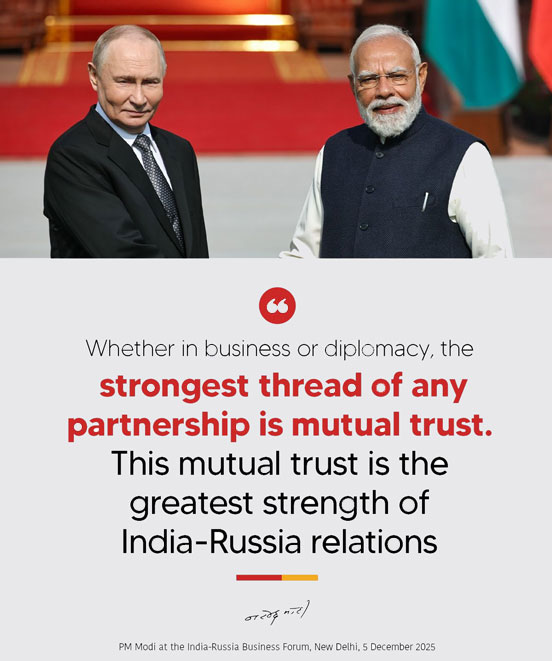
Vladimir Putin’s arrival in New Delhi on December 4 for his formal visit to India lacked the grandeur of a state ceremony. However, the low-key appearance conceals the significance of the occasion. This marks the leader’s first visit to India since the Ukraine conflict reshaped the global geopolitical landscape in 2022. It occurs at a period when both nations are managing sanction frameworks, increased tariffs, supply chain interruptions, and the broader disintegration of the Cold War economic system. The agendas (defense collaboration, space alliances, economic connections) seem familiar. Nonetheless, the strategic intent appears focused: in a reality shaped by persistent Western pressure, Moscow and New Delhi are reinforcing a longstanding partnership, adapting it to contemporary times.
At the summit, Prime Minister Narendra Modi and President Putin reiterated the enduring foundation of Indo-Russia relations: defense cooperation. For years, India has depended on Russian hardware. The novel aspect lies in the magnitude and aspirations of the stage. Russia has suggested the production of the fifth-generation Su-57 stealth fighter at Hindustan Aeronautics Limited, involving a significant transfer of technologies related to the engine, avionics, and stealth materials. Moscow also proposed offers for Lancet strike drones and kits to address India’s issue—delays in obtaining spare parts, for the current Russian systems.
This comes after the Russian Duma’s endorsement of a comprehensive new defense collaboration arrangement. The pact permits drills, humanitarian missions, and importantly, the legal basis for either party to station troops or assets on the other’s land. Combine this with the established "Make in India" initiative, and a clear trend emerges: India aims to upgrade its armed forces without relying solely on any one Western provider. Russia, constrained by sanctions, seeks a foothold in South Asia.
This act of balancing isn’t a development. Since the 1960s, India has maintained ties with Moscow while avoiding estrangement from Washington—at times effectively, at others clumsily. What has shifted is the calculation. The United States is currently India’s trading partner, a vital provider of technology, and a crucial ally in confronting Chinese assertiveness. Washington has also turned into an erratic economic player, imposing tariffs more often. This compels India to keep its connection intact if only to retain flexibility.
The defense-industry aspect represents one part of the narrative. The collaboration between India and Russia in space exploration—frequently neglected beyond policymaking arenas—remains a lasting foundation of their alliance. During the 1980s, India’s inaugural astronaut, Rakesh Sharma, journeyed aboard a Soviet Soyuz spacecraft, an event that continues to hold significance in institutional recollection. Forty years on, Russia still backs India’s 'Gaganyaan' manned project, providing astronaut training and guidance, on life-support and docking technologies.
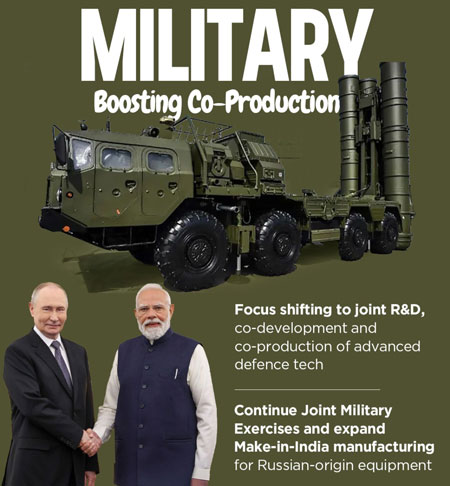
(Infographic courtesy: MyGovIndia)
This year’s summit rekindled that collaboration with an advanced technological focus. The talks emphasized development of rocket engines, including the possibility of domestic manufacturing of the RD-191M series of liquid-fueled engines—some of the strongest globally. Dmitry Bakanov, the leader of Roscosmos, suggested that "good news" is forthcoming regarding engine production, national orbital stations, and fuel innovation. The collective statement confirmed partnership in manned space missions, satellite navigation and exploration of other planets.
For India, these relationships fulfill three roles: speeding up independence; protecting against Western trade limitations; and guaranteeing that its space goals—whether lunar, Martian, or orbital—are not dependent on just one ally. For Russia, they offer prestige, financial income, and a demonstration that it remains a leader in aerospace technology despite the challenges of conflict and sanctions.
Economics, as always, serves as the stabilizer. Each nation faces challenges—Russia due to sanctions; India from US Tariff increases that hinder export expansion. Predictably, financial links dominated the summit discussions. Putin indicated Moscow’s aim to strengthen ties between the two countries, while the joint declaration detailed strategies to align national payment systems, digital currency infrastructures and financial messaging frameworks.
If put into effect, India’s RuPay and Russia’s Mir card could operate together—lowering dependence on middlemen and decreasing currency-exchange charges by up to 30 per cent. Talks have also progressed on connecting Russia’s Faster Payments System with India’s UPI, one of the globe’s effective digital-transaction platforms.
The reasoning is straightforward. Ninety per cent of trade between India and Russia currently avoids the US dollar being settled in rupees or rubles. Dmitry Peskov, the Kremlin spokesperson, stated plainly: Russia is willing to offer all it can in collaboration with India. Within a divided economy, this provides a buffer of stability for both parties.
However, trade exchanges continue to be unbalanced. Russia sends $64 billion in goods to India, whereas India exports merely around $5 billion to Russia—a gap New Delhi aims to address. The Inter-Governmental Commission, responsible for overseeing collaboration in trade, technology, and culture, examined possibilities for broadening exports to include machinery, agricultural products and raw materials. Both parties reiterated a goal: $100 billion in bilateral trade by 2030. Reaching that figure will demand more than commitments. Structural reforms will be required on both fronts in logistics and access to markets.
Beneath diplomacy is the personal rapport between Modi and Putin. Their recent encounter took place in Tianjin last September at the SCO summit. This trip revives the practice of India-Russia summits, a ritual interrupted by the pandemic and the Ukraine war. India has broadened its presence in Russia by establishing consulates in Kazan and Yekaterinburg. Russia, in response, has frequently commended India’s "position, on the Ukraine crisis—a courteous acknowledgment of New Delhi’s decision not to partake in Western denunciations.
India’s strategy has remained steady: uphold independence, steer clear of moral posturing, and advance national interests quietly. This displeases governments, yet it enables India to engage with all parties—including adversaries who have ceased communication amongst themselves.
The wider context is important. India is currently engaged in talks with the United States about lowering tariffs, while Russia is enduring some of the sanctions seen in recent times. American markets continue to be crucial for exporters. Meanwhile, Russian oil is essential for India’s energy stability. Neither partnership can be given up in favor of the other. Navigating this balance is not merely a challenge but a strategic imperative.
For Russia, the summit confirms that it still has at least one significant Asian ally as a reliable partner. For India, the trip guarantees access to cutting-edge defense technologies, securing supply chains, and creating opportunities for fresh economic and scientific partnerships. While the globe may be drifting towards blocs, India and Russia are attempting—carefully, practically—to maintain their relationship adaptable.
Putin’s visit to New Delhi was more than a courtesy; it served as a signal. Despite an era marked by sanctions, trade barriers, and geopolitical instability, certain enduring alliances persist. The Indo-Russian alliance has withstood changes, conflicts and the rise of new power hubs. In the fractured global landscape, both parties recognize the importance of reinforcing that connection.
Defense, space, finance, and trade—none of these areas are immune to global turbulence. Yet taken together, they form a strategic architecture that neither country appears willing to dilute. The world is moving fast, and not always in predictable directions. Amid that flux, India and Russia are quietly writing a new chapter in an old partnership, shaping a balance that could matter more in the decades to come.
-------------------------------
.jpg)
(M A Hossain is a political and defense analyst based in Bangladesh. He can be reached at: [email protected])
The views expressed are not necessarily those of The South Asian Times