By Ankeetaa Mahesshwari
World Children’s Day is a reminder that rights, not charity, must drive policymaking in India for the world’s largest population of children.
World Children’s Day arrives each year with reminders of hope, aspiration, and the promise that every child deserves opportunity. In India, home to the world’s largest child population, this day must serve as something more urgent: a mirror. Thirty-three years after ratifying the UN Convention on the Rights of the Child (CRC), India continues to receive praise for its progress on child rights, but also nearly identical warnings from the CRC Committee, the repetition of concerns across decades 1993, 2000, 2004, 2014, and 2024.
The CRC Committee’s Concluding Observations over the years form a comprehensive map of what India must fix to secure a dignified childhood for every child. When read together, they expose a systemic pattern which is policy ambition on one side, and chronic underinvestment, weak governance, and execution failures on the other. The CRC Committee has repeatedly highlighted India’s progress, but its cautions remain starkly consistent: high malnutrition, poor learning outcomes, unequal access for girls and children with disabilities, gaps in child protection systems, exploitation, trafficking, climate vulnerability, and lack of reliable, disaggregated data.
Nothing illustrates this more clearly than India’s persistent nutrition crisis. Despite significant improvements in immunisation and maternal health, India still reports some of the highest burdens of stunting and anaemia globally. The National Family Health Survey-5 shows nearly 67% of children under five are anaemic, a figure the CRC Committee has described as “deeply concerning for a rising economy.”
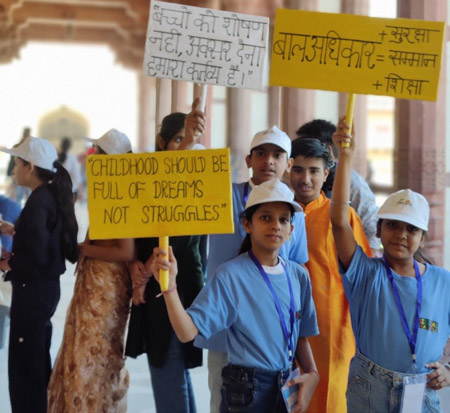
On World Children's Day, students in Rajasthan expressed the issues that matter to them most — from education and equality to safety and wellbeing. (Photo courtesy: X@UNICEFIndia)
The Committee has urged India to invest more in early childhood care, expand and strengthen ICDS infrastructure, ensure regular growth monitoring, and improve maternal health services. Instead, Anganwadis remain uneven in quality, grossly understaffed, and under-resourced. The CRC Committee’s recommendation is unambiguous: significantly increase public health spending, upgrade frontline infrastructure, and ensure universal access to essential nutrition services.
Education tells a similar story. India’s achievements in enrolment are overshadowed by severe learning deficits. The CRC Committee has insisted that India focus on foundational literacy and numeracy, reduce dropout rates among adolescent girls, and mainstream inclusive education for children with disabilities. However, the learning levels remain stagnant, teacher shortages persist, and the digital divide, especially evident during the pandemic, continues to punish the poorest children.
The Committee has repeatedly urged India to improve teacher training, invest in early childhood education, create safer digital environments, and make schools universally accessible. These are not new suggestions; they are long-standing, unmet obligations.
Child protection, one of the most urgent areas flagged by the CRC Committee, remains India’s weakest link. The Committee has repeatedly warned about widespread child labour, child marriage, trafficking, and online exploitation. It has emphasized the need for better enforcement of POCSO, the JJ Act, and child labor laws. Enforcement, however, depends on functional institutions, and this is where India falters. Child Welfare Committees and Juvenile Justice Boards in many states continue to operate with 30–50% vacancies. District Child Protection Units lack trained staff. Observation homes remain overcrowded and under-monitored.
The CRC has urged India to fill vacancies, train officials in child-sensitive procedures, strengthen rehabilitation services, and build systems for rapid reporting and response. Yet these structural reforms remain largely unrealized.
One of the CRC’s most forward-looking recommendations has been on climate change, yet another domain where Indian children are acutely vulnerable. From air pollution to heatwaves to extreme rainfall, climate risks now shape childhood in ways no earlier generation experienced.
The CRC’s recent guidance calls on countries to integrate climate resilience directly into child-related policymaking, ensure safe school infrastructure, and monitor environmental exposures that affect children’s health. India, despite ambitious climate commitments, has no national child-centred climate strategy.
Children remain invisible in disaster planning and environmental governance. The children of a climate-exposed nation deserve better. Across all themes, a single underlying gap ties these failures together: inadequate public financing. The CRC Committee has repeatedly asked India to increase its budget for children, ensure transparency in spending, and protect child-related allocations even during economic downturns. India, however, continues to spend just about 3% of its GDP on children, far below global recommendations and insufficient for a population so young.
Without reversing this trend, India simply cannot deliver the scale of services required to protect and nurture the world’s largest population of children. To be fair, India has made meaningful advances across all domains. Child mortality and maternal mortality have fallen. Digital public infrastructure is helping deliver welfare services more efficiently. NEP 2020 is conceptually strong. Programs like PM POSHAN, Mission Indradhanush, and Poshan Abhiyan reflect political recognition of child welfare. Yet the progress remains uneven, localized, and fragile. It is too dependent on individual states, too vulnerable to budget constraints, and too often unaccompanied by structural reforms.
World Children’s Day offers India a moment to confront its unfinished agenda. The CRC Committee’s recommendations are not criticisms; they are a framework for action. India must increase spending on child health, education, and protection; upgrade Anganwadis and schools; fill vacancies in protection systems; strengthen monitoring frameworks; create a national child-rights database; integrate climate resilience; and prioritise adolescence as a distinct policy category. Above all, India must treat children’s rights not as charity but as constitutional and international obligations.
A nation cannot rise if its children remain malnourished, unsafe, undereducated, or unheard. India stands at a critical juncture: aspires to global leadership, yet struggles to guarantee the basics for its youngest citizens.
World Children’s Day is a reminder that India cannot continue to forget its children. The future cannot be negotiated later. For millions of children, the future is being shaped now, in the nutrition they receive, the schools they enter, the protection they are afforded, and the risks they are forced to endure. The Government of India, especially over the past decade, has understood
this profound truth and is acting upon it despite challenges. Because Delhi knows that if India is to truly lead the world, it must start listening to the children in its own aangan.
(Ankeetaa Mahesshwari is an Associate Fellow at Pahlé India Foundation, a think-tank based in New Delhi. The views expressed are her own.)