[The opinions expressed in this article are those of the author. They do not purport to reflect the opinions or views of The South Asian Times.]
Having failed to ensure its internal stability, Pakistan appears to seek to shift the blame onto the Islamic Emirate to obscure its own shortcomings
By Abdul Saboor Mubariz
Pakistan pursues a Strategic Depth Policy toward Afghanistan. Through this policy, Pakistan seeks to maintain political influence in Afghanistan, prevent India’s influence, resolve the Durand Line issue in its favor, and secure access to Central Asia.
The primary cause of recent tensions is the Tehreek-e-Taliban Pakistan (TTP). Pakistan claims that the Islamic Emirate supports the TTP and provides them with safe havens inside Afghanistan. In contrast, the Islamic Emirate argues that Pakistan violates Afghanistan’s territorial integrity by conducting attacks on Afghan soil and creating security challenges along the Durand Line.
These Reciprocal accusations indicate that the central driver of the current conflict between the two sides is the TTP issue. Whenever Pakistan launches cross-border strikes into Afghanistan, it justifies them as targeted operations against TTP hideouts.
The TTP was established in 2007 in Pakistan. Despite facing internal challenges in 2014-2015, it re-emerged in 2018, resuming its attacks on Pakistani military installations. According to Pakistan’s Ministry of Interior (2023), the TTP has an estimated 7000-10000 fighters within the country.
The success of the Islamic Emirate in Afghanistan has significantly motivated the TTP, inspiring hopes of establishing a similar Islamic system in Pakistan and leading to intensified attacks. Official figures indicate that, since the Islamic Emirates' return in Afghanistan up to August 2023, TTP attacks have increased by 60 per cent, resulting in approximately 2,300 deaths among Pakistani military personnel and civilians. The South Asia Terrorism Portal reports 418 attacks in 2023, compared to 365 in 2022, while Al Jazeera cites a total of 650 attacks across Pakistan in 2023.
In the wake of these attacks, Pakistan demanded that the Islamic Emirate conduct extensive operations inside Afghanistan against the TTP. Warning that failure to do so would compel Pakistan to undertake operations on Afghan soil. The Islamic Emirate rejects all of these accusations. Foreign Minister Amir Khan Muttaqi characterizes them as propaganda, asserting that no groups based in Afghanistan pose a threat to the security of neighboring states.
Likewise, the Islamic Emirate’s spokesperson, Zabihullah Mujahid, refuted Pakistan’s claims, stating: “Rather than securing its own territory, Pakistan has once again leveled accusations against Afghanistan. The Islamic Emirate insists that it does not support such incidents and, in fact, condemns them; however, it is not the responsibility of the Islamic Emirate to prevent attacks in Pakistan; Pakistan must ensure the security of its own territory.”
Despite the Islamic Emirate’s repeated denials regarding the presence of the TTP in Afghanistan and its assurances that Afghan territory would not be used against any other state, Pakistan conducted airstrikes on Kabul on October 9, 2025. In response, the Islamic Emirate invoked its right to self-defense under international law and launched retaliatory strikes on Pakistani positions along the entire Durand Line. According to Zabihullah Mujahid, these operations
resulted in the deaths of 58 Pakistani soldiers and injuries to approximately 30 others, indicating that the TTP factor played a significant role in the escalation of the conflict.
Having failed to ensure its internal stability, Pakistan appears to seek to shift the blame onto the Islamic Emirate to obscure its own shortcomings. Furthermore, Pakistan aims to internationalize the issue to attract funding and projects under the pretext of counterterrorism. Simultaneously, Pakistan intends to use this situation as a tool of pressure to compel the Islamic Emirate into accepting its demands.
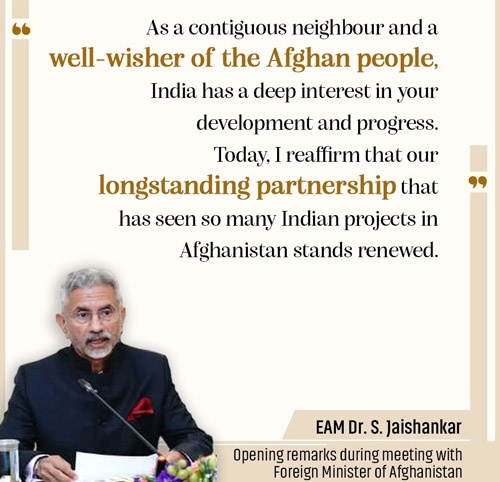
(Graphic courtesy: X@MEAIndia)
Over the past four years, in response to strained relations with Pakistan, Afghanistan has strategically leveraged the “India card” to exert diplomatic pressure and has sought to rebuild its bilateral relations with India. India is also motivated by the desire to reaffirm historical ties with Afghanistan, secure potential economic and trade access to Central Asia, and establish a friendly presence on Pakistan’s western flank, thereby deriving potential strategic advantages.
Pakistan carried out the attack on Kabul at a time when Afghanistan’s Foreign Minister, Amir Khan Muttaqi, had just traveled to India. A key component of Pakistan’s Strategic Depth Policy is to prevent Indian influence in Afghanistan. Muttaqi’s visit to India, marking the first such ministerial engagement in several years, reportedly provoked Islamabad, highlighting the sensitive nature of India-Afghanistan-Pakistan dynamics.
The Islamic Emirate delegation received an unprecedentedly warm reception from the Indian side. During his visit, Muttaqi also traveled to the Darul Uloom Deoband, a site that no Afghan official had formally visited since the 1950s. This visit to the Darul Uloom Deoband suggests that the Islamic Emirate seeks to present itself as a traditional and moderate Muslim entity, deliberately distancing itself from extremism. Strategically, it also signals a clear separation from ISIS from a security perspective and lays the groundwork for potential international recognition.
For India, this visit provides an opportunity to establish ties with the Islamic Emirate through engagement with the Darul Uloom Deoband and to regulate its bilateral relationship with the Emirate. This represents a strategic factor for India in shaping its engagement with the Islamic Emirate.
Although India does not share a direct border with Afghanistan, Indian narratives claim that they have a territorial connection through Gilgit-Baltistan, which they consider part of their domain. Consequently, preventing Indian influence in Afghanistan has become a central component of Pakistan’s foreign policy, aimed at safeguarding its perceived strategic interests in Gilgit-Baltistan.
Muttaqi’s visit to India has generated concern and provoked anger in Islamabad. New Delhi seeks to maintain its foothold in Afghanistan following the US withdrawal and to counterbalance the influence of China and Pakistan in the region. The Islamic Emirate’s rapprochement with India, and Muttaqi’s visit in particular, may have influenced Pakistan’s decision to strike Kabul, serving both to pressure the Islamic Emirate and to deter future engagement between the Emirate and India. Pakistan has also alleged that India is collaborating with Afghanistan to support the TTP and other militant groups against Pakistan.
The recent confrontation between the Islamic Emirate and Pakistan, coupled with the Islamic Emirate’s growing engagement with India, marks the beginning of a power rivalry between the two countries in Afghanistan. Consequently, Afghanistan’s institutions and territory risk being instrumentalized for strategic leverage, with the Afghan people likely to bear the greatest costs.
In this context, the Islamic Emirate should maintain a balanced approach in its relations with both states to prevent Afghanistan from once again becoming a competitive battlefield for India-Pakistan.
An additional consideration is Pakistan’s claim that the Islamic Emirate supports the TTP under Indian influence and that recent attacks are part of this alleged collaboration. This narrative is inaccurate for two primary reasons. First, over the past four years, there were no substantive relations between the Islamic Emirate and India, yet Pakistan conducted strikes in Paktika, Khost, and Kunar provinces, to which the Islamic Emirate responded. Second, the establishment of diplomatic ties between the Islamic Emirate and India, including Foreign Minister Muttaqi’s visit, constitutes a routine diplomatic practice. The Islamic Emirate maintains an independent foreign policy and possesses the sovereign prerogative to establish relations with any state in the region, including Pakistan.
Another significant factor in this conflict is the role of the United States. Recently, the US requested the Islamic Emirate to hand over the Bagram airbase, a request which the Islamic Emirate refused. Trump reportedly threatened that the United States would impose severe consequences if the base was not handed over.
Bagram Airbase holds strategic importance for the United States for two primary reasons. First, during the occupation, the base served as the Americans’ operational hub, from which combat missions were conducted within Afghanistan. Even presently, the airbase could function as a critical center for monitoring regional rivals and for intelligence collection. Second, due to its
extensive size, Bagram enables the US to have a station for logistical equipment, military hardware, large aircraft, and personnel efficiently, while also providing adequate facilities for large-scale military exercises.
Furthermore, a series of consecutive meetings between Pakistan’s Prime Minister, Chief of Army Staff Asim Munir, and President Trump indicate that the US factor cannot be discounted in Pakistan’s strike on Kabul. This marks the first instance in history in which Pakistan has directly targeted Kabul. One possible motive for the attack could be that the United States seeks, through Pakistan, to exert pressure on the Islamic Emirate to comply with specific demands, particularly granting access to the Bagram airbase.
Pakistan has consistently collaborated with the United States to advance US strategic interests in Afghanistan. During the Cold War, at Washington’s request, Pakistan supported the Mujahideen to prevent communism in Afghanistan. Later, in 2001, it again provided the United States with military bases and access routes in Pakistan to overthrow the Taliban regime.
Consequently, it is possible that Pakistan has once again targeted Kabul in pursuit of US objectives, aiming to signal to the Islamic Emirate that non-compliance with American demands could render Afghanistan a renewed center of instability.
[Abdul Saboor Mubariz is a Research Fellow at the Academy of Sciences of Afghanistan, the country’s leading governmental research institution.]