By Sakshi Arora
Indian women have provided continuous support to their nation through their agricultural and caregiving work along with their handicraft production and home management and cooperative activities and community support.
The Indian subcontinent achieved independence in 1947, marking the end of colonial rule and the beginning of a new era filled with hopes for political freedom and economic progress. The main element that fulfilled this commitment to freedom existed as a concealed force, which people did not recognize. Women participated in agricultural work and household industry and small-scale workshop activities throughout the time before independence. Yet, their contributions remained unrecorded and unacknowledged.
During the first post-independence Census of 1951, only about nine per cent of the female population was classified as “workers.” In reality, a far greater number of women were engaged in unpaid or informal labor. The economic statistics and government policies disregarded their research work which provided lasting support to families and villages and local economies for more than 40 years. This research studies how women's work functions as the essential support system for the Indian economy while the economic situation progresses and society needs to recognize this unacknowledged work for national development.
From subsistence farming to cottage industries: Women as the backbone of agriculture and informal work
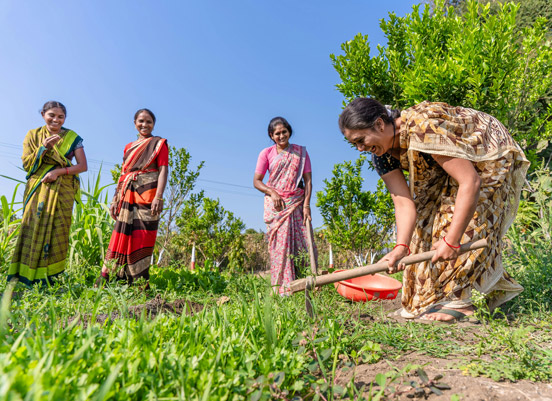
India's economic foundation at independence depended on agriculture which women sustained through their essential work. Women in rural India performed various agricultural tasks which included sowing seeds and weed control and crop harvesting and processing and livestock care and fodder collection and water and firewood retrieval and household task management.
Despite performing nearly all farm-related tasks, less than 10–12 per cent of rural women held land titles or formal ownership. Land records, tenancy documents, and compensation were typically registered in men’s names. Women performed all the necessary work but they were not allowed to own the land or its agricultural products.
Women maintained their traditional cottage industries and handicraft practices. They created home-based products by spinning yarn, weaving cloth, making pottery, embroidering textiles, preserving food, and crafting baskets. Before industrialization brought cheap imported goods, these industries enabled families to achieve financial independence and economic self-sufficiency.
However, colonial policies and post-independence industrial expansion introduced inexpensive factory-made goods into the market. As a result, many handloom and artisanal sectors collapsed, reducing employment in these areas by more than half in some regions. Millions of women lost their traditional livelihoods.
Domestic work required women to spend their time and energy which they used for agricultural work and craftwork. Women were responsible for cooking and cleaning and collecting fuel and water and taking care of children and elderly people. The subsequent time-use research showed that women dedicated five to six hours per day to unpaid care duties which exceeded the time men spent on such responsibilities. If monetized, such labor would represent a considerable share of national income. Yet, at the time, this work was excluded entirely from economic records.
Women established the hidden foundation which supported both rural and semi-urban economic systems by performing agricultural work and handling informal employment and operating cottage businesses and providing home-based care services. The unpaid work of women protected food security while they maintained traditional skills and built sustainable income sources which remained unacknowledged and unprotected.
The study investigates how urban work and official employment together with workers' rights lead to both partial achievements and continuing obstacles:
The formal employment sector of urban areas during the post-independence industrialization period saw only a limited number of women join professional fields which included teaching and nursing and clerical work and administrative positions.
The female urban workforce in 1951 had only 12 to 13 per cent participation rate. The entry requirements imposed major obstacles which people needed to overcome. The 1940s saw female literacy rates reach only eight per cent. Women experienced restricted mobility because social norms defined "acceptable" conduct standards which they were required to follow. The system operated without two essential components which included secure transportation routes and facilities for maternity care and childcare services.
Women who entered the workforce earned 30 to 40 per cent lower wages than men and faced restricted chances to advance their careers. Women lost their ownership rights to property and productive assets because inheritance laws and tenancy systems and societal norms prohibited them from inheriting property rights. Women faced nearly complete exclusion from formal credit access which required them to find male guarantors for loan applications. This restriction limited their ability to start businesses or pursue independent economic activity.
The implementation of legal reforms through property rights laws and wage regulations and equal pay legislation faced difficulties because authorities did not consistently implement these measures. The transformation of social behaviors occurred at a gradual pace. The result established a pattern which showed that most women stayed in informal jobs which offered no security and paid them minimal wages.
Economic participation needs education and health and social conditions as its fundamental elements. The educational system restricted women from participating in economic activities because it limited their access to academic programs. In 1940 less than nine per cent of females could read which reached only slight improvement by 1950. Women who did not receive educational training faced obstacles to obtaining skilled jobs and vocational education and government employment and financial self-sufficiency.
The situation involved serious health problems. Maternal mortality rates reached high levels because of poor nutrition and limited healthcare access which particularly affected rural populations. The majority of villages in the area operated without hospitals or qualified medical personnel because they depended on traditional midwives. Women maintained their agricultural duties and household tasks while they suffered from pregnancy and disease and physical fatigue. The extra work Women had to perform created two problems which affected their productivity and their ability to stay healthy throughout their lives.
The public health improvements together with maternal care developments and literacy campaigns and social reforms created substantial advancements which improved women's health standards and educational attainment in society. The population of female literates grew while maternal and child death rates dropped and people became more aware of their rights. The situation still shows existing inequalities. In several areas girls continue to face educational disadvantages while rural women handle extensive unpaid work and healthcare access remains incomplete.
Structural inequalities continue to prevent women from achieving complete and equal access to the standard economic activities. The three elements of cooperatives and informal sectors and sustainable contributions make up this establishment. Women made major contributions to the informal markets through their work in cooperatives and household enterprises and environmentally sustainable activities that extended beyond their agricultural and industrial tasks.
The establishment of dairy and weaving and handicrafts and small-scale industry cooperatives after independence provided women with employment opportunities that included stable income and decision-making authority and financial stability. The successful establishment of cooperatives in specific areas resulted in increased recognition of women members together with improved financial security for them.
The majority of women work in informal jobs which include street vending and tailoring and home-based food processing and small shopkeeping and seasonal agricultural labor and domestic services despite the expansion of formal employment sectors. The informal sector provides work opportunities to about 70 to 80 per cent of women who work in India. The work which
provides minimal pay and no social security benefits supports both household needs and the economic activities of the community. Women have also made essential contributions towards environmental sustainability.
Women maintain a strong relationship with their ecological livelihoods through their activities which include seed saving and organic farming and conservation of water and forest resources and waste reuse and eco-friendly craft production. Women in rural areas gather forest materials to create natural dyes which they use for their production of eco-friendly products that help maintain economic strength while protecting the environment.
Conclusion
Indian women have provided continuous support to their nation through their agricultural and caregiving work along with their handicraft production and home management and cooperative activities and community support. The social norms which restrict people together with their discriminatory laws and their educational barriers and their restricted understanding of work have made it impossible to see their actual work.
The expansion of educational opportunities together with increased access to formal employment and legal reforms has not yet achieved its full potential because most women continue to work in informal jobs which do not provide compensation and recognition and legal protection. The presence of wage gaps together with restricted property rights and unstable job conditions and the unequal distribution of household duties continues to prevent people from achieving economic equality.
India needs to establish formal recognition and evaluation and protection of women work which occurs in domestic spaces and agricultural fields and craft industries and cooperative businesses and informal trade sectors if it wants to become a nation that practices true social justice and achieves economic success. The nation will achieve economic justice together with sustainable growth when it starts to recognize and empower women to work through national development processes.
REFERENCES
The views expressed are personal and not necessarily those of The South Asian Times