By Ajeet Kumar Sahoo & Barkha Goyal
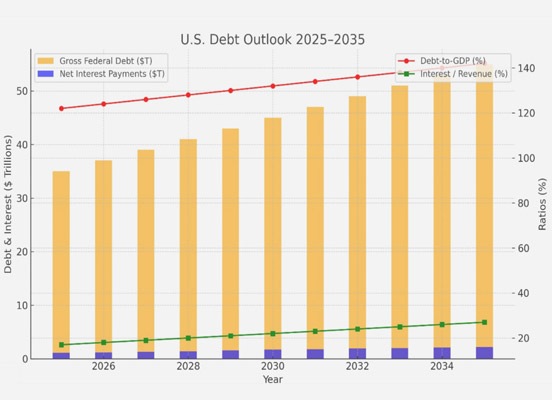
The United States stands at the edge of a fiscal precipice. With gross federal debt already above $37 trillion in 2025 and projected to exceed $53 trillion by 2035 (US Treasury; CBO, 2025), the debt-to-GDP ratio, currently at 123%, is expected to increase to around 141%, as shown in the figure above. Net interest costs, already over $1 trillion in 2025, are expected to soar past $1.8 trillion by 2035, consuming over 22% of federal revenues. This escalating burden constitutes the “US Debt Bomb,” a dynamic in which rising interest payments crowd out essential spending and trap the government in a spiral of borrowing simply to service past borrowing.
Amid this crisis, President Donald Trump and his allies have promoted a novel escape route: the USD1 stablecoin, issued by World Liberty Financial. Pegged 1:1 to the dollar and backed by US Treasuries and cash, it effectively tokenizes sovereign debt. Every purchase of USD1 would channel global capital into US Treasuries, expanding demand beyond banks and foreign central banks to millions of crypto users worldwide.
For Washington, this promises debt absorption, lower borrowing costs, and diversification of its investor base. In theory, blockchain efficiency could also reduce reliance on intermediaries in debt issuance and settlement.
Yet this apparent innovation masks deep risks — particularly for the global system. By monetizing Treasuries off-balance-sheet, the US could obscure its true debt exposure, shifting risks onto private, politically connected entities. Unlike bondholders, stablecoin holders have weaker legal protections, meaning in a crisis they could face redenomination, haircuts, or frozen redemptions — effectively a hidden default. Foreign lenders, believing they hold dollar-equivalents, might find their claims subordinated or illiquid, while the US avoids overt sovereign default. This amounts to cheating creditor nations, replacing transparency with contractual ambiguity.
Trump’s strategy also coincides with a renewed tariff war, framed as both an industrial policy and a revenue-raising measure. In early 2025, his administration imposed sweeping tariffs of 10–20% on a broad range of imports from China, Mexico, and the European Union, with duties on specific Chinese goods reaching as high as 60% (USTR, 2025). The administration projects that these tariffs could generate $300–400 billion in additional federal revenue annually (White House estimates, 2025), which would marginally offset the budget deficit.
However, independent analyses, such as those from the Peterson Institute for International Economics, suggest that tariffs function as a hidden tax on American households, raising consumer prices by an estimated 1.5–2% annually. For a median US household, that equates to an additional $1,500–$2,000 in yearly costs (PIIE, 2025).
Moreover, the tariff war is likely to provoke retaliation. China has already signaled potential countermeasures targeting US agricultural exports, while the European Union is preparing proportional duties on American industrial goods. Such retaliation could reduce US exports by $100–150 billion annually and erode manufacturing competitiveness (WTO dispute filings, 2025).
The irony is stark: tariffs may provide short-term federal revenue, but they also risk stoking inflation, disrupting supply chains, and reducing GDP growth by up to 0.5 percentage points annually (CBO, 2025). The unemployment rate is also observed at 4.3% in August 2025, the highest in nearly four years, underscoring a stagnating US economy weighed down by mounting debt pressure.
When coupled with the stablecoin plan, tariffs illustrate a two-pronged Trumpian approach to fiscal pressure: squeeze domestic consumers through higher import costs while siphoning global liquidity into US Treasuries via blockchain channels. In both cases, the burden of US debt management is exported outward — onto American households through higher living costs, and onto foreign creditors through digitalized debt instruments with weaker protections.
The global spillovers could be enormous. USD1 would act as a private digital dollar, fueling “crypto-dollarization” in weaker economies, destabilizing currencies, and diverting global capital into Treasuries at the expense of emerging markets. Its dominance could undermine rival CBDCs such as China’s digital yuan or Europe’s digital euro, while allowing Washington to weaponize payments further for sanctions. Crucially, a loss of confidence in USD1 — triggered by scandal or politics — could unleash a digital run at internet speed, freezing trade and capital flows worldwide.
In 1971, Richard Nixon shocked the world by severing the dollar’s convertibility to gold, unraveling the Bretton Woods system. Trump’s stablecoin debt strategy could echo that shock — not by breaking a gold peg, but by weaponizing blockchain to sustain US borrowing while exporting hidden risks to the world. Like the Nixon Shock, it would be a unilateral US move to ease domestic constraints at the expense of global financial order.
The US may temporarily defuse its debt bomb through this mechanism, but the cost would be a new era of instability, dependency, and mistrust in international finance. For allies and rivals alike, the message would be the same as in 1971: America will not hesitate to rewrite the rules of the global system when its own fiscal survival is at stake.
In sum, US debt has shifted from being a fiscal issue to becoming a profound strategic vulnerability. With federal debt soaring to unprecedented levels, confidence in Washington fiscal is eroding, fueling a cycle of perpetual borrowing. Moreover, the US debt is not just a single figure; it is a complex mix of publicly held debt, intragovernmental holding, holding such as social security trust fund, and short-run instrument like Treasury bills that constantly roll over, making the economy more vulnerable o refinancing risks, higher borrowings cost, and long-term fiscal pressures.
In response, the Trump administration has turned to the idea of tokenizing Treasuries through stable coin with passing the GENIUS Act in July 2025 as a possible solution, promising potential benefits like broader market participation and faster settlement. However, this approach introduces considerable serious risks including cyberattacks and regulatory ambiguity, while simultaneously enabling the US to quietly devalue its debt and shift hidden financial risk onto others. Much like past episodes in the 1930s and 1970s, the US appears set to resolve its debt issues at the expense of global stability, accelerating the shift toward a cryptocurrency-based financial system.
------------------------------------------------
.jpg)
[Ajeet Kumar Sahoo is an Associate Professor of Economics, School of International Studies, Jawaharlal Nehru University (JNU) and Barkha Goyal is Faculty of Finance & Economics, Delhi School of Business, New Delhi.]
The views expressed are not necessarily those of The South Asian Times