[The opinions expressed in this article are those of the author. They do not purport to reflect the opinions or views of The South Asian Times.]
True gender equality cannot be achieved without recognizing the constraints traditional masculine roles impose on men's economic and mental well-being.
By Gopish Agarwal & Lakshay Sharma
In many societies worldwide, a man's value is often tied narrowly to economic success—his ability to earn a stable and respectable income. This long-standing social expectation, commonly known as the "male breadwinner norm", places tremendous pressure on men to be the primary financial providers for their families. While this expectation has historically been praised as a marker of masculinity and responsibility, it carries a harsh reality: failure to meet these economic standards is often stigmatized as a personal failure. This cultural burden not only causes immense psychological distress but also amplifies economic and social problems that are frequently ignored in gender discussions.
The societal double standard
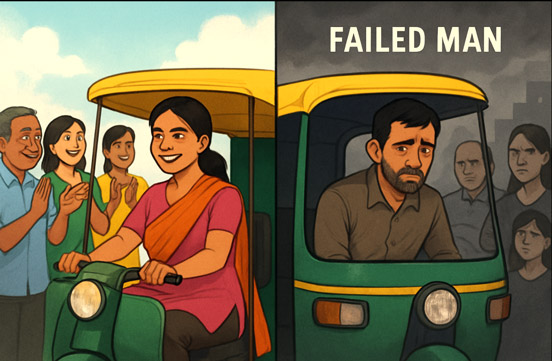
One stark way to grasp these gendered pressures is by contrasting societal reactions to men and women in low-wage or informal labour. For instance, a woman venturing into a traditionally male-dominated or low-paying field is often hailed as brave and shattering glass ceilings. In contrast, a man involved in the same work may be met with sympathy or contempt, branded a failure for not attaining a better job or income. This double standard underscores rigid gender norms where economic success defines masculine value, while different, more adaptable standards judge women.
On one hand, a woman working the same informal job is socially praised as empowered and trailblazing; on the other hand, a man in the same job is seen as unsuccessful and socially marginalized.
Mental health and economic struggles
These gendered cultural norms have real consequences beyond social perception. Research shows that about 1 in 6 men have experienced sexual violence, an often overlooked source of trauma linked to economic hardship and mental health challenges. Moreover, male victims of such abuse or economic failure face disproportionately high rates of depression, anxiety, and other mental health problems that affect their ability to sustain stable employment or earnings.
The economic impact of these pressures is significant. Studies estimate the lifetime economic cost of intimate partner violence and sexual abuse for men at over $23,000 per victim, including lost income, medical expenses, and reduced productivity. This adds weight to what many men silently endure: financial hardship coupled with insufficient support, often compounded by stigma.
Key data on economic stress and male well-being
The mental health toll, combined with economic pressures, has multiple intertwined effects. Consider these approximate statistics that capture the economic-related struggles men face:
● 45% of men report experiencing economic stress severe enough to cause mental health issues.
● 35% suffer from depression or anxiety directly linked to financial hardship.
● 15% have attempted or committed suicide due to financial burdens and the overwhelming pressure to provide.
● About 20?cefamily or social rejection connected to financial failure and perceived inadequacy.
These stark figures are portrayed in the chart below:
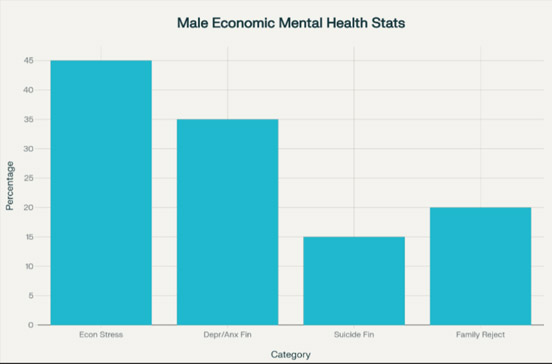
Key economic-related male mental health issues and social outcomes. (Source: Rainn, 2025)
The male breadwinner trap
The "male breadwinner trap" forces many men to define their identity almost exclusively through earning capacity. When men fail to provide economically—whether due to unemployment, underemployment, or working in precarious sectors—they often internalize this as a personal failure rather than recognizing broader structural economic challenges.
This identity conflict has dangerous health implications. Men who hold traditional views of masculinity experience heightened stress and feelings of worthlessness when they cannot fulfill the provider role. They are also less likely to seek help for mental health issues because such vulnerability is perceived as weakness or failure within masculine norms.
Social and economic costs
At a broader level, this narrow definition of masculinity and economic value leads to significant economic inefficiencies. Men who feel trapped in low-wage roles without perceived alternatives limit labor market mobility and productivity. The fear of social judgment discourages many from retraining or seeking jobs in emerging sectors that might be deemed less "masculine" but could offer greater stability or satisfaction.
Moreover, mental health issues and suicide linked to economic pressure place heavy burdens on public health systems. The cycle of isolation, stigma, and economic failure traps many men in persistent hardship, limiting their contributions not only economically but also socially and emotionally to their families and communities.
Furthermore, mental health issues and suicide linked to economic pressure place heavy burdens on public health systems. These systems must be equipped to provide comprehensive mental health care, including prevention, early intervention, and ongoing support. The cycle of isolation, stigma, and economic failure traps many men in persistent hardship, limiting their contributions not only economically but also socially and emotionally to their families and communities. Public health systems can play a crucial role in breaking this cycle and supporting men's economic and social well-being journey.
Toward a broader definition of manhood and economic value
Addressing these issues necessitates a multifaceted approach. First and foremost, there needs to be a cultural shift in how masculinity is perceived. There should be less emphasis on income as the sole measure of success and more recognition of diverse male roles, including caregiving, emotional expression, and part-time work. Educational initiatives from early schooling that challenge rigid gender roles can lay the groundwork for this.
Second, policymaking should support men's mental health through accessible and stigma-free services. Workplace policies can be reformed to recognize and compensate caregiving and flexible roles that are typically undervalued for men. Public messaging and campaigns that promote healthy masculinity beyond the breadwinner image are vital.
Finally, economic policies must recognize men's structural challenges in a changing labor market. These challenges include, but are not limited to, job displacement due to automation, lack of access to quality education and training, and discrimination in hiring and promotion. Policies should support retraining, education, and transitions to sustainable employment instead of reinforcing narrow notions of "success" based on outdated industrial-era roles.
Conclusion: Redefining masculinity for economic and social well-being
True gender equality cannot be achieved without recognizing the constraints traditional masculine roles impose on men's economic and mental well-being. When society stops defining men's worth solely by their income, we open the door to healthier, more inclusive communities.
Everyone benefits when men can explore their full potential beyond the narrow confines of economic success. By dismantling harmful gender norms and building supportive economic and social systems, we can create a future where men's value is seen in their whole humanity—not just their paycheck.
[Gopish Agarwal is a student of Economics and Dr Lakshay Sharma is an Assistant Professor at CHRIST University, Delhi NCR Campus.]
------------------------------------------------
SOURCES
● https://pmc.ncbi.nlm.nih.gov/articles/PMC8211126/
● https://rainn.org/get-the-facts-about-sexual-violence-against-men-and-boys
● https://papers.ssrn.com/sol3/papers.cfm?abstract_id=4617812
● https://gbfinancemag.com/masculinity-norms-and-their-economic-consequences
● https://www.frontiersin.org/journals/psychology/articles/10.3389/fpsyg.2019.01590/full