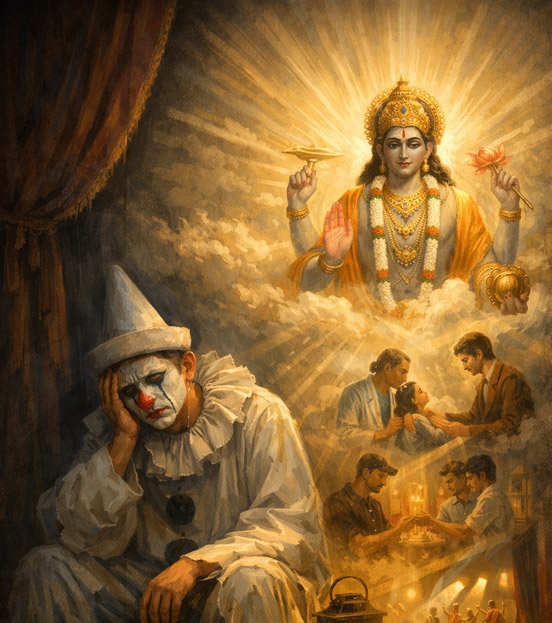
There is an old story, popularized in modern times by the graphic novel Watchmen, that captures a deep and unsettling human truth. A man goes to a doctor and says he is deeply depressed; life feels unbearable. The doctor tries to reassure him and says, “The cure is simple. The great clown Pagliacci is in town tonight. Go and see him—he is the funniest man alive. He will surely lift your spirits.” The man breaks down and replies, “But doctor… I am Pagliacci.”
The story lingers because it feels uncomfortably familiar. Many of us, at different points in life, are Pagliacci.
Outwardly, we guide others, support families, lead teams, serve communities, or remain the emotional anchor for those around us. Inwardly, we carry struggles we cannot easily share. The smile becomes a habit. The mask slowly becomes our identity.
There are countless examples from everyday life. A parent who worries silently about finances but reassures the family that everything is fine. A leader who motivates others while feeling uncertain and exhausted within. A caregiver who comforts everyone else but has no one to lean on. A volunteer who serves tirelessly while feeling emotionally empty. These are not dramatic crises—just quiet, unspoken burdens that sit in the heart.
Pagliacci’s suffering deepens because he believes he must carry it alone. The role overtakes the person. When there is no space to remove the mask, the weight becomes heavier than the role itself.
So what should we do to lessen the impact of this inner suffering?
The first step is practical and honest: if there is something within our capacity, we should do it. We must make the effort, seek solutions, ask for guidance, and take responsibility where possible. Spiritual wisdom never dismisses effort.
But there are moments when, despite sincere effort, nothing more can be done. It is here that the timeless teachings of the Hindu saints reveal a deeper truth: God alone is the Sarva Karta—the all-doer. Nothing happens without His wish. No action unfolds outside His divine will.
When this understanding truly settles in the heart, a profound peace follows.
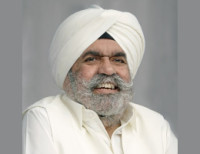
Pramukh Swami Maharaj emphasized this principle repeatedly, including during the inauguration of the BAPS Shri Swaminarayan Mandir in Kolkata in 2014. He reminded devotees that God works through everyone. Individuals are merely instruments; the power, the inspiration, and the outcome all belong to God. When this belief becomes firm, conflict dissolves, ego softens, and unity naturally emerges.
Much of our inner turmoil arises from the mindset of “I did this” or “They did that.” Pride grows when things go well; resentment grows when they do not. But when we accept that God makes us act and God brings the result, both pride and bitterness lose their grip. Success does not inflate us, and failure does not break us—because neither truly belongs to us.
This does not make us passive. Effort remains essential. Discipline and responsibility remain our duty. Yet the fruits of action are surrendered. God places us in situations, guides our thoughts, and moves us to act for purposes we may not immediately understand. What feels like difficulty today may reveal itself as grace tomorrow.
When we accept God as the all-doer, even pain takes on meaning. The question shifts from “Why is this happening to me?” to “What is God shaping within me through this?” Anxiety gives way to trust. Resistance gives way to acceptance. Inner turmoil gradually dissolves.
Pramukh Swami Maharaj taught that belief in Sarva Karta dissolves ego clashes. When God is the doer, there is no competition, no urge to dominate, no need to prove superiority. Differences remain, but they no longer become conflicts. Relationships soften. Forgiveness becomes natural, because there is no one left to blame.
When we see God working through everyone, unity follows. No one is entirely good or bad; each person plays a role shaped by divine will. This vision transforms how we view family, society, and even disagreement—not as opposition, but as participation in a larger divine plan.
Believing in Sarva Karta is not resignation. It is active trust. We act sincerely and surrender the outcome to God. In doing so, the painted smile loosens, the heart becomes lighter, and peace stops being something we search for outside. It becomes our natural state.
Lenin Joshi
BAPS Swaminarayan Sanstha