At a time when society was experiencing a visible decline in moral values and social cohesion, Bhagwan Swaminarayan undertook a profound and transformative effort to restore balance and harmony. More than two centuries ago, His response to these challenges was the Shikshapatri—a concise yet comprehensive code of conduct personally dictated by Bhagwan Swaminarayan to guide individuals and society toward ethical, spiritual, and disciplined living.
Written in Vadtal, Gujarat, on February 12, 1826 CE (Maha Sud 5, Vikram Samvat 1882), the Shikshapatri stands as one of the primary scriptures of the Swaminarayan Sampraday. Composed in just 212 Sanskrit shlokas, it remarkably condenses guidance covering nearly every dimension of human life. For its time, the concept of a single, universal code of conduct applicable to all members of society—regardless of age, gender, social status, or life stage—was both unconventional and groundbreaking.
The Shikshapatri offers instructions on health, hygiene, dress, diet, etiquette, finance, education, diplomacy, friendships, habits, penance, celebrations, and religious duties. Its relevance lies not only in its breadth but also in its clarity and balance, blending prevailing social norms with lofty spiritual ideals. Whether addressing householders or sadhus, men or women, the young or the elderly, the guidance is inclusive and practical, rooted in compassion and moral responsibility.
At its spiritual core, as articulated in shloka 116, the Shikshapatri emphasizes the aspirant’s goal of identifying oneself as Brahma—distinct from the physical body—and offering devotion to God. This principle anchors the scripture’s moral teachings in a deeper spiritual purpose, ensuring that righteous conduct is not merely external discipline, but an expression of inner realization.
The far-reaching social impact of Bhagwan Swaminarayan’s teachings did not go unnoticed. British administrators in Gujarat, Kathiawad, and Kutch observed marked improvements in public order and discipline within regions influenced by His work.
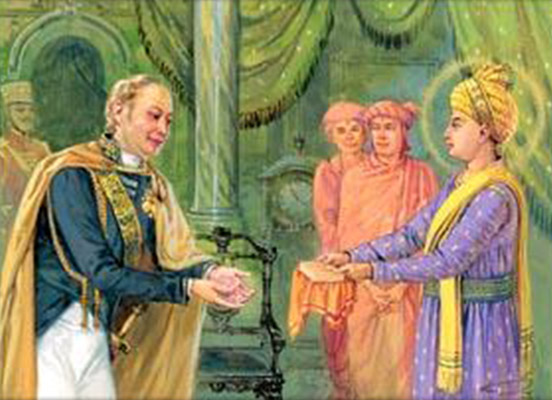
Mr. Williamson, Collector of Baroda, reported to Bishop Reginald Heber that “some good has been done among many of these wild people by the preaching and popularity of the Hindu reformer Swaminarayan.” David Anderson Blane, acting political agent at Rajkot from 1828-30, informed Governor Malcolm about the good work and positive influence on the people of Bhagwan Swaminarayan. In tune with his objective, this explains the Governor of Bombay, Major-General Sir John Malcolm’s great desire to meet with Bhagwan Swaminarayan. This led to a historic meeting on February 26, 1830, between Bhagwan Swaminarayan and Sir John Malcolm. During their meeting in Rajkot, conducted in an atmosphere of mutual respect, Bhagwan Swaminarayan presented Sir John Malcolm with a copy of the Shikshapatri—a fitting gift that encapsulated the moral and social principles underpinning His success in reforming society. That very manuscript is preserved today in the Bodleian Library at Oxford University. It remains one of the oldest surviving copies of the Shikshapatri, bearing witness to its historical, cultural, and global significance.
Originally composed in Sanskrit and accompanied by Gujarati commentaries, the Shikshapatri has since been translated into 29 languages, reflecting its universal appeal and enduring relevance. As the world reflects on over 200 years since its composition, the Shikshapatri continues to stand as a rational, progressive, and deeply spiritual framework—guiding individuals and communities toward moral integrity, social harmony, and devotion to God.
- Lenin Joshi
BAPS Swaminarayan Sanstha