By Basab Dasgupta
Despite the existence of the question, “Is there a God?” for thousands of years, there has been no unanimity about the answer. Sadly, most of the wars and violent conflicts in human history over centuries centered around differences in religious opinions about the answer.
I do not have the audacity to preach one way or the other, but can describe what I feel and why. My belief system was influenced by how I was raised. I grew up in a God-centric environment. We lived on the second floor of a building in the town of Chandannagar, about 30 minutes by train from Howrah station (West Bengal).
Another family headed by a patriarch, whom we called “Dadu,” lived on the first floor. Dadu was a religious man. Every evening, he will sit in front of images of various gods and goddesses to perform a traditional “Arati” and recite slokas from scripture. I watched his activities with utmost attention.
People of Chandannagar loved religious celebrations. We worshipped Durga, Jagadhatri, Kali, Saraswati, Laxmi, Kartik, Viswakarma, Bhubaneswari, and celebrated Diwali, Jagannath’s chariot parade, Janmashtami, Holi, and so on.
I thought that if the grown-ups spent so much time, energy, and money worshipping God, then God must exist. My parents bought children’s books about Ramayana, Mahabharata, and Hindu mythological tales. Instead of playing with toys, I played with small clay replicas of statues of different Gods and Goddesses. They were like my family members.
Despite the outward show of devotion, deep down inside, I had doubts. The Hindu mythologies seemed too elaborate and complicated to offer a comprehensive and consistent account of God’s role in determining our purposes on this earth and the reason for our existence. I still believed in God but hoped for a better explanation. Two observations contributed to my strong belief in God: the intricacy and preciseness of how everything functions, and death.
It is an absolute miracle when I look around and examine how things work. How a baby is born and grows up to become a mature adult with millions of parts inside his/her body functioning in perfect harmony, not only in human babies but in all species. Incredible, colorful beauty of nature from majestic mountains to limitless oceans with farmlands, forests, and deserts in between.
How food is grown from the ground with all the right nutrients. Precise motions of planets and the existence of four seasons, each with its relevant contribution to our existence. How can all these happen without a mastermind planning and working behind the scenes?
My first experience with death was Dadu’s passing away. One morning, I saw him strapped to a cot and everyone crying loudly or weeping silently. I asked my mother what was wrong with Dadu. She did not tell me the truth; she said that he was sick and being taken to the hospital. Even though I was little, her answer did not make sense. People go to the hospital to get well; so, what was all the crying all about? Dadu did not come back from the hospital. I did not believe that people could just disappear; if their souls go to heaven or hell, how does that happen?
I saw a dead human body for the first time a year later. Our house was on the Ganges. Dead bodies would often float down the river; people accidentally drowned in the river or were bitten by a snake while bathing, or committed suicide. Usually, we would not see them. On this occasion some guy was screaming about a dead body on the ghat. Before my mother could stop me, I ran to the ghat to see the body, a naked and colorless, cold male body. It was perfectly still, with the eyes staring at the sky without blinking. It reminded me of the animals hanging in the butcher shop. It did not scare me nor make me sick. I just stared at it and tried to fathom what would happen to me one day!
The eternal question came to me: “Who am I?” My answer was “I am Basab Dasgupta!” The voice in my head was not satisfied with this simple answer and said, “That is your name, but who are you?” I tried to clarify: “I am the son of Shailen Dasgupta”. The voice chuckled and said, “Now you are describing a relationship with someone, but who are you?” I would keep on playing this game with more answers, but never quite getting to the bottom of the question, “Who are you?”
Soon, I would go into a transcendental state where I was not grounded but kind of floating freely in some space. Although it was a strange sensation, I felt a degree of joy that I cannot describe, like “warping” into some other space. It was a “high,” and I would play this way often. No one taught me this game: it came naturally. I developed a distinct feeling that there was a different world somewhere, and life on this earth was just a charade.
I participated, somewhat superficially, in all religious festivities. I never read any scripture nor sought out a guru. Much later in my life, I visited a retreat near San Diego when I was in my forties: it was the “Self-Realization Fellowship” temple, established by Paramhansa Yogananda. I bought his book “An Autobiography of a Yogi”. There is a chapter, “Resurrection of Sri Yukteswar,” where Yogananda narrates what his guru, Yukteswar, who had passed away by then, told him about the afterlife during his resurrection.
Yukteswar said that we have to go through hundreds, if not thousands, of reincarnations while undergoing improvements in each life. It is like peeling an onion. The outer layers of the onion symbolize reincarnation in a physical body with the usual five senses. The next layers represent what Yukteswar called an “astral body,” where we lose our five senses but can still feel emotions and other extra-sensory perceptions.
The innermost layers constitute the “causal body,” where wisdom is the prevalent trait. Once all layers are gone, the entity inside (soul or a piece of God or energy) merges with an all-pervading universal consciousness or God. That is Nirvana and absolute end. Our only purpose in life is to understand this process and make every effort to achieve Nirvana as early as possible.
For the first time, I found a coherent, consistent, and logical explanation of everything about our existence and purpose in this one chapter. My faith in God was permanently cemented.
Many people do not believe in God because they are disappointed by all the miseries in this world; they ask, “Why is there so much suffering if there was a God?” In my view, God’s intention is not to give us what we want. HE wants to show us that this earth is a miserable place; our purpose should be to find a way so that we do not come back here in future repeated reincarnations and unite with HIM instead. Sri Yukteswar's “Kriya Yoga” offered one such way. Other prophets have preached other disciplines, but the ultimate goal is the same: embrace God as early as possible.
-------------------------------------------
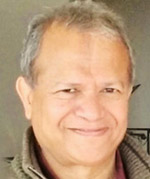
(California-based Basab Dasgupta has a doctorate in Physics from the University of Wisconsin and has worked with Sony as Vice President of an operating division)