Tehran: Iran is still open to diplomacy, Foreign Minister Abbas Araghchi asserted, revealing that he and US President Donald Trump’s special envoy were close to a “historic breakthrough” before the outbreak of the Israel-Iran war. In an opinion piece published in the Financial Times, Araghchi praised Trump-era efforts and criticized the previous administration’s approach to nuclear talks.
“In just five meetings over nine weeks, US special envoy Steve Witkoff and I achieved more than I did in four years of nuclear negotiations with the failed Biden administration. We were on the cusp of a historic breakthrough,” he wrote.
This statement suggests momentum may be building for renewed negotiations on Iran’s nuclear program. Araghchi said they were 48 hours from a pivotal sixth meeting when Israel launched airstrikes targeting Iranian nuclear facilities and ballistic missiles on June 13. He acknowledged having received messages indicating Washington may be ready to return to negotiations.
"Iran remains interested in diplomacy, but we have good reason to have doubts about further dialogue. If there is a desire to resolve this amicably, the US should show genuine readiness for an equitable accord," Araghchi wrote.
Trump told reporters this week that he would like to lift sanctions on Iran at some point. "I would love to be able to, at the right time, take those sanctions off," he said.
|
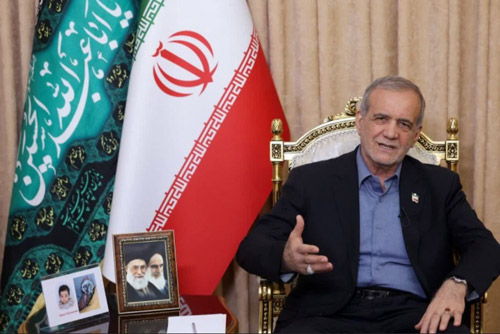
Pezeshkian claims Israel tried to assassinate himIranian President Masoud Pezeshkian has claimed that Israel attempted to assassinate him during last month’s 12-day conflict between the two countries. Speaking to US media personality Tucker Carlson in his first major interview with Western media since the war, Pezeshkian said Israeli forces targeted the location of a high-level meeting he was attending. “They did try, yes. They acted accordingly, but they failed,” Pezeshkian said when asked whether Israel had sought to kill him. “I was in a meeting, they tried to bombard the area in which we were holding that meeting.” He also acknowledged that the US airstrikes on June 22 caused such extensive damage to three of Iran’s nuclear facilities that Iranian officials still cannot access them to assess the destruction. "We don’t have any access to them, we cannot see. And this access will have to wait for that." He added that Iran is open to renewed cooperation with the United Nations nuclear watchdog but cannot yet permit complete inspections at the damaged sites. Meanwhile, Iran’s government said this week that its recent conflict with Israel resulted in 1,060 fatalities, and that the number could potentially rise due to severe injuries. |