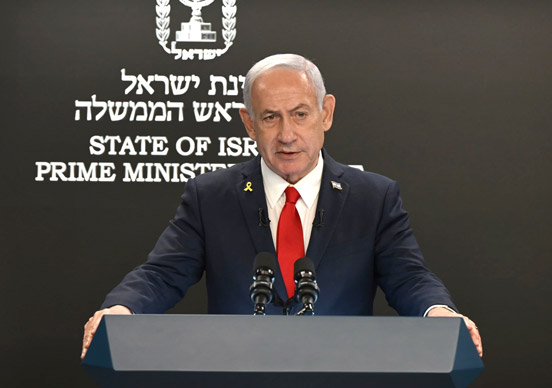
Tel Aviv: Israeli Prime Minister Benjamin Netanyahu has defended his government’s controversial plan to take full military control of Gaza City, describing it as the “speediest and most effective way” to end the ongoing war.
Addressing a press conference, Netanyahu said that Hamas’ continued refusal to surrender its weapons has left Israel with no alternative but to press forward with its military campaign.
“Given Hamas’ refusal to lay down its arms, Israel has no choice but to finish the job and complete the defeat of Hamas,” he said, adding that Israeli forces already have control over 70–75 per cent of Gaza.
The operation has faced widespread criticism from the international community, including some of Israel’s closest Western allies, over humanitarian concerns. However, Netanyahu dismissed the criticism as “false claims” and argued that the offensive is designed not only to defeat Hamas quickly but also to minimise civilian harm.
“We are not going to occupy Gaza - we are going to free Gaza from Hamas. Gaza will be demilitarised, and a peaceful civilian administration will be established, one that is not the Palestinian Authority, not Hamas, and not any other terrorist organization."
- Benjamin Netanyahu
He stated that civilians would be given safe passage to designated zones where they would receive food, water, and medical care, reiterating Israel’s claim that its military has consistently worked to prevent a humanitarian crisis, in contrast to what he described as Hamas’ deliberate efforts to create one.
Highlighting Israel’s role in facilitating humanitarian aid, Netanyahu said that nearly two million tonnes of aid had been allowed into Gaza since the war began. “If we had a starvation policy, no one in Gaza would have survived after two years of war,” he asserted.
He added that discussions are underway with the United States to implement additional humanitarian measures, including expanding aid delivery via ground routes and airdrops, as well as increasing the capacity of the Gaza Humanitarian Foundation’s distribution points.