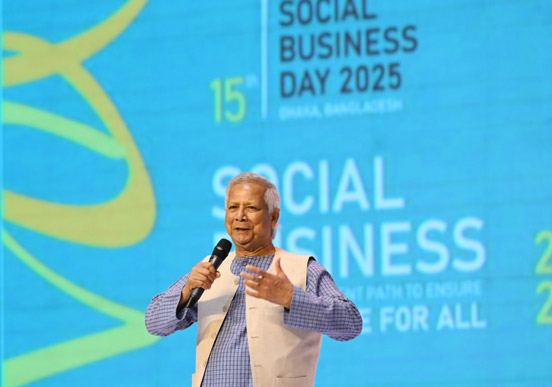
The legacy of Bangladesh's Chief Advisor Muhammad Yunus will rest not on what he stood for, but on what he can deliver next.
By K S Tomar
When Nobel Peace Laureate Muhammad Yunus was unexpectedly installed as interim Prime Minister of Bangladesh on August 8, 2024, it was a moment both unprecedented and fraught with risk. For many, it felt like a democratic anomaly — a celebrated economist thrust into the country’s political cockpit amid street chaos, shattered institutions, and an imploding regime. One year later, Yunus’s experiment in governance offers a mixed verdict: some institutional mending, mild economic stabilization, and diplomatic tightrope-walking — but also political paralysis, public impatience, and growing fears of a stalled transition.
A crisis that opened the door
The breakdown that enabled Yunus’s elevation was years in the making. The January 2024 general elections — boycotted by the Bangladesh Nationalist Party (BNP) — were marred by low turnout, street violence, and widespread allegations of rigging by the ruling Awami League. With Dhaka paralyzed by protests and the country's credibility in tatters, the military — long a shadow force in Bangladesh politics — opted not for direct rule but for a figure who could stabilize the country without inciting further international backlash.
Enter Yunus. His moral stature, global recognition, and lack of political baggage made him a palatable choice — especially for Western governments such as the US and members of the European Union, who had already dismissed the elections as a sham. But domestically, his appointment sparked polarizing reactions. The Awami League labeled it a "soft coup," while the BNP viewed it with suspicion, fearing Yunus’s Western backing could dilute its grassroots support.
A year of fragile governance
One year on, Yunus’s greatest achievement may be the relative calm he has preserved in a country historically prone to violent political churn. His administration has taken initial steps to restore institutional balance: a restructured Election Commission, a partially independent judiciary, and a media landscape where censorship has eased. Anti-corruption drives targeting figures from both the Awami League and the BNP have lent an air of neutrality.
Yet Yunus’s governance style — cautious, technocratic, and allergic to political theatrics — has its downsides. His cabinet, composed largely of civil society figures, retired bureaucrats, and academics, lacks the political heft required to manage entrenched party structures and navigate grassroots mobilizations. The absence of an electoral mandate has further slowed decision-making, with bureaucrats hesitating to act in a politically ambiguous environment.
His promise to hold inclusive, transparent elections by early 2026 is widely supported. But critics warn that without deep structural reforms — especially to the electoral machinery and political culture — such polls may simply repeat the cycle of polarization, repression, and violence.
Economic strains and limited reforms
The economic terrain Yunus inherited was bleak: inflation at its highest in over a decade, dwindling foreign reserves, a weakening taka, and falling investor confidence. His administration secured an IMF-backed stabilization package in return for fiscal discipline and gradual subsidy reforms. Import restrictions and a push to enhance remittance inflows have marginally stabilized the currency.
Social justice has been a recurring theme of Yunus’s agenda. Expanded microcredit, rural development initiatives, and targeted welfare transfers have won praise, especially among the rural poor. Yet these are seen more as moral gestures than structural economic transformations. Broader reforms in banking, taxation, and infrastructure investment remain on hold, hamstrung by political indecision and administrative inertia.
Bangladesh’s flagship export sector — readymade garments — faces mounting pressure. Global buyers, spooked by political instability, are pulling back, while domestic labor unions demand wage hikes amid high inflation. Without restored political credibility and a pro-growth industrial policy, Yunus’s economic roadmap may fall short of reversing the downturn.
Diplomatic balancing act
On the foreign policy front, Yunus has tried to navigate a narrow path. His administration has sought to reassure all sides without alienating any. Relations with India have cooled, especially as New Delhi mourns the sidelining of Sheikh Hasina — long seen as its most dependable ally in Dhaka. China, though officially neutral, has withheld fresh infrastructure investments, demanding contractual assurances.
The West, particularly the US, has stayed supportive — for now. For Washington, Yunus represents a rare liberal, secular interlocutor in a volatile region. But with the Biden administration’s successor, Donald Trump, reprioritizing global engagements, sustained attention to Bangladesh is far from guaranteed.
Yunus’s personal reputation may command respect at the UN and among international donors, but it doesn’t translate into hard-statecraft. Bangladesh, surrounded by assertive regional powers and struggling with internal drift, needs more than moral authority to secure its interests.
A dangerous vacuum
What lies ahead is more uncertain than ever. Yunus was never meant to be a permanent fixture. His credibility hinges on a successful transition. But with the Awami League and BNP unwilling to reform or compromise, that transition looks increasingly elusive. The judiciary remains burdened and slow, civil society is only just beginning to recover from a decade of intimidation, and there is no clear political roadmap.
This vacuum creates a perilous scenario — the creeping normalization of unelected, technocratic rule. While many Bangladeshis welcomed a break from the toxic political climate, the longer this interim arrangement lingers, the more it risks breeding disenchantment. The spectre of permanent non-partisan rule, devoid of electoral legitimacy, could undermine whatever democratic gains have been made.
A flicker of hope
Yet, amid the gloom, a cautious optimism survives. In the aftermath of Sheikh Hasina’s authoritarian decade, Yunus’s ascension marked a clean break. At 85, the founder of Grameen Bank brought not just moral authority but also the rare ability to soothe a bitterly divided polity.
His government has eased draconian media laws, restored space for dissent, and initiated long-overdue electoral reforms. Investigations into financial crimes and banking scams — once unthinkable — are now underway. These are modest but meaningful steps that have reawakened a dormant civil society and inspired calls for deeper democratic accountability.
Yunus’s effort to reposition Bangladesh as a responsible regional player — balancing ties with China, India, and the West — has so far avoided major missteps. Whether this fragile order can become a springboard for democratic consolidation remains uncertain. But for many Bangladeshis, it is the first real chance in years.
Conclusion: Between breakdown and breakthrough
Muhammad Yunus did not seek power; it was thrust upon him by a nation in distress. His first year in office has restored a measure of calm, institutional decency, and international goodwill. But the deeper ailments of Bangladeshi democracy — hyper-partisanship, intolerance, and elite impunity — remain largely unaddressed.
His legacy will rest not on what he stood for, but on what he can deliver next. Will he facilitate a genuinely inclusive, peaceful transition? Or will he become another well-meaning figurehead lost in the machinery of power?
Bangladesh today stands between breakdown and breakthrough. Whether it moves forward or slides back will depend not just on Yunus, but on the political class and people who must now choose democracy, not as a slogan, but as a lived, accountable system.

(The writer is a senior political analyst and strategic affairs columnist based in Shimla.)
The views expressed are not necessarily those of The South Asian Times