The story behind the first postage stamps of independent India and Pakistan.
By Pradip Jain
The early philatelic histories of India and Pakistan do more than trace administrative changes—they reveal how two newly sovereign nations used visual symbols and postal tools to define themselves. India’s stamps reflected
secularism and democratic unity; Pakistan’s emphasized Islamic identity and heritage.
These tiny items carried weight far beyond their denomination—they were instruments of messaging, memory, and meaning. From the overprints of Nasik to the artistry of Chughtai, from “Jai Hind” to “Pakistan Zindabad", each stamp and slogan told a story of rebirth, struggle, and pride.
Today, these first issues and cancellations are not just historical curiosities. They are living witnesses to the birth of nations, tangible artifacts that continue to resonate across generations, borders, and philatelic collections.
India's post-independence philatelic journey
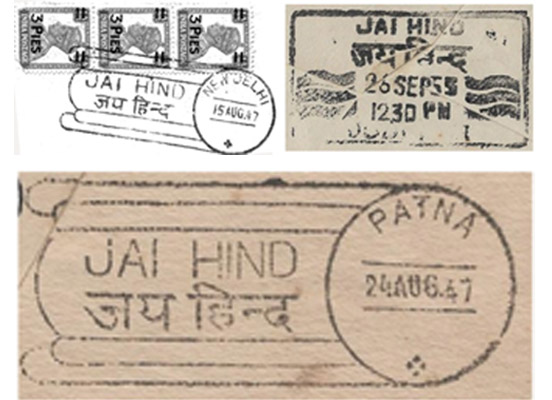
In the immediate aftermath of independence, India did not release any new postage stamps. With the India Security Press in Nasik prioritizing the urgent overprinting of stamps for Pakistan, India instead made a symbolic postal gesture. On 15th August 1947, post offices across the nation used a special cancellation mark reading “Jai Hind”— a slogan capturing the spirit of unity, victory, and national awakening.
.jpg)
The first commemorative stamp of Independent India was eventually issued on 21st November 1947. Depicting the Indian Tricolor flying proudly and written Jai Hind, it marked the beginning of a new philatelic identity grounded in the ideals of freedom, democracy, and pluralism.
A moment of unity in Japan: India and Pakistan together
.jpg)
Even as the subcontinent faced division, a moment of quiet unity unfolded thousands of miles away in Japan. The Indian Army was stationed in Japan as part of Brindiv (British and Indian Division), which functioned under the BCOF (British Commonwealth Occupation Force) and its Indian postal contingent was called the Force Postal Unit with Field Post Offices (FPOs) at 56, 77, 148, 651, 652 and 653, the Brigade HQ FPO was 112.
At the time, the troops had not yet been formally split between the new dominions of India and Pakistan. On the occasion of independence, they jointly celebrated with flag-hoisting ceremonies, parades, and a commemorative dinner at Tokyo’s Imperial Hotel. Most remarkably, a special cancellation was issued, displaying the flags of both India and Pakistan—an extraordinary philatelic symbol of shared history during a time of fracture.
.jpg)
The Azad Hind stamps
"Before India or Pakistan released their first official issues commemorating independence, the Azad Hind Fauj, under the leadership of Netaji Subhas Chandra Bose, had already asserted its sovereign aspirations through
postage stamps. In 1943, a compelling set of 9 'Azad Hind' stamps was produced in Nazi Germany to promote the vision of a free India. Though never valid for postal use, these stamps endure as powerful philatelic emblems of the anti-colonial struggle."
.jpg)
India’s status from Dominion to Republic
India became an independent nation on 15th August 1947, but like Pakistan, it did so as a dominion within the British Commonwealth. Officially called the Union of India, the country remained a dominion until 26th January 1950, when it adopted its constitution and became a republic.
Pakistan’s postal assertion of Independence
Pakistan became an independent state on 14th August 1947, also as a dominion within the British Commonwealth. Officially known as the Dominion of Pakistan, it retained this status until 23rd March 1956, when it promulgated its first constitution and became the Islamic Republic of Pakistan. The constitution also administratively split the nation into West Pakistan and East Pakistan.
.jpg)
In its early days, Pakistan faced immediate logistical challenges. Without a domestic stamp printing facility, the country turned to the India Security Press in Nasik, which overprinted 19 existing British Indian stamps with the word “PAKISTAN”. The ISP Printing Pakistan Overprint Stamps was an administrative arrangement made out of necessity and mutual convenience during the fragile early days of independence. These emergency issues, released on 1st October 1947, served as Pakistan’s temporary postage solution and remained in circulation until 31st October 1949.
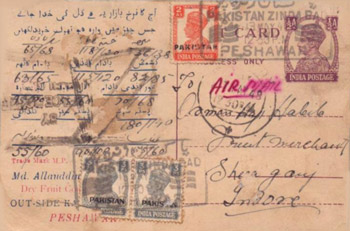
Yet even before those stamps reached the public, Pakistan made its first postal statement of independence on 15th August 1947. On that historic day, a special slogan cancellation reading “Pakistan Zindabad” (Long Live Pakistan) was used at post offices across the country. This patriotic slogan served as more than a celebratory gesture—it was a declaration of sovereignty in ink. Covers bearing this postmark are now rare and highly sought after by collectors, representing Pakistan’s very first postal assertion of nationhood.
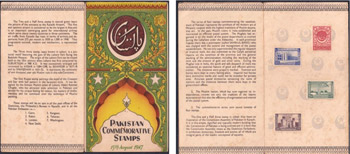
Pakistan’s first set of postage stamps was eventually released on 9th July 1948. Designed by iconic artist A R Chughtai and approved by Muhammad Ali Jinnah, the stamps featured motifs of Islamic culture and identity, including the crescent moon and five-rayed star. Intriguingly, they bore the date 15th August 1947—a reflection of initial administrative ambiguity, as both dominions began functioning on the morning of that date after the swearing-in of their respective assemblies on 14th August. Pakistan would later adopt 14th August as its official Independence Day in early 1949, in part due to its alignment with 27 Ramadan 1366, a sacred night in the Islamic calendar.
The first set of four commemorative stamps spoke volumes about Pakistan’s identity:
• 11⁄2 anna – Karachi Constituent Assembly
• 21⁄2 anna – Karachi Airport, symbolizing global outreach
• 3 anna – Lahore Fort, invoking Mughal and Islamic heritage
• 1 rupee – Designed by Abdur Rahman Chughtai, bearing exquisite Islamic motifs and calligraphy
(The author has won several Gold Medals in International philately and served three terms as the Governing Council member of the Philatelic Congress of India)
(All photos courtesy of the author)