By Sanga Mitra and Anirban Som
You may be wondering what we mean by a "world sculpted in sand". Many of us have visited museums showcasing paintings, sculptures, artifacts, and historical treasures. Across the globe, renowned museums celebrate the works of legendary painters and sculptors whose creations have stood the test of time. But how often do we come across a museum where sand itself serves as the medium for artistic expression? And how many of us are familiar with the remarkable art of sand sculpting?
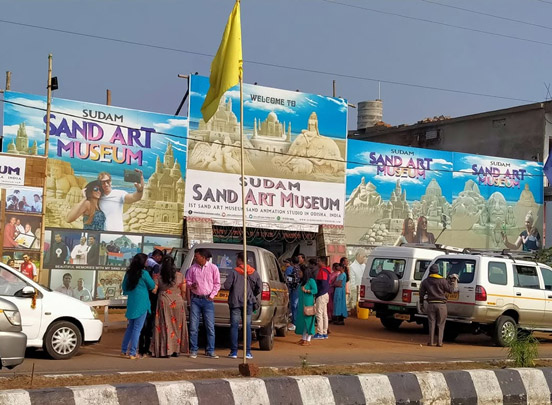
During a recent visit to the Sudam Sand Art Museum on the Puri–Konark Marine Drive in Odisha, we discovered a fascinating world where ordinary grains of sand are transformed into extraordinary works of art. Created by internationally acclaimed sand artist Sudam Pradhan, the museum showcases how a seemingly simple material can be used to depict religion, culture, history, heritage, global landmarks, and popular imagination with stunning creativity and detail.
.jpg)
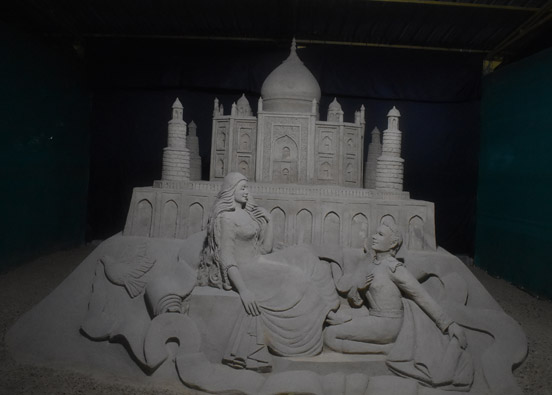
Sand sculptures of Lord Jagannath and the historic Taj Mahal. (Photos courtesy: Sudam Pradhan/Facebook & authors)
Puri has long been a favorite destination for visitors drawn to the sacred Jagannath Temple and its golden beaches. Yet, tucked along the scenic Marine Drive is another attraction that deserves a place on every traveler's itinerary.
The Sudam Sand Art Museum offers a unique experience that complements the city's spiritual and coastal charm, inviting visitors to explore a world where art, culture, and storytelling emerge from nothing more than sand, water, and imagination.
Sudam Pradhan's artistic journey began on the banks of the Jeera River in Bargarh, Odisha. In 2004, he moved to Puri and started creating sand sculptures on the city's Golden Beach, where his work quickly attracted admiration from tourists and locals alike. His talent eventually earned him recognition on international platforms, leading to numerous awards and accolades.
Building on this success, he established the Sudam Sand Art Museum, which was inaugurated on February 4, 2018, by Maheswar Mohanty, then Odisha's Minister of Revenue and Disaster Management, along with other state dignitaries.
The museum's exhibits span an impressive range of themes. Visitors can explore sculptures depicting religious and spiritual figures such as Lord Jagannath, Lord Ganesha, Lord Shiva, Buddha, and the Sun God. Indian heritage is represented through iconic landmarks, including the Konark Sun Temple, the Taj Mahal, and cultural depictions of Maharashtra, Rajasthan, and West Bengal.
The collection also extends beyond India's borders, featuring representations of the Seven Wonders of the World and other globally recognized monuments. Historical and national figures such as Mahatma Gandhi and former President Dr A P J Abdul Kalam are prominently featured in the collection.
The museum also embraces popular culture, with sculptures depicting the Avengers, King Kong, Tarzan, and characters from The Jungle Book. This thematic diversity transforms the museum into a unique cultural space where religion, history, tourism, global heritage, and entertainment coexist through the medium of sand.
Beyond the main sculpture gallery, the museum houses a dedicated gallery that chronicles Sudam Pradhan's artistic achievements. Through photographs, awards, and memorabilia, visitors can trace his journey from a beachside artist to an internationally celebrated sculptor.
The gallery highlights his first-place victory at the Shirahama Beach Sand Art Contest in Wakayama, Japan, in 2015, where he led an Indian–Japanese team in creating a sculpture symbolizing friendship between the two nations.
Photographs documenting his interactions with former President Ram Nath Kovind, Prime Minister Narendra Modi, and other distinguished personalities further underscore the recognition his work has received. The gallery also features the sand art model of the Bundelkhand Expressway, which was showcased during its inauguration in July 2022.
One of the most impressive aspects of the museum is its sustainability. The sculptures are created using sand, water, and a small amount of adhesive, and the sand is continually reused as exhibits are updated to reflect new themes and contemporary interests.
Protected by specially designed shelters, the sculptures remain remarkably well preserved despite their unconventional medium. The museum remains open daily from 7:00 am to 8:30 pm, with an entry fee of ₹30 per person, making it an affordable attraction for visitors of all ages.
While the Sudam Sand Art Museum is unique, it is part of a growing global appreciation for sand sculpture. India's first sand sculpture museum opened in Mysuru, Karnataka, in 2014, while a seasonal sand art museum was recently launched in Sindhudurg, Maharashtra.
Internationally, the world's first permanent indoor sand sculpture museum was established in Tottori, Japan, in 2012, following earlier exhibitions that began in 2006. Antalya, Turkey, is home to one of the world's largest outdoor sand sculpture exhibitions.
A visit to the Sudam Sand Art Museum leaves one with a renewed appreciation for the limitless possibilities of creativity. It is a reminder that even the simplest materials can be transformed into powerful artistic expressions that celebrate culture, history, imagination, and human achievement.
---------------------------------------------
.jpg)
(Sanga Mitra is a bioinformatics researcher and Anirban Som is an Associate Professor of Marketing at the Indian Institute of Management Tiruchirappalli. Both are avid travel enthusiasts who enjoy exploring new places and cultures.)