By Murli Menon
For the discerning traveler seeking to explore the deep, unconventional mysteries of human faith and its unique relationship with the animal kingdom, there is no place like the Karni Mata Temple in Deshnok. Located in the arid Thar Desert region of Rajasthan, approximately 30 kilometers south of the historic city of Bikaner, this extraordinary shrine challenges conventional perceptions.
The quiet, open desert landscapes surrounding the village give way to a space of intense spiritual energy and protective animal companionship. Having spent considerable time documenting unique ecological and spiritual traditions across Gujarat, Rajasthan, India and Southeast Asia, I found that the peaceful coexistence at Deshnok provides a fascinating subject for cultural study. It stands as an architectural and anthropological treasure waiting to be discovered by the adventurous traveler.
The journey to Deshnok takes one through the heart of rural Rajasthan, passing through vast, flat desert expanses where the dry air is cooled by a constant, refreshing breeze that kicks up small dust trails behind your vehicle.
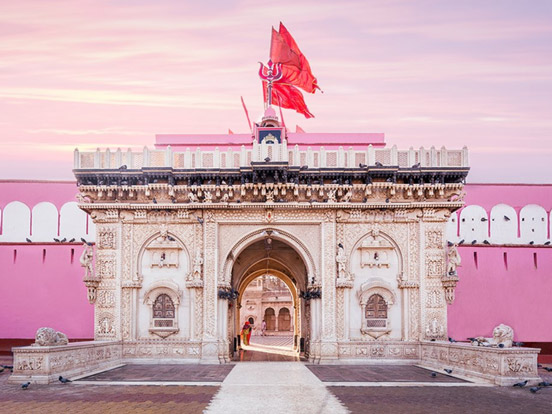
The temple stands out in the desert landscape due to its striking, ornate architecture. Conceived as a grand, fortified sanctuary, it features an imposing facade crafted entirely from spotless white marble, completed by the royal weavers of the region.
The entrance gates are a masterpiece of design, featuring solid silver doors with intricate repoussé work that depicts scenes from the goddess's life, floral borders, and geometric motifs. The marble pillars in the courtyard are beautifully carved, supporting galleries where hundreds of creatures live in complete protection.
The inner sanctum houses a small, stone idol of Karni Mata, depicted holding a trident (trishul) and surrounded by symbols of power, yet the true focus of the temple's daily life is the thousands of small, furry residents that move freely across the marble floors.
Ancient Vedic scriptures trace the origins of this temple to the historical figure of Karni Mata, a revered mystic belonging to the Charan clan. She led a deeply spiritual life, performing numerous miracles for the welfare of the desert communities and local rulers. The defining legend of the temple arose when her stepson, Laxman, accidentally drowned in a sacred pond in Kapil Sarovar while attempting to drink water.
Grief-stricken, Karni Mata implored Yama, the God of Death, to restore the young man's life. Yama initially refused, stating that the laws of karma and destiny could not be altered once a soul had left its earthly form. Undeterred, Karni Mata used her immense spiritual power to decree that none of her clan members would ever fall into the hands of the Lord of Death again.
Instead, when they died, their souls would temporarily inhabit the forms of sacred rats (kabas) within her sanctuary, living in safety until they could be reborn back into her human family, bypassing the usual realms of death.
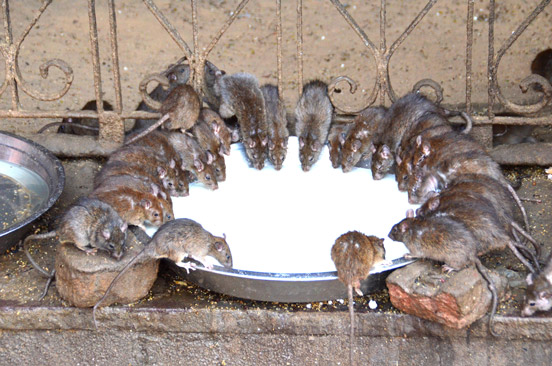
The temple is home to over twenty thousand rats, or kabas, that are considered auspicious. (Photo courtesy: Wikimedia Commons)
Today, the temple is home to over twenty thousand kabas (souls reincarnated as rats), known affectionately as kabas, which are considered sacred extensions of the goddess's family. Remarkably, despite their dense population, no foul odour exists within the temple, and there has never been a recorded case of disease among the pilgrims over the centuries.
Spotting one of the rare white kabas among the thousands of brown ones is considered an exceptionally auspicious sign, believed to grant special spiritual blessings to the traveler. Even seeing a photograph of a khite kaba is considered auspicious for prosperity consciousness.
During plague epidemics in Europe and Surat, Deshnok had divine protection and has never recorded a single case of plague in a thousand years. The devotees eat prasad after the kabas eat it. From children to villagers in their nineties, all enjoy the kaba-eaten prasad, before leaving the shrine.
Dining
Ranavas, Nagore, owned by Jodhana Hotels, Jodhpur, managed by the Royal family of Jodhpur House, offers authentic Rajasthani flavors with a Marwari touch at their all suites Palace Homestay at Nagore, aptly named Rananvas. Highlights include Bajra Rotla paired with tangy Jaisalmeri garlic chutney mashed with Red chillies and stuffed bharwan baingan, echoing the rustic traditions of the Thar. For vegans, refreshing watermelon juice and soothing ginger infusions are available at markets near Deshnok, and Ranavas offers a vegan fruit platter for breakfast.
Accommodation
Managed by Jodhana Hotels, Jodhpur Ranavas suites are adorned with rustic décor. The personalized service evokes the warmth of Rajasthan’s heritage homestays, making every stay memorable. It boasts of huge central courtyards and ancient trees that shelter Indian Eagles and Eagle Owls.
Getting there
By road: About 30 km from Bikaner city (45 minutes).
By train: The nearest major station is Bikaner Junction, with onward road travel to Deshnok.
By air: The closest airport is Nal Airport, Bikaner (domestic), or Jodhpur Airport for wider connectivity.
Deshnok remains a soulful experience, leaving its indelible imprints on every traveler who seeks the deep mysteries of faith in the quiet spaces of the Thar desert.
----------------------------------------------
.jpg)
(Murli Menon is the author of ZeNLP books and conducts storytelling workshops based on his works on eschatology. He can be reached at [email protected])