By Murli Menon
Exploring the temple complex at Bayon, Cambodia, one is perplexed by the mysterious smile on the face of Lord Vishnu. The answers to the riddle of the construction of Angkor Wat have left scientists searching for answers. They are dumbstruck by the technology used by the Angkorian kings to haul thousands of stones weighing hundreds of tons and transport them over hundreds of kilometres across several cities stretching from Thailand to Vietnam.
How were these stones sculpted to depict scenes from the Mahabharata, Ramayana and thousands of birds, plants, animals, deities, devatas and apsaras? How have these ancient monuments survived to this day without much damage, though these monuments were left to the elements for a thousand years!
The silent faces of Bayon mock the achievements of modern science. There is no better proof of the power of ancient wisdom than a visit to the hundred Hindu temple complexes strewn across Thailand, Cambodia, Laos and Vietnam.
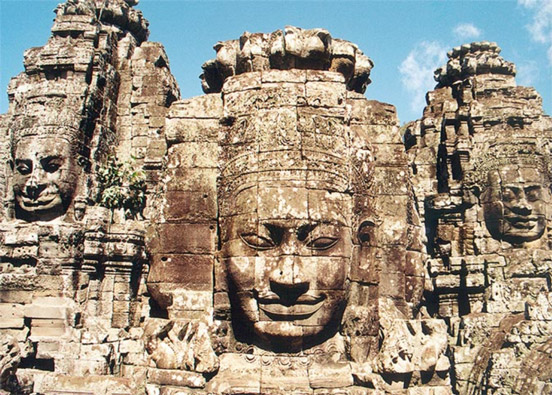
Face-towers depicting Bodhisattva Avalokiteshvara at Bayon Temple in Angkor. (Photo courtesy: Wikimedia Commons)
In the wee hours of the morning, the streets are alive with a procession of tourists on their way to see the sandstone replica of “Mount Meru,” bathed in molten gold. I hitch a lift on the moped of a local villager going to sell wooden carvings to the early birds. He drops me to the ticket window where I purchase a three-day unlimited pass for 60USD.
Bayon is just one of the 60 temples that exist in the 50 km radius around Siem Reap town. Some of the temples are located 50 km away from Siem Reap. There are 50 more such treasure troves to discover during my fifteen-day stay at Siem Reap.
The most exciting part of going to Angkor Wat is to experience the architectural beauty of the temples combined with the beauty of nature. Several temples are viewed best before sunrise or sunset. This allows one to enjoy the changing phases of the sun and also study the changing colors of the temples under various shades of light.
Some of the temples of Angkor have been purposely left exactly as the explorers found them. This is a good thing as one can see the giant silver cotton trees growing throughout the temple and giving it a wild look. This also ensures one has to trek on foot through thick forests to enjoy the beauty of these temples, which were abandoned to the elements.
Even a cursory visit to all the major temple complexes of Angkor could take almost three to four days. One can spend a considerable amount of time at the major temples if one stays at Angkor for seven days.
The more one spends time at Bayon, the more one wishes to stay on. As one would not only like to photograph each of these enigmatic faces, but would also like to catch it in different moods during the three twilights of the day.
The most spectacular views are at mid-day and dusk. It is a pleasure to watch the crimson rays of the sun reflected by the black stones as the sun sets. The other important feature of Bayon is that it is located in the middle of thick forests, and the sounds of the crickets reverberate throughout the day as the crickets get fooled by the semi-darkness that envelops these forests.
At many places, the sun’s rays fail to penetrate the forest floor due to the thick forest cover! After a tough day exploring the temples on foot, it is soothing to laze on the hammocks between the trunks of two big trees, while listening to the shrill cries of the crickets. One can meditate to the binaural beats of the crickets under the giant trees which surround these giant temples.
Every step inside the ancient complex of Bayon is no short of a miraculous experience. The sound of the rainforest pervades the temple. The chirping of birds and shrill cries of macaques rent the air, and in the centre of the wilderness stands a black pagoda with giant sculpted faces!
The effect of the first morning light on Bayon is an incredibly touching moment. The most unbelievable part of one’s visit to Bayon is that the faces look different at different times of the day and are a photographer’s dream. Each face is worth a million pictures, and each picture speaks more than a million words. The language of stone defeats the language of man!
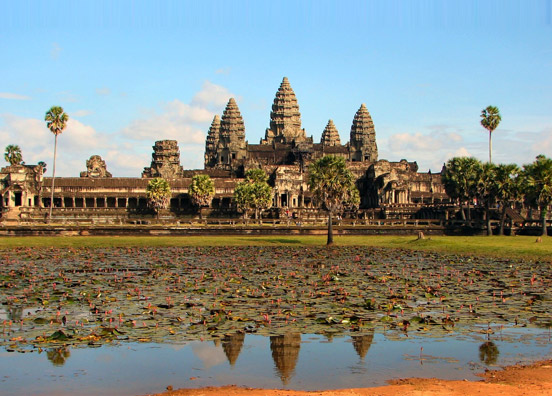
After watching the sunrise over Angkor Wat, it is time to move on to the giant faces of Bayon, which were abandoned centuries ago after the Siamese sacked Angkor. A minimum amount of restoration has been carried out by archaeologists and most of the temple exists in harmony with the giant silver cotton trees and the evergreen forests that surround the numerous temple complexes that dot Angkor Wat.
The ideal time to visit Bayon is late afternoon when the sun plays on the enigmatic smiles on these faces. A giant Shiva lingam welcomes visitors into the narrow entrance to Bayon. One has to almost crawl through the series of tiny steps that lead to the terrace.
As soon as one climbs up the steps, one is astounded by the stupendous scene that emerges. There are several towers at Bayon, each sculpted with four faces looking in all four directions. Each face is eight feet in height and four feet in breadth and has been assembled by individually sculpting square blocks of stone.
A first glimpse of Angkor, nestled amidst evergreen forests, like a precious jewel, protected by nature, has a humbling effect. One’s logical mind fails to comprehend how a temple built nearly 1000 years ago is so massive that modern science cannot even dream of building such a temple in the next one thousand years!
--------------------------------------------
.jpg)
Murli Menon is the author of ZeNLP books and conducts storytelling workshops based on his works on eschatology. He can be reached at [email protected]