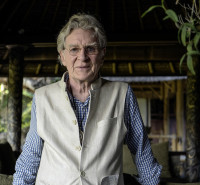
By Murli Menon
Nestled in the Kathiawar peninsula of Gujarat, Sayla offers a serene escape into heritage and nature. In Gujarati, Sayla is commonly known as Bhagat nu Gam. My stay at Bell Guest House, a charming heritage homestay, provided a deep insight into Kathiawari culture and Gujarati hospitality of this erstwhile princely state.
Located just 150 km from Ahmedabad—a smooth 150-minute drive—Sayla sits 400 meters above sea level, ensuring a refreshing nip in the air even in September. Sayla, Lothal, and Wadhawan were coastal cities, but after the sinking of Dwarka, they became landlocked savanna grasslands, surrounded by the silver desert of Kutch and the Aravallis.
Our journey began with "lake hopping" to Mansarovar Lake, located 3 km from my homestay. This lake is a magnet for migratory birds from the Northern China, Tibet, and Siberia from September to February. During the fifteen-minute drive, we sighted flocks of Black-Headed Ibis and later, Lesser Flamingos.
Nearby, the Kashi Vishwanath Temple stands guarded by ancient neem and peepal trees. Basking in the primordial energy of these giant trees while circumambulating this intricately carved temple built by the erstwhile royal family was a divine experience.
The surrounding grasslands, or veed in Gujarati, are home to blue bulls, peacocks, and grey francolins. For the adventurous, night treks offer the thrill of sighting blue bulls in pitch darkness or stargazing to see Saturn and Venus from a traditional rope bed in the veed. Bajra (pearl millet), Wadhwani Marcha (capsicum), and Chuda red chillies (mild red chillies) grow in the farmlands of Bhagat nu gam.
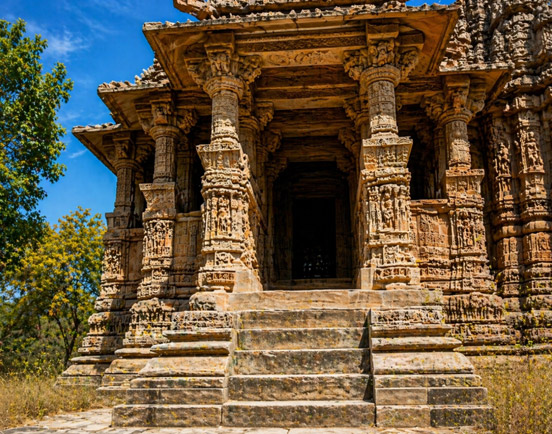
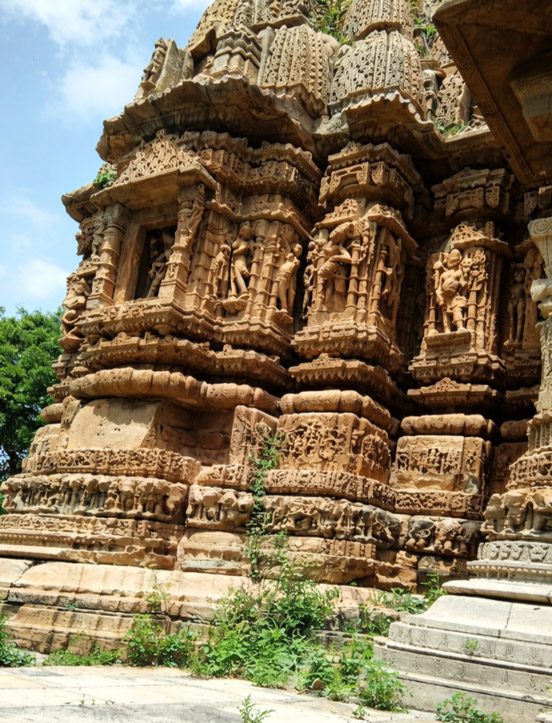
Located 25 km from Sayla is the undiscovered architectural marvel of Sejakpar - the Navlakha temple. Dating back to the 11th century and built by the Solanki rulers, this one-thousand-year-old Shiva temple is a masterpiece of Maru-Gurjara style architecture. The name "Navlakha" suggests it was built at a cost of nine lakh (nine hundred thousand) gold coins, though some locals also attribute the name to the "nine hundred thousand" intricate doll sculptures and carvings that ornament the stone walls of the Navlakha temple.
Each of these nine hundred dolls is sculpted so intricately that each one appears distinct from the others. The language of stone defeats spoken language at the Navlakha Temple. This temple sits adjacent to a thousand-year-old neem tree, its roots seemingly intertwined with the history of the site. Every inch of the exterior is covered in detailed carvings—deities, celestial dancers (apsaras), and mythical creatures that seem to come alive when the sun hits the stone.
The temple is built on a high plinth (pitha), and its sanctum is surrounded by an ambulatory path where devotees can bask in the energy of the ancient structure.
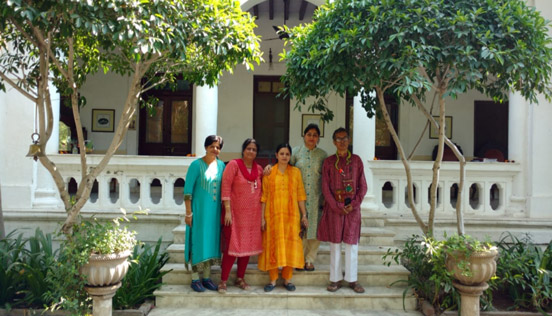
Guests at the entrance of Bell Guest House, a heritage homestay in Sayla.
Unlike the more famous Somnath or Modhera, Navlakha remains a hidden treasure, often secluded and quiet. The cobalt-blue sky provides a stunning backdrop to the weathered stone, offering endless photo opportunities. The silence of the surrounding countryside, broken only by the rustle of the ancient neem leaves, adds to the temple's primordial aura.
It is not just a place of worship but a testament to the unparalleled craftsmanship of ancient Gujarat, standing undisturbed through centuries of history.
A short distance from Sayla lies the gateway to the Little Rann of Kutch, home to the Gudkar Safari. This safari is dedicated to sighting the Indian wild ass, locally known as Khur or Gudkar. These magnificent creatures are among the fastest Indian animals and are found nowhere else on Earth.
Driving across the vast, cracked saline desert of the Rann is an otherworldly experience. The horizon blurs into mirages, and the dust kicks up behind the jeep as you track herds of these golden-fawn animals. The safari also reveals diverse birdlife and desert foxes, making it an essential adventure for wildlife enthusiasts visiting Sayla.
To understand the landscape of this region, one must visit the Agariyas, the traditional salt farmers. Living in makeshift huts for eight months of the year, the Agariyas endure harsh conditions to harvest 75% of India’s salt. A visit to their "salt farms" is a humbling experience. You see the vast white expanses where brine is pumped from the earth and evaporated in large square pans. The hospitality of the Agariyas is legendary; despite their arduous work, they welcome visitors with warm smiles, explaining the meticulous process of raking the salt crystals until they reach the perfect purity.
|
• DINING The Bell Guest House serves traditional Kathiawari cuisine. Highlights include Sayla Rotla (a delicious secret mix of Jowar and Bajra), served with coriander chutney and bharwan baingan. For vegans, fresh watermelon juice and ginger infusions are available. • ACCOMMODATION The guest house, managed by Thakoresaheb Somrraj Singh Jhala and his wife, features six heritage suites with rustic decor and personalized service that rivals heritage homestays of Rajasthan. • GETTING THERE - By road: 150 km from Ahmedabad (3 hours); 70 km from Rajkot (1 hour). - By train: Nearest stations are Surendranagar or Limbdi (35 km away). • NEARBY ATTRACTIONS The famous Chamunda Mataji Temple at Chotila Shaktipeeth is only 35 km away, making Sayla a perfect base for pilgrims, wildlife fans, birdwatchers and heritage travelers alike. |
-----------------------------------------------------
.jpg)
(Murli Menon is the author of ZeNLP books and conducts storytelling workshops based on his works on eschatology. He can be reached at [email protected])
(All photos courtesy of the author)