By Murli Menon
Checking into the lush surroundings of Khajuraho is a soothing experience that immediately begins to peel away the stresses of modern life. Rows of verdant Ashoka trees line the pathways, standing like silent sentinels that greet travelers as they approach the heart of this ancient site.
One of the greatest luxuries for the seeker here is proximity; almost all the significant monuments are within a comfortable walking distance, allowing the journey to unfold as a slow, meditative stroll through history.
The echoes of the Jain Tirthankaras
The journey often begins at the serene Eastern Group, specifically the ancient Jain temples of Adinath and Parsvanath. Constructed around 950 AD by the Jain rulers of Bundelkhand, these structures are a masterclass in delicate masonry. On the outer walls of the Parsvanath temple, rows of sculptures depict nymphs, Jain Tirthankars, and a variety of animals.
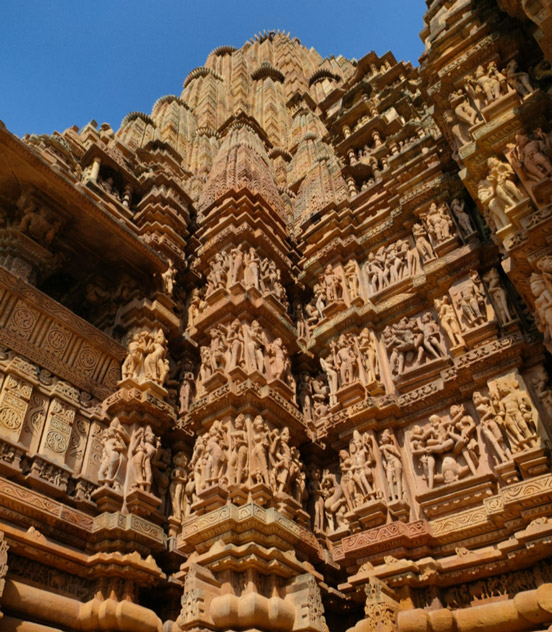
Intricate friezes of celestial nymphs and deities adorning the sandstone walls. (Photo courtesy of the author)
The Adinath temple is particularly striking, topped with a kalash (sacred pitcher). Its walls are decorated with nymphs whose faces exude a spectrum of human experience—happiness, grief, playfulness, and even anger. These are not merely decorations; they are reflections of the soul's journey.
Nearby, the Shantinath temple, though a more modern reconstruction from around 1900 AD, stands proudly on the ruins of older shrines, maintaining the spiritual continuity of the site.
The majesty of the western group
As one transitions from the Jain circuit to the massive Hindu temple complex, the atmosphere shifts. Entering the gardens surrounding these monuments feels like stepping through a portal into an era where art and divinity were inseparable.
Among the first wonders to greet the visitor is the Varaha temple. This shrine houses a giant, monolithic sculpture of a wild boar—an incarnation of Lord Vishnu—standing nearly two meters high. Carved from solid stone, this magnificent beast is covered in hundreds of tiny, intricate figures of deities. It is a remarkable feat of preservation, having withstood the vagaries of time and historical invasions, seemingly protected by a cosmic force.
Diametrically opposite the main Shiva temple stands another marvel: the Big Bull, or Nandi. This celestial vehicle of the three-eyed Shiva is a towering six-foot-tall sculpture, radiating a sense of silent, powerful devotion. A pair of elephants and lions guard the entrances to these twin shrines, symbolizing the strength and majesty of the divine presence within.
The mountain of masonry: Kandariya Mahadev
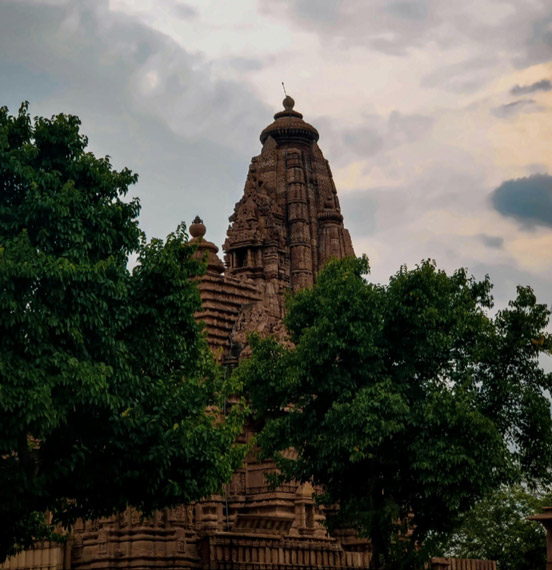
The crown jewel of the complex is undoubtedly the Kandariya Mahadev, often translated as the "Mountain of Masonry". Dedicated to Lord Shiva, its name is a fitting tribute to its architecture, which mimics the peaks of the Himalayas. The temple is a divine metaphor, where the cosmic forces of creation, maintenance, and destruction are symbolized through the primary deities: Brahma, Vishnu, and Shiva.
The walls of this temple are a literal gallery of 10th-century life and celestial visions. There are more than 600 sculptures that dot this "storytelling in stone." Here, one finds full-bodied nymphs in various states of grace—one playing the flute, another looking into a mirror, and another interacting with a parrot.
Every inch of the sandstone surface is occupied by flowers, plants, horses, elephants, and human figures. In this sacred space, the proximity of animals, nature, and humanity symbolizes the cosmic unity of all beings on this planet.
Sunlight and shadows
The spiritual trail continues to the temple dedicated to Surya, the Sun God. Here, a five-foot sculpture of Surya crowns the temple, strikingly similar in its regal pose to the famous images found at Konark in Odisha. This temple also features a rare representation of an eleven-headed Vishnu, representing his various incarnations.
Beyond the major structures, the landscape is dotted with other ancient gems like the Vaman, Brahma, Dulhadeo, and the Chausath Yogini (the temple of the sixty-four deities). Each shrine offers a different facet of the same spiritual diamond.
A seeker’s sanctuary
For the traveller, Khajuraho offers photographs that rival any picture postcard, especially during the golden hours when the sandstone glows with an inner light. For the environmentalist, it is a lesson in the harmony between man-made structures and the natural world. But for the seeker, it is something much deeper.
A visit to this complex is a profoundly spiritual experience. It touches the emotional chords of its visitors, offering answers to those looking to discover the true purpose of cosmic existence. In the silence between the stones, one can almost hear the breath of the artisans who believed that to create beauty was the highest form of worship.
|
How to get there: Khajuraho features its own airport with connections to New Delhi and Varanasi. For those preferring the rails, the nearest major railhead is Jhansi, followed by a scenic 185 km drive to the temple town. Where to stay: The Holiday Inn Resort offers a comfortable and picturesque stay. Its grounds are a haven for birdwatchers; mornings are musical with the tunes of hundreds of birds singing under a canopy of green. Where to eat: The town is dotted with small restaurants/dhabas offering a variety of cuisines. For those seeking authentic local flavors, Agrawal Restaurant provides deliciously sumptuous North Indian vegetarian fare that perfectly complements a day of spiritual exploration. |
-----------------------------------------------------
.jpg)
[Murli Menon is the author of ZeNLP books and conducts storytelling workshops based on his works on eschatology. He can be reached at [email protected]]