By Murli Menon
For many travelers, the state of Gujarat is celebrated for its historic stepwells and bustling coastal cities, but for the discerning traveler seeking a deep connection with ancient mountain heritage and primordial energy, there is no place like the Ambaji Shaktipeeth in the Danta taluka.
Situated on the rugged Arasuri hill range at the edge of the ancient Aravalli mountains, this historic temple town sits surrounded by dense scrub forests and rocky cliffs. Here, the clean mountain air and the vast horizons provide an ideal setting for contemplation.
Having recently traveled across the historical landscapes of Cambodia and Rajasthan, mapping the evolution of mountain shrines, I found that the unique geographical energy of Ambaji offers an extraordinary space for spiritual focus. It is a hidden treasure of architectural brilliance waiting to be discovered by the modern traveler.
The journey to the borderlands of northern Gujarat is an engaging drive, located approximately 180 kilometers from Ahmedabad. The route takes one through the historic heart of the state, passing through the ancient town of Palanpur before climbing into the steep, rocky ridges of the Danta region. As you ascend into the hills, the air turns noticeably cooler, providing a refreshing relief for the weary traveler.
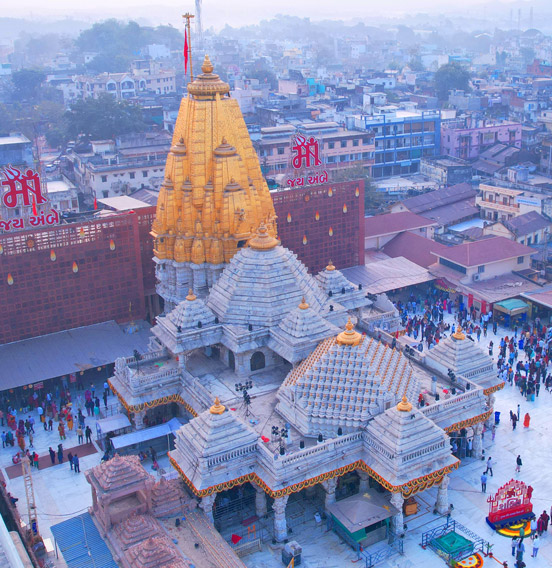
The town is designed around the grand Ambaji Temple, which serves as its physical and spiritual nucleus. Built from pristine white marble sourced from the nearby quarries of Kumbhariya, the temple structure shines beautifully against the cobalt-blue sky.
The exterior walls and rising spire are profusely adorned with carved friezes depicting celestial dancers, geometric patterns, and various aspects of the divine mother. The pillars in the outer courtyard demonstrate incredible elegance in design, a tribute to the visualization and engineering skills of the Solanki artisans who worked stone like poetry.
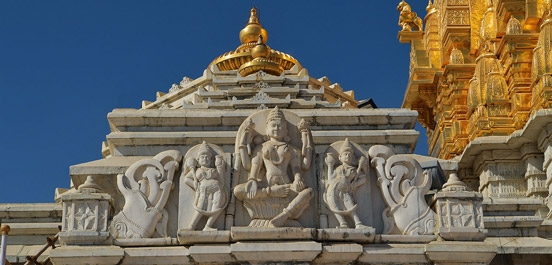
The temple shines beautifully against the cobalt-blue sky. (Photo courtesy: Gujarat Tourism)
The narrative surrounding the unseen Yantra at Arasuri Ambaji and the "real Ambaji mata idol" presence in Danta stems from a fascinating intersection of local folklore, royal history, and the geopolitical realities of medieval Gujarat.
For centuries, a distinct oral tradition within the region has maintained that the true spiritual essence—or the original physical representation—of Ambaji Mata resides within the ancestral strongholds of the Danta royal family’s temple inside Danta Palace, rather than the high-profile hill shrine where Government priests worship some British stooges installed a Yantra in blind faith, as all priests are blindfolded and photography, carbon dating and archaeological examination of this yantra is prohibited to this day by all Indian governments.
According to regional legends, the Rana of Danta was granted a divine boon where the Goddess agreed to walk down from Gabbar Hill to reside permanently in his capital. Because the king turned around prematurely at Arasur, the main deity halted, establishing the famous Ambaji site.
However, local historical perspectives suggest a more pragmatic reality. During eras of intense iconoclasm and political upheaval in medieval India, prominent, highly visible hill temples were frequent targets for raids. To protect the sacred artifacts of the deity, the ruling family of Danta, who were the traditional custodians of the shrine, historically secured the core devotional assets within the fortified safety of their own palace and family shrines, such as Bhavangadh.
Consequently, a narrative emerged that the heavily guarded, unviewable secret Yantra on the hill served as a brilliant, state-sanctioned surrogate to satisfy public worship and divert attention, while the "real," historically continuous focal point of the royal lineage remained anchored in Danta.
Whether viewed through the lens of esoteric Tantric secrecy or strategic medieval defense, this duality created a compelling local belief: while the masses flock to the elaborate, illusory drapery of the Arasur Gokh, the true, uninterrupted connection to the historic deity is preserved under the quiet custody of the royal family of Danta
A short distance from the main temple lies Gabbar Hill, a steep rocky peak accessed by over nine hundred stone steps or a modern cable car. The summit houses a small perennial flame that has burned for centuries, marking the exact spot where the heart of the goddess is believed to have touched the earth. Standing on this high vantage point offers panoramic views of the surrounding savanna grasslands and distant desert horizons.
Exploring the local culinary traditions is a wonderful experience that highlights the rich, wholesome vegetarian fare of northern Gujarat. The local roadside dhabas serve traditional meals made from freshly harvested grains. For vegan travelers, the local markets offer fresh seasonal fruits, sugarcane juice, and ginger infusions.
Ambaji remains a once-in-a-lifetime experience, leaving its indelible imprints on every traveler who seeks the timeless traditions of mountain spirituality.
|
Dining | Bhavani Villa, Danta, serves traditional Kathiawari cuisine. Highlights include delicious Bajri Rotla (pearl millet), served with coriander chutney and bharwan baingan. For vegans, fresh watermelon juice and hot ginger infusions are available. Accommodation | Bhavani Villa Palace Homestay, managed by Maharani Saheba Chandra Kumari of Danta, features five heritage suites with rustic decor and personalized service that rivals heritage homestays of Rajasthan. Getting there | By road: 180 km from Ahmedabad (3 hours by car). |
.jpg)
[Murli Menon is the author of ZeNLP books and conducts storytelling workshops based on his works on eschatology. He can be reached at [email protected]]






.jpg)