By Sanga Mitra & Anirban Som
Civilizations across the world have grown along rivers — the Nile, the Indus, the Tigris and Euphrates. In the southern Indian state of Tamil Nadu, the Porunai (Thamirabarani) has played a similar role, quietly shaping societies, trade networks and cultural life for centuries.
The newly inaugurated Porunai Museum in Tirunelveli, opened by the Chief Minister of Tamil Nadu, M K Stalin on December 20, 2025 brings this river-centred history to life in an impressive and accessible manner.
We visited the museum with our family recently during a weekend trip, reaching the campus around 5.15 pm. The first thing that struck us was the crowd. The museum was buzzing with people — mostly local families — suggesting that it has already found a place in the public imagination.
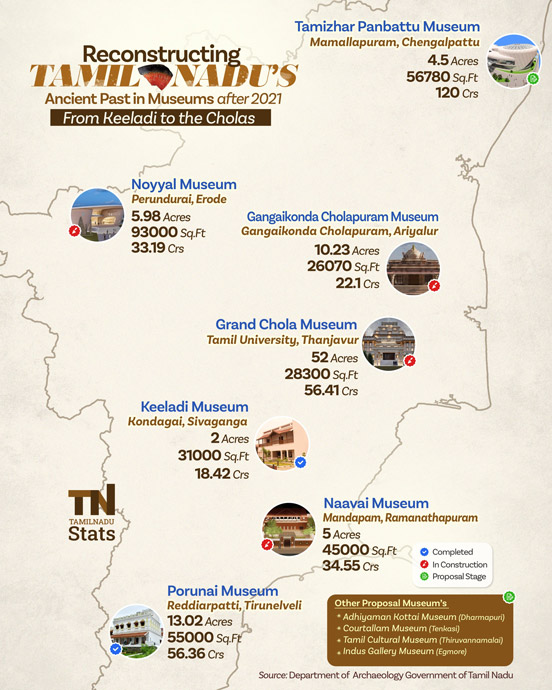
After 2021, Tamil Nadu strengthened heritage through museums that bring archaeology to people. (Infographic courtesy: X@TamilnaduStats)
Tickets were easy to obtain, both through cash and UPI, and the entry fee was refreshingly modest: ₹20 for adults, ₹10 for children and ₹5 for students. Even the additional attractions — a 5D theatre and a 7D VR boat simulator — are priced affordably at ₹25 each.
As we stepped in, it became clear that this was no small museum. Spread across multiple buildings and galleries, the scale of the space took us by surprise. In hindsight, we wished we had arrived earlier. With closing time at 7.00 pm (museum opens at 10.00 am), we had to move faster than we would have liked and eventually missed the 5D and 7D experiences as it was already 7.00 pm by the time we reached those sections.
The visit begins with an Introduction Gallery, where a 17-minute audio-visual presentation (for which no separate fee was charged) traces the story of excavations along the Porunai river basin — from Adichanallur and Sivagalai to Korkai and Thulukkarpatti.
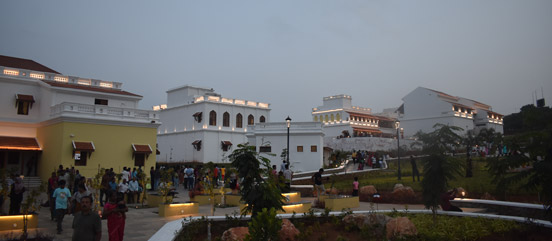
The buildings look especially striking in the evening when the lights come on. (Photo courtesy of the authors)
Even without fully understanding the narration, which is in Tamil, the visuals convey the long journey of discovery: excavation trenches, burial sites, artefacts emerging from the soil, and expert interpretations. For visitors unfamiliar with Tamil, English subtitles would greatly enhance the experience and help the museum reach a wider audience beyond the state.
Moving through the galleries, the museum steadily builds a picture of the Porunai basin as a thriving centre of early civilization. Pottery, tools, burial practices and trade-related artefacts point to a society that was both rooted in agriculture and connected to wider commercial activities.
The displays also acknowledge the long history of archaeological research in the region, referencing scholars such as Fedor Jagor, Robert Caldwell, Louis Lapicque and Alexander Rea, among others. This grounding in scholarship adds depth without overwhelming the visitor.
One particularly welcome feature is the museum’s emphasis on scientific credibility. Radiocarbon dating reports, including those from the Beta Analytic Laboratory in Miami, USA are displayed openly, allowing visitors to see how timelines are established and evidence is validated. It is a rare and commendable example of transparency in a public museum.
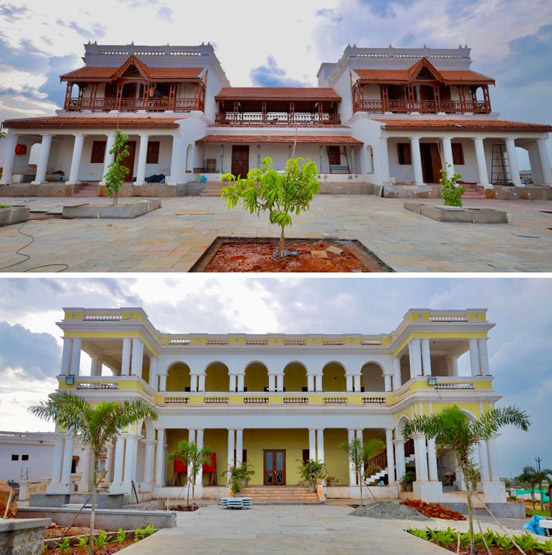
Architecturally, the Porunai Museum is a delight. The buildings look especially striking in the evening when the lights come on. The galleries are air-conditioned, spread over two floors, and easily accessible via lifts and ramps, making them friendly for elderly visitors and those with physical challenges.
The flooring deserves special mention — Athangudi tiles, laid in different patterns across galleries, add colour, texture and a strong sense of regional identity. The campus itself encourages visitors to linger. Landscaped green spaces, shaded seating areas, pedestrian walkways, battery-operated vehicles, and handicrafts outlets make it a relaxed public space rather than just a site of display.
During our visit, a dance performance was underway at the open-air theatre, adding a lively cultural dimension and reminding us that heritage is not only about the past, but also about living traditions.
From a broader perspective, the Porunai Museum offers an interesting lesson in heritage marketing. The product is strong — well-curated, informative and visually engaging. The pricing is truly inclusive. The location is accessible, with Tirunelveli railway station, good bus connectivity and the Tuticorin airport nearby.
Promotion, however, seems so far concentrated largely at the local level. Given its quality, the museum deserves wider visibility — nationally and even internationally — alongside institutions such as the Keeladi Museum near Madurai, the Government Museum in Chennai, and many other museums across Tamil Nadu. Simple steps such as bilingual Audio-Visual content, online ticketing platforms and curated travel packages could go a long way.
Having visited the Keeladi Museum soon after its opening in 2023, we found the Porunai Museum equally impressive, if not more expansive in scope. It succeeds in telling the story of a river not merely as a geographical feature, but as a civilizational force.
As we left, navigating through the evening crowd, one thought stayed with us: this is a museum that invites repeat visits. With more time, one could return not just to see artefacts, but to reflect, to listen, and to understand how deeply the Porunai has shaped the land and its people.
------------------------------------------------------------
.jpg)
Sanga Mitra is a bioinformatics researcher and Anirban Som is an Associate Professor of Marketing at the Indian Institute of Management Tiruchirappalli. Both are avid travel enthusiasts who enjoy exploring new places and cultures.