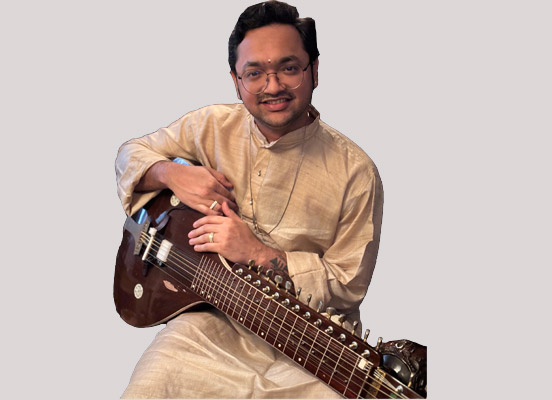
On the evening of January 9th, inside the elegant halls of the Crest Hollow Club in Long Island, a rare sound cut through the winter chill. It was a moment of profound celebration—an event hosted by The South Asian Times to honor the legendary Dr Jatin Shah. But as the audience settled in, they were met with something more than a ceremony; they were met with a "Sacred Sound."
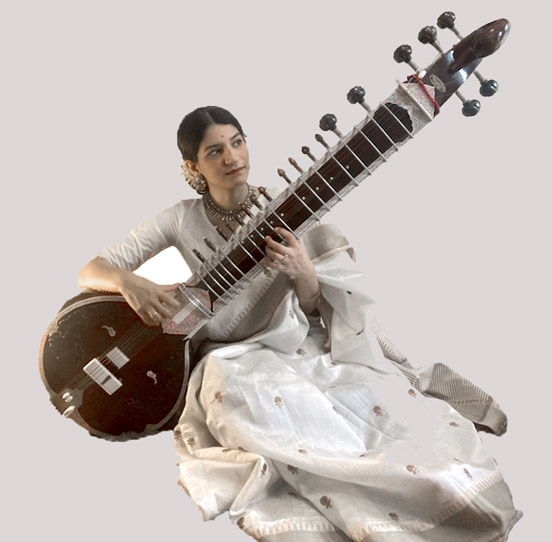
Radhika Samson
Leading the ensemble were Ramanan Venkatraman and Radhika Samson, two artists who have turned the tradition of Indian classical music into a global mission. Supported by the rhythmic precision of Manav Khurana on Tabla and Joe Costello on Ghatam, the performance was a masterclass in Sadhana (disciplined practice). It was a testament to the vision of Sunny Thakkar’s Sneh Arts, whose commitment to curating high-caliber cultural experiences has made them the premier bridge for classical arts in New York.
The foundational light: Pandit Barun Kumar Pal
The mastery witnessed that evening was not an overnight success; it was the fruit of a rigorous Parampara (lineage). The cornerstone of both Ramanan and Radhika’s identity is the late Pandit Barun Kumar Pal. A senior disciple of Bharat Ratna Pandit Ravi Shankar, Pt Barun Kumar Pal was the visionary who pioneered the Hansaveena.
To Ramanan and Radhika, he was the architect of their musical souls and spiritual minds. Under his tutelage, they absorbed the intricacies of the Senia-Maihar Gharana, learning that music is not a performance, but a consecration. Today, they carry his name with the highest honor, ensuring that Hindustani Classical Music is heard in its most authentic, unadulterated form.
Ramanan Venkatraman: The alchemist of sound
Ramanan’s path to the "dream city" of New York is a masterclass in grit. Starting as a self-taught guitar player, his journey has been defined by extreme hard work and relentlessness, fueled by the constant guidance of his Guru, mentors, and friends. Today, Ramanan stands as a rare artist who occupies the intersection of ancient resonance and modern precision. Whether as a Hansaveena virtuoso, a masterful guitarist, or a visionary audio engineer, he has achieved excellence in every facet of his career.
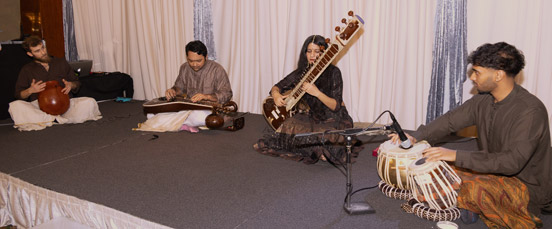
Supported by Manav Khurana on Tabla and Joe Costello on Ghatam, Ramanan and Radhika performed at an event hosted by The South Asian Times on Jan 9 to honor oncologist Dr Jatin Shah.
With five acclaimed albums to his name, Ramanan’s influence extends deep into the production world through Arcube Records. He has produced numerous artists across the spectrum—from Metal and Rock to Hip-Hop and rigorous Indian Classical—capturing the "science of the sacred" with a refusal to settle for anything less than sonic perfection.
Radhika Samson: The grace of three disciplines
Radhika Samson represents a profound multidisciplinary devotion. She is a celebrated Sitar and Surbahar player whose music is an extension of her life as a dancer. As a disciple of the unparalleled Shrimati Sujata Mohapatra—the icon of Odissi—Radhika embodies the sculptural grace of the Kelucharan Mohapatra style.
Her quest for purity has led her to the roots of Indian melody. She is currently undergoing advanced training in the Surbahar under the living epitome of Dhrupad, Ustad Bahauddin Dagar. Representing the 20th generation of the illustrious Dagar family, Ustad Bahauddin is the guardian of Dagarvaani—an austere, meditative style that is considered the pinnacle of Indian classical thought. Under his guidance, Radhika delves into the profound depths of a tradition that demands total immersion.
Building pillars: Sadhana, Chhandayan, and BVB
In 2014, Ramanan and Radhika founded the Sadhana Arts Academy in New Delhi, which has since trained over 120 students, fostering a sanctuary for traditional arts. This mission birthed the Ministry of Music, an intimate stage in Delhi for pure, acoustic performances.
Now based in New York, they serve as faculty members at the Chhandayan Center for Indian Music and the Bhartiya Vidya Bhavan (BVB). As educators, they are mentoring a new generation, teaching that Indian art is not a museum piece, but a living discipline that requires time, patience, and love.
The rhythm of the moment
The magic of their New York performances is amplified by their world-class collaborators. On January 9th, the ensemble was grounded by Manav Khurana, a talented young Tabla player of the Farrukhabad Gharana. An initiated shishya of the maestro Pandit Samir Chatterjee, Manav’s playing balances traditional rigor with a youthful vitality that has already seen him
perform with some of the most notable names in Indian Classical music.
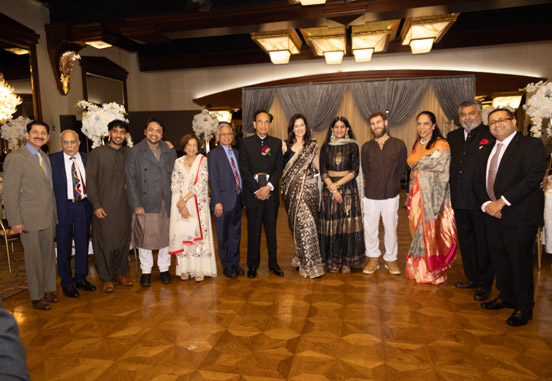
The artists came together for a group photo with Drs Jatin Shah and Ivana Shah, Kamlesh Mehta, Chairman-Publisher of The South Asian Times, his wife Nimmi Mehta, and other top members of the Indian community at the Crest Hollow Club in Long Island.
Completing the rhythmic dialogue was Joe Costello, a versatile percussionist with over 16 years of experience. A student of the renowned Giridhar Udupa, Joe brings a wide range of texture and improvisation to the Ghatam, seamlessly blending South Indian traditional mastery with a global musical perspective.
A resistance against the "age of content"
What makes the partnership between Ramanan and Radhika so compelling is their refusal to succumb to the "super-fast age of content-throwing competition." In a world of 15-second clips, they represent a deliberate resistance.
"We are looking to meet and connect with those who still believe in upholding this tradition," says Ramanan. "Those who understand that true art cannot be rushed or 'manufactured' for an algorithm," adds Radhika. Their work is an invitation to Thahrav—the stillness within the sound.
The shared path forward
As the evening at Crest Hollow Club concluded, the standing ovation for the artists and the guest of honor, Dr Jatin Shah, felt like a validation of this path. Through the visionary support of Sunny Thakkar’s Sneh Arts, Ramanan and Radhika have found a home in New York that values depth over speed.
At the heart of their story remains a simple, beautiful friendship forged in the fires of discipline. They have turned the loss of their foundational Guru into a powerhouse of cultural preservation.
Ramanan Venkatraman and Radhika Samson are not just playing for the world; they are playing for the lineage. In an age of noise, they are the guardians of resonance, creating an eternal echo that began with their masters and continues through every string they pluck.
(All photos courtesy: Sneh Arts)