On October 10, 1957, Postmaster General Arthur Summerfield stated that "the Post Office Department is happy to call to the attention of the American people the significance of the Flushing Remonstrance, through the issuance of a commemorative stamp." It was a privilege, he continued, to honor the first declaration of "religious freedom in America" made in 1657.
The document to which he referred in such reverent terms was a protest by 30 English settlers of the newly established community called Vlissingen or, in English, Flushing, challenging a decision taken by the Director General of Nieuw Nederland (the New Netherlands), Petrus (Pieter) Stuyvesant (1612-1672), to disallow the practice of non-official religions. In particular, the signatories were horrified by the persecution of members of the Religious Society of Friends (Quakers). The Remonstrance has come to be regarded as one of the very first statements of freedom of conscience on the North American continent.
The previous day, on a pleasantly warm evening, some 10,000 exuberant residents of the ethnically diverse community of Flushing marched in procession to the still surviving house of one of the original campaigners for religious freedom, John Bowne (1627-1695).
This was the opening event of the 300th anniversary celebration of the Flushing Remonstrance. There, they heard Governor William Averell Harriman (1891-1986) and New York Mayor Robert Ferdinand Wagner Jr (1910-1991) deliver uncompromising and impassioned speeches celebrating religious freedom, equality, tolerance, and "the liberty of conscience" and fiercely attacking the arch-segregationist governor of Arkansas, Orval Eugene Faubus (1910-1994), who, at the time, was defying the unanimous decision of the Supreme Court to end segregation.
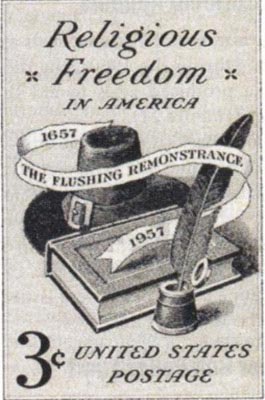
The design that was selected consists of an ornamental ribbon inscribed "1657 the Flushing remonstrance 1957" linking a Pilgrim-style hat with a holy book and a quill pen. According to Summerfield, the hat identifies the people of the place and period, the book symbolizes "everlasting truth," and the quill pen located in an inkwell reflects "man's determination to speak the truth through the written word." Geissmann used a modernized version of 17th-century lettering for the inscriptions. In the upper portion of the stamp, the wording "Religious Freedom in America" is arranged over three lines.
(All images courtesy: Pradip Jain)