By Murli Menon
Badrinath is an architectural and spiritual treasure waiting to be discovered by those willing to make the dramatic trek into the heart of the upper Himalayas.
For the discerning traveler seeking to escape the frantic pace of modern life and experience a profound connection with nature's vastness, there is no place like Badrinath in Uttarakhand. Tucked away deep within the Garhwal Himalayan range on the banks of the roaring Alaknanda River, this ancient, sacred town sits at an elevation of 10,800 feet above sea level.
Here, the crisp mountain air, the towering snow-clad peaks, and the rhythmic sound of mountain streams create an environment perfectly suited for deep meditation. Having spent months exploring remote historical sites and spiritual retreats across Southeast Asia, I found that the raw, primeval energy of Badrinath offers a striking space for quiet contemplation.
The journey to the northernmost pillar of the Char Dham circuit is an unforgettable mountain adventure. Starting from the plains of Rishikesh, the route winds upward along dramatic mountain highways for nearly 300 kilometers, tracing the spectacular confluences (Prayags) where emerald-green rivers meet roaring silver torrents. As one ascends past Joshimath, the landscape shifts into stark, rocky valleys and pine-forested ridges, where the cool, refreshing mountain air immediately revives the weary traveler.
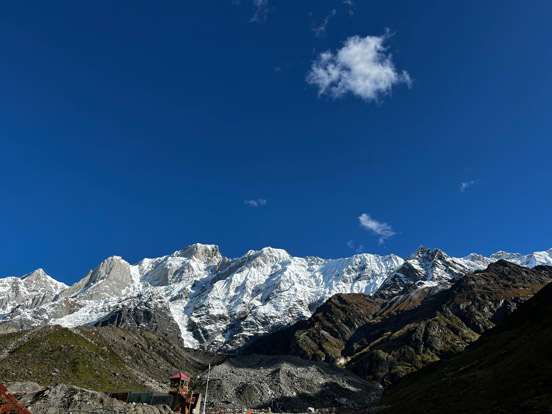
As one ascends past Joshimath, the landscape shifts into stark, rocky valleys and pine-forested ridges. (Photo courtesy: Murli Menon)
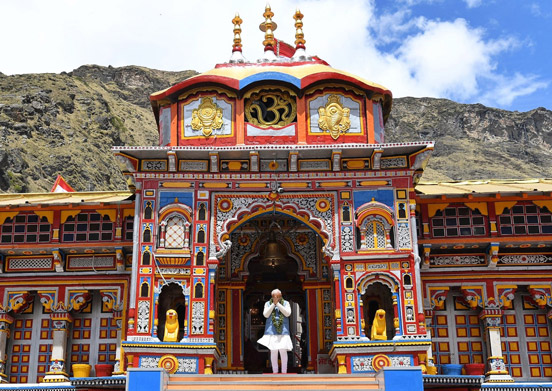
The town itself is designed around the bright, colorful facade of the Badrinath Temple, which serves as its spiritual nucleus. Framed against the sheer, vertical rock face of the Nar and Narayana mountain peaks, the temple resembles a vivid tapestry against the stark stone.
Built in the form of a modest mountain fortress with a brightly painted arched gateway, the structure reflects traditional Garhwal hill architecture. The inner sanctum houses a three-foot-tall, self-manifested (Swayambhu) black stone deity of Lord Vishnu sitting in the meditative lotus posture (Padmasana), a rare sight for a Vishnu idol, which is typically seen in a reclining position. Priests from Kerala perform the pooja at Badrinath.
Vedic texts narrate that Lord Vishnu once chose this secluded Himalayan valley for intense, uninterrupted meditation. Undisturbed by the freezing wind and biting cold, the Lord remained absorbed in his penance for thousands of years. Deeply concerned by the harsh climatic conditions his form was enduring, His consort, Goddess Lakshmi, took the form of a massive Badri tree (wild jujube or Indian ber) to shelter Him from the snow, rain, and mountain storms.
When Lord Vishnu finally opened His eyes and saw the goddess protecting Him from the elements, He was deeply moved by her devotion. He proclaimed that henceforth, this sacred valley would be named after her form as the Badri tree, calling it "Badrinath" or the Lord of the Badri Forest. He declared that any devotee who meditated in this valley would achieve spiritual progress, as the land itself is charged with the energy of dual cosmic penance by both Lord Krishna and Goddess Lakshmi.
Badrinath is home to remarkable natural features, most notably the Tapt Kund, a natural thermal spring located just below the temple steps. Despite being surrounded by freezing Himalayan snowmelt and sub-zero temperatures, the spring consistently bubbles with sulfur-rich water at a warm 45°C.
Wading into these therapeutic waters before morning prayers is an invigorating experience that relaxes the muscles after a long mountain journey. A short distance away lies Mana, the last Indian village before the border, where the Saraswati River emerges dramatically from a cavernous rock opening before vanishing underground.
Traveling through the high Himalayan valleys is an adventurous culinary experience. Due to the altitude and sacred status of the town, the local eateries and rustic dhabas serve hearty, warming vegetarian/vegan food designed to combat the mountain chill. For macrobiotic and vegan travelers, the local markets offer fresh mountain apples, walnuts, and dried apricots.
Badrinath remains a once-in-a-lifetime experience, leaving its indelible imprints on every traveler who seeks quietude and spiritual focus amidst the highest mountains of the world.
|
Accommodation Forest Guest House, Badrinath | Nestled in the serene, high-altitude landscape of Uttarakhand, the Forest Guest House offers a tranquil, close-to-nature stay experience. GMVN Tourist Rest House, Badrinath | Managed by the Garhwal Mandal Vikas Nigam, this facility offers highly reliable, comfortable, and well-maintained lodging options right on the Badrinath Temple Road. GMVN Tourist Rest House, Devlok | Situated conveniently along NH 58, this GMVN property provides excellent views of the surrounding Himalayan peaks. GMVN Yatri Nivas | A budget-friendly choice also located along NH 58, offering straightforward dormitory and standard room accommodations with panoramic mountain views, tailored perfectly for spiritual groups and solo travelers. Dining The region around Badrinath serves soulful, traditional Garhwali and North Indian vegetarian cuisine. Highlights include comforting local dishes like Aloo ke Gutke (spiced mountain potatoes) and Gahat ki Dal (horse gram lentils) served with hot, fresh flatbreads. For vegans, local eateries easily provide fresh fruit juices, traditional herbal decoctions, and hot ginger infusions—perfect for the crisp mountain climate. Getting there By air: The nearest airport is Jolly Grant Airport in Dehradun (nearly 310 km away). By road from Ahmedabad: A pristine mountain journey. It is typically approached by flying or taking an overnight train to Dehradun/Rishikesh, followed by an incredibly scenic 9 to 10-hour drive up the mountain roads flanking the Alaknanda River. |
.jpg)
Murli Menon is the author of ZeNLP books and conducts storytelling workshops based on his works on eschatology. He can be reached at [email protected]