By Murli Menon
After having lived in Gujarat for close to thirty of my forty-six years on this planet, I have travelled to the most remote pockets of the state. However, last month I made a trip to Patan, which is only a six-hour drive from Ahmedabad, but returned with a treasure trove of memories, having visited one of the most beautiful stepwells in India.
Called Rani ki Vav (Queen's Stepwell), this ancient treasure is located at Patan, 135 km away from Ahmedabad, and offers a great experience to Indian families who want to spend a blissful day away from the vagaries of stressful life.
Stepwells are subterranean structures with steps leading down to the water level and are found in large numbers in the arid regions of Gujarat and Rajasthan. They started as simple structures, and in the course of time, these wells evolved to become complex, aesthetically pleasing works of art.
Patan was called Anhilpur Patan when King Siddharaj Jaysingh ruled, and it was the erstwhile capital of Gujarat. Vanraj Chavda founded Patan. The richly sculptured stepwell, which is seven storeys deep, was constructed during the period of the Solanki or Chalukya.
It was built in the memory of Bhimdev-I (1022 AD - 1063 AD), son of Mularaja, the founder of the Solanki dynasty of Patan, in about 1050 AD by his widowed queen Udayamati. Rani ki Vav was completed by Udayamati and Karandev-I a thousand years ago. A reference to Udayamati building the monument is in the "Prabandha Chintamani" composed by Merunga Suri in 1304 AD. It was one of the largest and most sumptuous structures of its type.
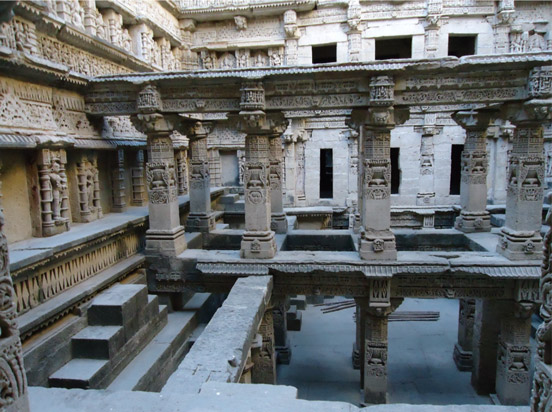
Almost all the intricate sculptures are visible now, including endless rows of sculptured panels in the circular part of the well. The pillars are proof not only of the elegance of their design but also a tribute to the engineering abilities and visualization skills of the artisans.
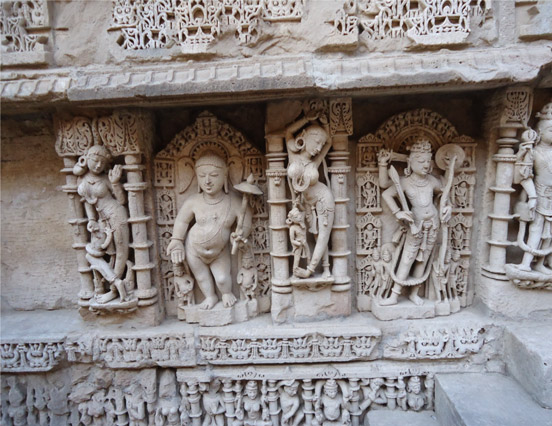
The stepwell houses numerous sculptures, most of them in devotion to Lord Vishnu and his incarnations. (Photo courtesy of the author)
A part of the west well is extended from which it appears that the wall had been built in brick and laced with stone. From this wall, projections of vertical brackets can be seen. These brackets support the different galleries of the well shaft. This bracketing is arranged in tiers and is richly carved. There is also a small gate below the last step of the stepwell, which has a 30-kilometer tunnel leading to the town of Siddhpur near Patan.
This tunnel was used by the kings as an escape gateway in times of defeat. Most of the sculpture is in devotion to Vishnu, in the forms of his avatars - Krishna, Rama, etc, representing their return to the world. Around 50 to 60 years ago, there used to be lemongrass around this area, which made the water in the well alkaline. This alkaline lemongrass-flavored water accumulated in the stepwell is good for health.
After entering Patan city, one encounters a fort with a wall running around the old city. One has to drive along the wall to be led to this step-well. Giant trees protect this monument like soldiers guarding a king. Lots of migratory birds have made their homes on these giant trees and sing their flowery tunes at dawn. The walk down the stepwell offers a bird's-eye view of the well. But as we descend the steps, we can experience poetry etched in stone. Delicate sculptures of plants, animals, gods, goddesses, nymphs, and serpents adorn the walls of this stepwell.
The story of Lord Vishnu's ten incarnations is sculpted in stone here. Starting from Matsya (Fish) and ending with Kalki (on a horse with a sword), destroying the forces of evil. As you descend the steps, you reach a short tunnel which leads to the water.
More than 800 sculptures form a remarkable backdrop to what was purely a functional structure. The Vav is laid out in an east-west direction, with the entrance in the east and the well in the west. The entrance, the side walls of the stepped corridor, some of the "mandapas' and the back wall of the well are majestic.
Five lateral, staggered staircases attached to these side-walls connect the various storeys. The Vav is very rich in sculptures. Each level is profusely adorned with carved friezes and deities. Sculptures of deities in recessed and projecting niches cover all sides of the well. The lowest level has 37 niches with rudimentary images of Lord Ganesh in the centre. The images of Sheshashayi Vishnu in the central niches, on the upper levels, are more elaborate. Also, on the upper levels, are impressive images of Laxmi-Narayana, Uma-Mahesh, Brahma-Brahmi, and Kuber and Ganesh, with their respective consorts.
Where to stayPatan is a religious place, and there are several pilgrim shelters, where one can stay the night. Budget hotels ranging from Rs. 500/- to Rs. 1000/- are found near the bus station. How to reach The nearest airport to Patan is Ahmedabad. The 135 km drive from Ahmedabad to Patan takes about 180 minutes. Patan has a railway station and is also connected by trains. Where to eat Lots of small restaurants serving Gujarati cuisine are found in Patan and all along the highway from Ahmedabad to Patan. Hot Bajra (millet) rotis are served with potatoes, fenugreek, and brinjals cooked in a mild gravy flavored with cumin. Macrobiotic vegans can get a variety of fruits and vegetables at the local market. |

(Murli Menon is the author of ZeNLP books and conducts storytelling workshops based on his works on eschatology. He can be reached at [email protected])