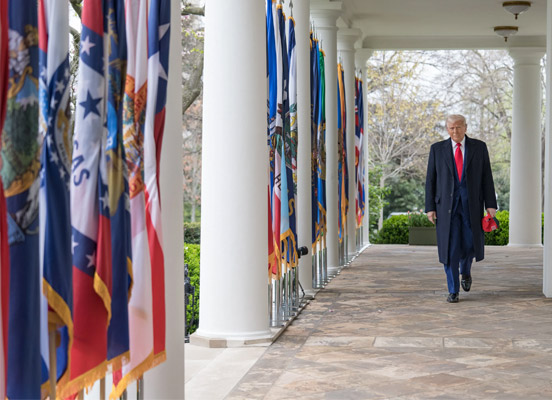
New York: US President Donald Trump has stated that India is working on a trade deal along the same lines as the one he announced with Indonesia, which will provide the US with greater access to the Indian market.
Under the deal with Jakarta, there will be a 19 per cent tariff on imports into the US, but none on exports from the US to Indonesia, he told reporters in Washington, DC.
“India basically is working along that same line", he said. “We're going to have access to India”.
Negotiators from India and the US are working to reach a deal before the August 1 deadline Trump has set for making deals or face arbitrary tariffs.
While he has issued letters to several countries and the European Union threatening tariffs as high as 35 per cent if they don’t make a deal by that date, he has sent a similar warning to India.
It is not clear if he meant an exact duplication of the Indonesia deal, which would be a tough sell for India, or other levels of tariffs and other concessions by India.
If the bilateral trade agreement between the US and India under negotiation mirrors the Indonesian one, it would mean a 19 per cent tariff on India’s exports and none on imports from the US.
Trump also said that Russia’s President Vladimir Putin could agree to a peace deal with Ukraine before the 50-day deadline, which would spare India and others from buying Russian energy products from the 100 per cent punitive tariff he has threatened.
Asked by a reporter about the September 2 deadline, he said, “I don't think 50 days is very long, and it could be sooner than that”.
Trump announced that he was taking strong action against Russia because it has so far refused to agree to a ceasefire in its war against Ukraine.
One of those is the imposition of a 100 per cent secondary tariff on countries importing energy from Russia making India and others collateral victims of the actions directed against Moscow.
The aim of the punitive tariffs on importers of Russian energy is to force them to stop the purchases and to cut off funds to Moscow, and to make the buyers put pressure on Russia to make a deal.
Meanwhile, the Republican Party’s leader in the Senate, John Thune, said that he was holding off on bringing a bill that sought to impose a 500 per cent tariff on Russian energy importers.
Trump had expressed scepticism about the need for such legislation when he could impose sanctions himself.
On the deal with Indonesia and a prospective deal with India, Trump said, “You have to understand, we had no access to any of these countries. Our people couldn't go in. And now we're getting access because of what we're doing with the tariffs”.
He said that Indonesia has high-quality copper and rare earth minerals that the US needs.
High pharma tariffs might come at the end of month: TrumpWashington: US President Donald Trump has said his administration might start imposing tariffs on pharmaceutical imports at the end of the month, while noting the timeline for duties on semiconductors was "similar" to that of those on pharmaceuticals. Trump made the remarks, suggesting that his administration will phase in the tariffs on pharmaceuticals to allow time for companies to construct their production facilities in the United States. "Probably at the end of the month we are going to start off with a low tariff and give pharmaceutical companies a year or so to build, and then we're going to make it a very high tariff," he said during a press availability after returning from a public event in Pittsburgh. Trump also said his timeline for implementing tariffs on semiconductors was “similar” and that it was “less complicated” to impose levies on chips, without providing additional detail. Last week, Commerce Secretary Howard Lutnick said that the Trump administration will complete its national security probes into semiconductor and pharmaceutical imports at the end of this month -- an indication that Trump's tariff announcements on the imports might be approaching. Lutnick was referring to the investigations that he initiated in April under Section 232 of the Trade Expansion Act of 1962. Under the law, the president is provided with authority to adjust imports into the U.S. when he determines they threaten to impair national security. At a Cabinet meeting earlier this month, Trump said he planned to impose a 50 per cent tariff on copper in the coming weeks, and that he expected pharmaceutical tariffs to grow as high as 200 per cent after giving companies a year to bring manufacturing back to the US. Trump has already announced investigations under Section 232 of the Trade Expansion Act of 1962 on drugs, arguing a flood of foreign imports was threatening national security. |